



















September 14, 2018
Typhoon Mangkhut Reaches Luzon
In the early hours of September 15, 2018, Super Typhoon Mangkhut (Ompong) blew into Cagayan Province near the northern tip of Luzon, one of the most populated of the Philippine islands. Local reports described wind speeds of 205 kilometers (130 miles) per hour. The storm stretched nearly 900 kilometers (600 miles) across, with an eye 50 kilometers (30 miles) wide. It is the strongest tropical cyclone in any ocean basin so far this year.
Luzon is a major corn and rice-growing region of the Philippines, and it is nearly time for the harvest. News agencies reported than at least 4 million people were in the path of the storm, and thousands were evacuated from coastal lowlands before Mangkhut arrived. Forecasters from PAGASA were predicting storm surges up to 6 meters (20 feet) and exceptional rainfall.
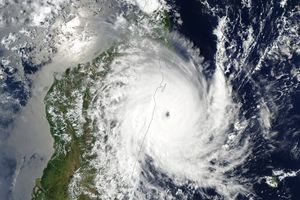
On September 14, 2018, the Visible Infrared Imaging Radiometer Suite (VIIRS) on the Suomi NPP satellite acquired a natural-color image of Mangkhut just after midday. At 8 p.m. Philippine Standard Time (12:00 Universal Time) on September 14, the U.S. Joint Typhoon Warning Center reported that the storm still had sustained winds of 145 knots (165 miles/270 kilometers per hour), with gusts to 175 knots. Maximum significant wave heights were 40 feet (12 meters).
The second, false-color image shows infrared signals known as brightness temperature. This is useful for distinguishing cooler (dark) cloud tops from the warmer (whiter) clouds and water surfaces below.
On September 13, Mangkhut crossed the U.S. territory of Guam and knocked out 80 percent of the island’s electric power. The typhoon is expected to make another landfall around Hong Kong and southern China on September 16.
References & Resources
- BBC (2018, September 14) Typhoon Mangkhut: Millions in Philippines braced for storm. Accessed September 14, 2018.
- Philippine Atmospheric, Geophysical and Astronomical Services Administration (PAGASA) (2018) Tropical Cyclones: Severe Weather Bulletin. Accessed September 14, 2018.
- The Philippine Star (2018, September 15) Ompong makes landfall in Cagayan, retains strength. Accessed September 14, 2018.
- The New York Times (2018, September 14) Typhoon Mangkhut Updates: Storm Slams into the Philippines. Accessed September 14, 2018.
NASA Earth Observatory images by Lauren Dauphin, using VIIRS data from the Suomi National Polar-orbiting Partnership . Story by Mike Carlowicz.