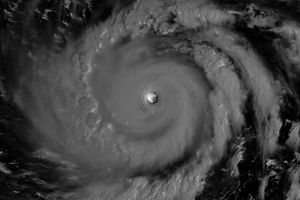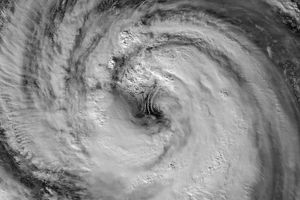


























Typhoon Nesat spins over the Philippine Sea in this Moderate Resolution Imaging Spectroradiometer (MODIS) image acquired on June 3, 2005, by NASAâs Aqua satellite. At the time, Nesat had winds of 213 kilometers per hour (132 mph) with gusts to 259 kph (161 mph), making it the equivalent of a Category 4 hurricane. The storm formed near Guam on May 30 and moved slowly west-northwest over the following four days. On June 3, Nesat skirted the Philippines as it curved northeast towards Japan. It is expected to miss the island nation as it moves east over the North Pacific.
To the north of the typhoon, a white and brown plume of ash and steam drifts across the ocean from the Anatahan volcano. Located in the Northern Mariana Islands, just beyond the right edge of the image and immediately north of where Nesat formed, the volcano has been erupting for much of 2005. The ash plume cuts northwest across the upper right corner of the image, then curves sharply down across the upper left corner of the image. To the left of the center of the image, a silvery strip is formed by the reflection of the sun off the waterâs surface.
The large image provided above has a resolution of 250 meters per pixel, MODISâ maximum resolution. The MODIS Rapid Response Team provides the image in additional resolutions.
References & Resources
NASA image courtesy Jeff Schmaltz, MODIS Rapid Response Team at NASA GSFC