














Despite reaching Category 4 intensity east of the Philippines, Typhoon Nesat remained over open waters and did not cause any damage. Nesat became a depression on May 27, 2005, east of the Yap Islands in the western Pacific. The system then moved west and began to intensify, passing north of the Yap Islands and south of Guam, before entering the southern Philippine Sea as a minimal typhoon.
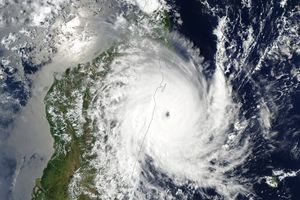
Nesat continued to intensify becoming a Category 4 typhoon on June 3, with maximum sustained winds estimated at 125 knots (232 kph, 144 mph) by the Joint Typhoon Warning Center. Nesat then turned north, sparing the Philippines and weakening slightly. The Tropical Rainfall Measuring Mission (TRMM) satellite captured this image on June 6, as the storm began to regain strength. The storm has a well-defined center with a continuous area of intense rainfall (dark red area) in the northern semi-circle of the eye. Tight bands of rain containing widespread areas of heavy rain (dark red areas) circle the eye. These features are commonly associated with a mature, intense cyclone. At the time this image was acquired, Nesat had sustained winds estimated at 115 knots (213 kph, 132 mph) by the Joint Typhoon Warning Center. Nesat is expected to turn northeast and remain east of Japan before weakening.
Since its launch in 1997, the TRMM satellite has been a valuable platform for monitoring tropical cyclones, especially over remote ocean areas. In this image, rain rates in the center portion of the swath are from the TRMM Precipitation Radar (PR), while those in the outer portion are from the TRMM Microwave Imager (TMI). The rain rates are overlaid on infrared (IR) data from the TRMM Visible Infrared Scanner (VIRS).
TRMM is a joint mission between NASA and the Japanese space agency JAXA.
References & Resources
Images produced by Hal Pierce (SSAI/NASA GSFC) and caption by Steve Lang (SSAI/NASA GSFC).