












- Animations
- EIT (53 MB QuickTime)
- LASCO zoom (11 MB QuickTime)
- LASCO wide-angle (18 MB QuickTime)
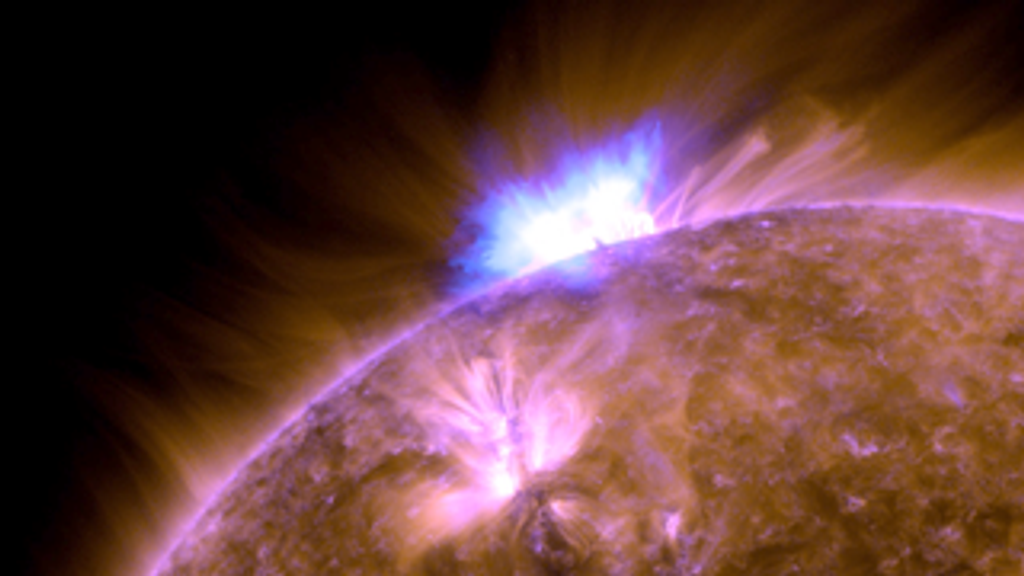
On January 20, 2005, a massive solar flare erupted on the surface of the Sun, sending extremely high-energy particles streaming toward Earth. Protons and neutrons measured by satellites and Earth-based instruments showed the flare to be the strongest in at least 15 years. In addition to creating beautiful auroral displays, the particles emitted by solar storms also have the potential to harm astronauts on deep-space voyages to the Moon and Mars, knock out orbiting satellites, and even disrupt high-voltage lines in the terrestrial electrical grid.
These images show the flare from the perspective near L1—a point in space 1,500,000 kilometers (1 million miles) from Earth. Captured by the Solar and Heliospheric Observatory, the images show the flare as it erupted (top) and the coronal mass ejection that shot towards Earth (lower). The top image was acquired by the Extreme ultraviolet Imaging Telescope (EIT), while the image sequence was acquired by the Large Angle and Spectrometric Coronagraph Experiment (LASCO)
For more information, read Solar ‘Fireworks’ Signal New Space Weather Mystery.
References & Resources
NASA images by Robert Simmon, based on data provided by the NASA/ESA SOHO EIT and LASCO teams