















By evaporating water, plants cool their surroundings. By replacing plants with impervious surfaces, cities trap heat, and create a phenomenon known as the urban heat island. A variety of factors affect the urban heat island. Bigger cities tend to have stronger heat-trapping capacities than smaller cites. Cities surrounded by forest have more pronounced heat islands than do cities in arid environments. A new study, presented at the 2010 Fall Meeting of the American Geophysical Union, found that a city’s layout—whether sprawling or compact—can also affect the potency of its urban heat island.
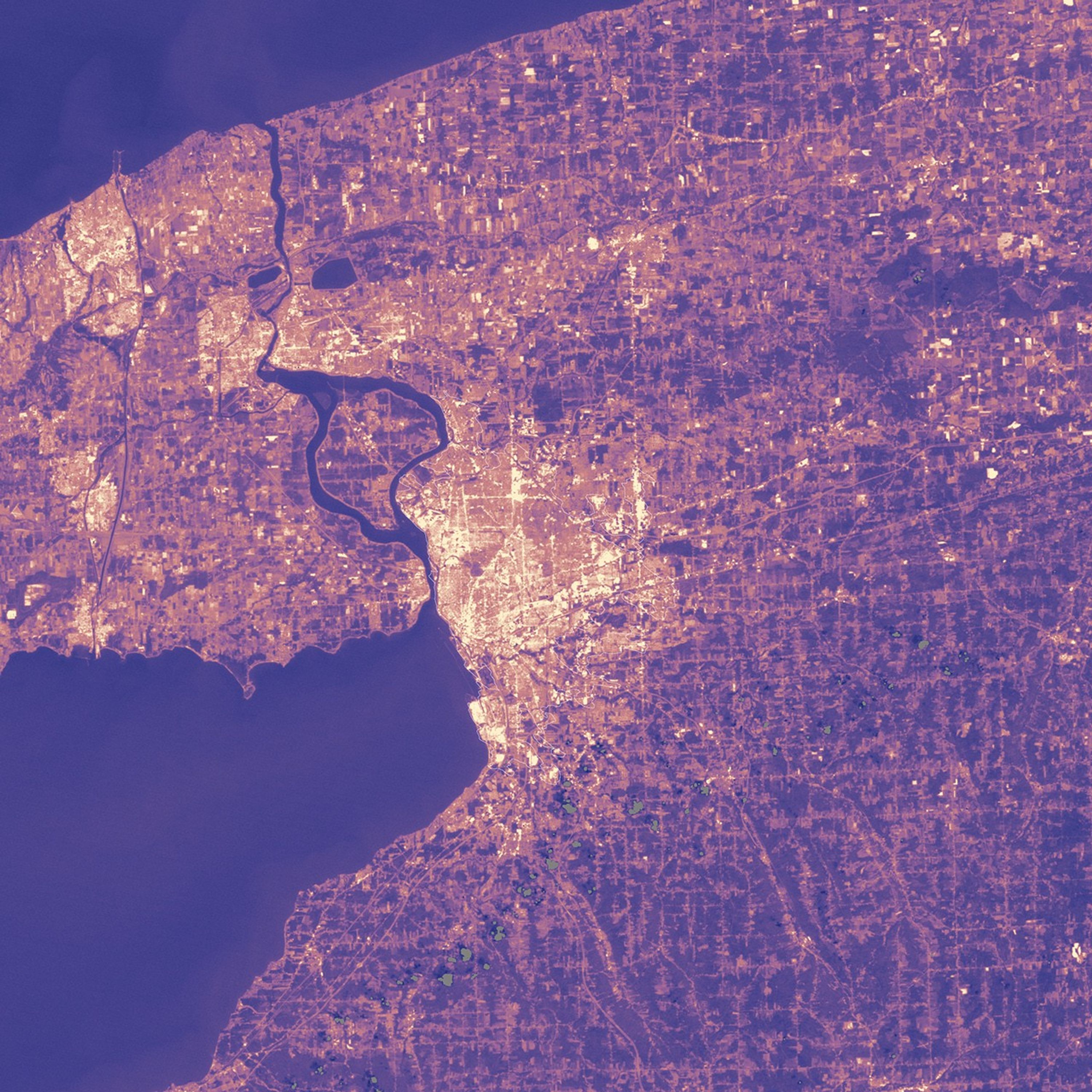
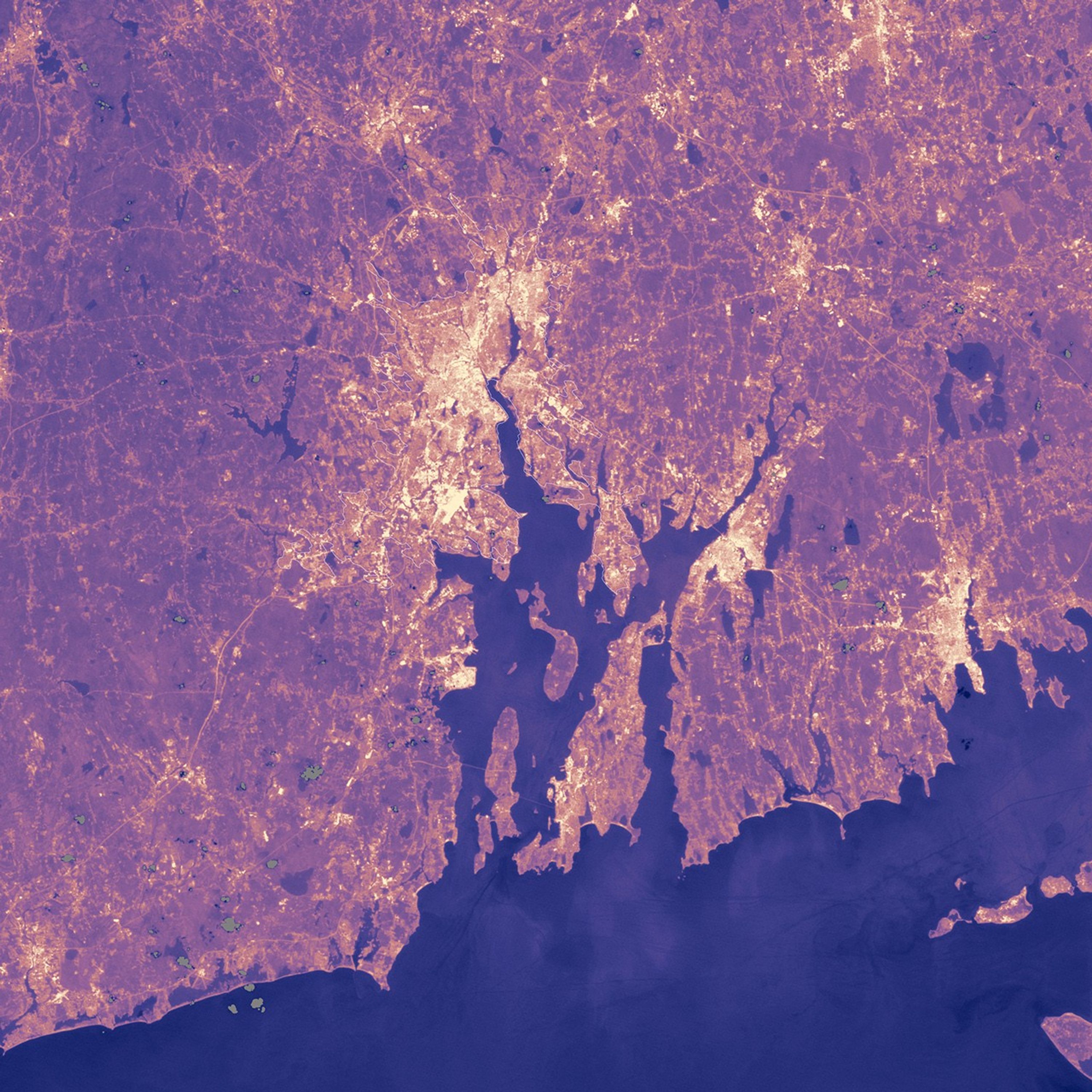
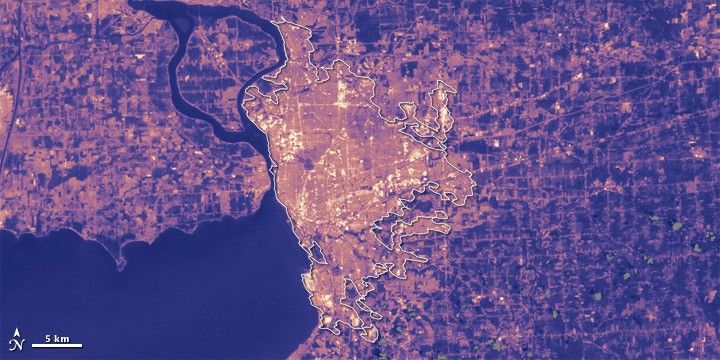
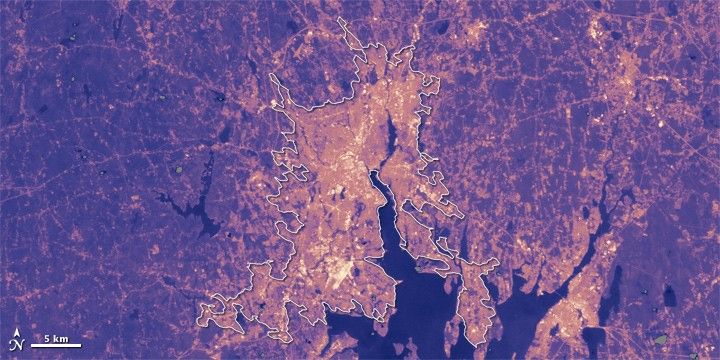
These images compare Buffalo, New York, on August 3, 2002 (top), and Providence, Rhode Island, on July 31, 2002 (bottom). Acquired by the Enhanced Thematic Mapper on NASA’s Landsat 7 satellite, they show temperature, ranging from blue (warm) to yellow (hot). White lines delineate city limits.
Providence and Buffalo are roughly the same size, and both fall within the study area chosen by the research team: the forested environments in the northeastern United States. By choosing cities that are similar in size, and situated in similar environments, researchers can better compare city development patterns and their corresponding urban heat islands.
The researchers found that Providence has a denser development pattern than Buffalo, and a greater heat island effect. About 83 percent of Providence is densely developed, whereas just 46 percent of Buffalo is densely developed. Providence has surface temperatures roughly 12.2 degrees Celsius (almost 22 degrees Fahrenheit) warmer than its surroundings, whereas Buffalo has surface temperatures just 7.2 degrees Celsius (almost 13 degrees Fahrenheit) warmer than its surroundings.
Although the cities’ development patterns differ, the nature of their surroundings also plays a role. Dense forest surrounds Providence while a mix of forest and farmland surrounds Buffalo. The urban heat island effect is more pronounced when forest rings a city.
Urban heat island research has significant implications for human health. In the middle of an already hot summer, the urban heat island effect can be deadly, especially at night. Round-the-clock heat means that city residents have no respite, and those who manage to sleep through the night may not drink enough water to stay hydrated. Although air conditioning provides relief, not everyone has access to it, especially poorer neighborhoods and developing nations. Where available, some kinds of air conditioning can raise outside temperatures.
Some measures can mitigate the urban heat island. Painting roads and rooftops white instead of black enables those surfaces to reflect more sunlight and absorb less heat. Planting vegetation on rooftops also reduces surface temperatures.
Links
- Beating the Heat in the World’s Big Cities
- Urban Heat Island: Baltimore, MD
- New York City Temperature and Vegetation
References & Resources
- Imhoff, M.L. Zhang, P., Wolfe, R.E., Bounoua, L. (2010). Remote sensing of the urban heat island effect across biomes in the continental USA. Remote Sensing of Environment, 114(3), 504–513.
- Voiland, A. (2010, December 13). Satellites pinpoint drivers of urban heat islands in the northeast. NASA. Accessed December 13, 2010.
- Zhang, P., Imhoff, M.L. Wolfe, R.E., Bounoua, L. (2010). Detecting urban heat island drivers in northeast USA cities using MODIS and Landsat products. American Geophysical Union Fall 2010 Meeting.
NASA Earth Observatory image created by Jesse Allen and Robert Simmon, using Landsat data provided by the United States Geological Survey. Caption by Michon Scott.