















The high-altitude, volcanic, arid terrain at the border of Bolivia and Chile has been described as the best Earth-based analog for conditions on Mars billions of years ago—a time when scientists think it's possible that the surface of Mars harbored icy lakes and rivers. A team of scientists led by Nathalie Cabrol of NASA Ames Research Center believes the similarities are so compelling that in late October 2003, they arrived at the Licancabur Volcano to explore what life is able to exist in such an extreme environment—as well as to test diving and other high-tech equipment like bodysuits that one day might be used to monitor the physiology (breathing rates, heartbeat, etc) of Mars explorers.
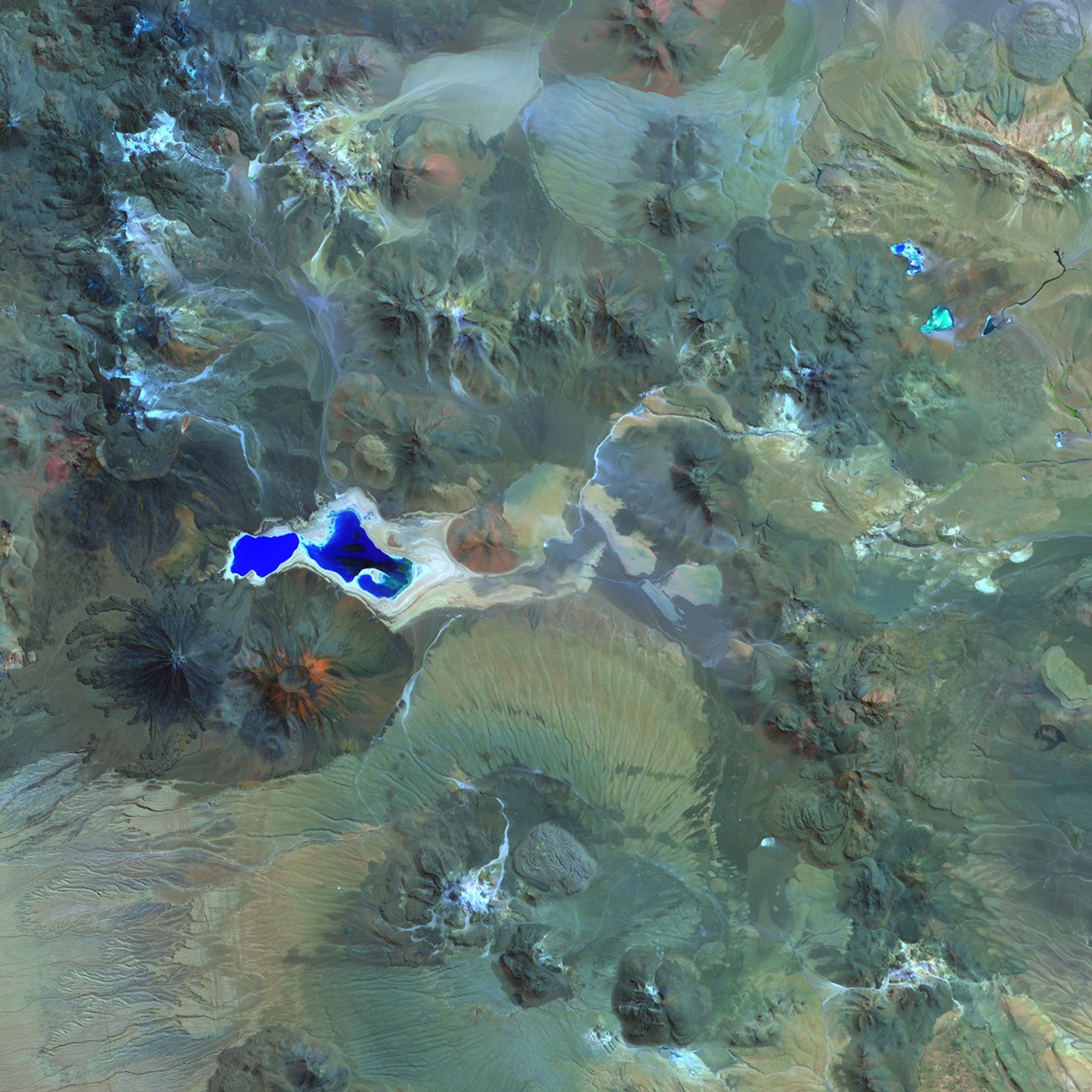
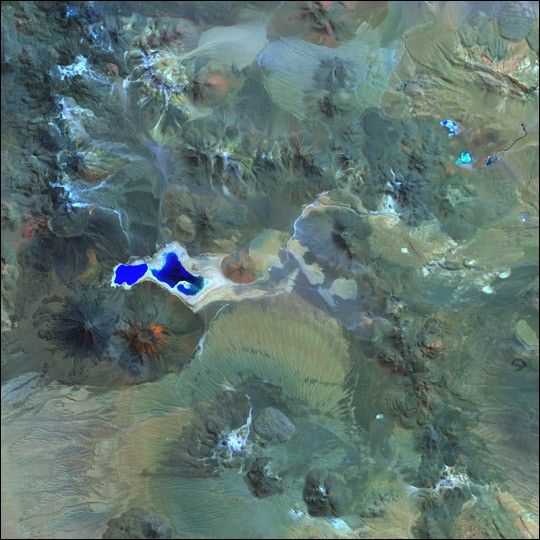
Among the most interesting sites are the lakes—the one in the caldera of the volcano itself and the one at the base of the volcano. Pictured here in this false-color image from the Advanced Spaceborne Thermal Emission and Reflection Radiometer (ASTER) on the Terra satellite, the latter lake stands out in sapphire blue to the northeast of Licancabur (the solid charcoal peak). The microscopic plant life that survives in this lake is under increasing pressure as the lake, adjacent to the Atacama Desert (to the west), slowly dries up. The former extent of the lake bed now appears in a white ring around the lake. Former river courses, long since dried up, trace pale furrows across the rocky terrain.
Preliminary field work conducted in 2002 suggests the microscopic plants are becoming increasingly deformed as a result of increasing exposure to ultraviolet radiation as the lake levels drop. Whether these changes signal the beginning of these organisms’ extinction or whether the organisms are evolving adaptive responses to the extreme environment is not yet clear. The organisms found here might help scientists determine the point at which extreme becomes too extreme for life; their fate may reveal clues about what could have happened to any life that might once have been present on Mars.
The Licancabur Expedition is funded in part by grants from the National Geographic Society, NASA, and the SETI Institute. For more information about this story, read High Lakes May Yield Clues to Life on Mars, on the National Geographic Website.
References & Resources
ASTER data made available by NASA/GSFC/MITI/ERSDAC/JAROS, and U.S./Japan ASTER Science Team