

























September 25-October 19, 2023
Watching for Color in the Wasatch Back
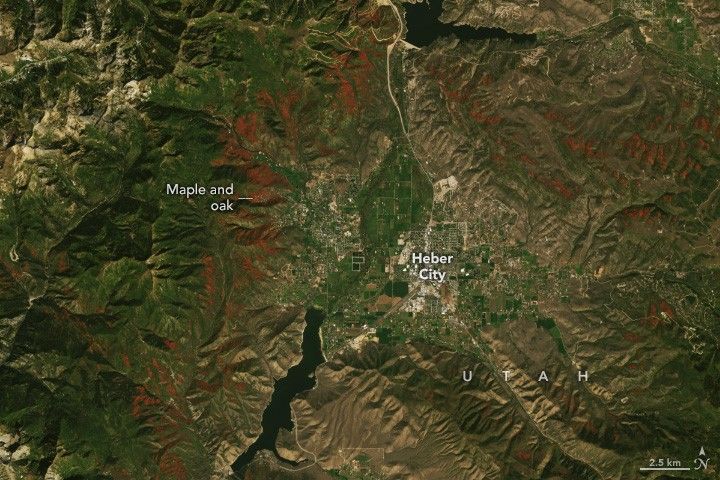
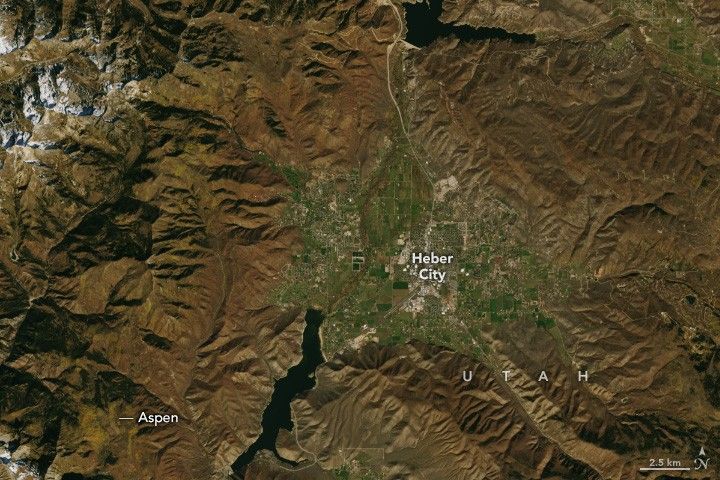
Heber City, Utah, lies in the Wasatch Back, a region on the eastern side of the Wasatch Range of the Rocky Mountains. It is located just 43 miles (69 kilometers) southeast of Salt Lake City, but the mountain town and surrounding region displays fall color on its own timeline.
In summer, the Wasatch Back’s maples, oaks, and aspens hold leaves that appear green due to chlorophyll, the molecule that plants use to synthesize food. As the arrival of autumn brings shorter daylight hours and cooler temperatures, chlorophyll concentrations drop. Loss of the green pigment offers a chance for other leaf pigments—particularly carotenoids (yellow) and anthocyanins (red)—to show off their hues.
In the Wasatch Back region, reds and oranges tend to show up first. These colors adorn trees such as bigtooth maple and Gambel oak. After those trees reach their peak autumn color, aspens usually begin to reveal bright yellow leaves. The change is visible in this pair of satellite images from autumn 2023, which show Heber City and surrounding forests on September 25 (left) and October 19 (right). They were acquired with the OLI (Operational Land Imager) on Landsat 8 and the OLI-2 on Landsat 9, respectively.
The timing and intensity of Utah’s autumn colors depend on several factors. Elevation plays a role, with fall color generally starting sooner at colder, higher altitudes. The Wasatch Back region is higher and cooler than the Salt Lake Valley and tends to see fall color sooner. Heber City and Park City are about 5,600 and 7,000 feet (1,700 and 2,100 meters) above sea level, compared to Salt Lake City at 4,300 feet.
Too much or too little precipitation, and the timing of that water, also affect fall color. Utah’s trees this year benefited from a large snowpack and wet summer. None of the state was in severe drought at the end of August 2023, compared to 58 percent of the state during the same time in 2022, according to the U.S. Drought Monitor. The water caused leaves to change color later than usual this year, but the color was likely more vibrant, according to news reports.
References & Resources
- The Daily Universe (2023, September 29) Fall colors in Utah set to peak in October. Accessed November 9, 2023.
- KPCW (2023, September 26) Vibrant fall colors explode in Wasatch Back thanks to water supply. Accessed November 9, 2023.
- ParkRecord (2023, September 23) Autumn returns in red, orange and yellow. Accessed November 9, 2023.
- Utah.com Alpine Loop Scenic Drive. Accessed November 9, 2023.
- Utah.com Utah’s Wasatch Back Region. Accessed November 9, 2023.
- Utah State University Fall Color in Utah. Accessed November 9, 2023.
NASA Earth Observatory images by Wanmei Liang , using Landsat data from the U.S. Geological Survey . Story by Kathryn Hansen .