




























APOD
Astronomy Picture of the Day
Discover the cosmos! Each day a different image or photograph of our fascinating universe is featured, along with a brief explanation written by a professional astronomer.
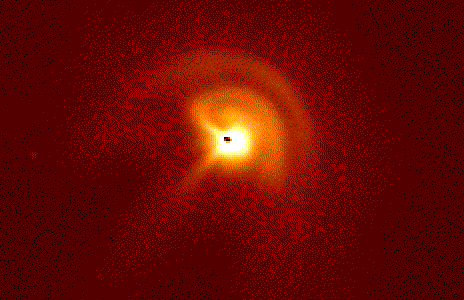
The Rotating Jets of Comet Hyakutake
Explanation: Comet Hyakutake will reach its closest point to the Sun on May 1, passing well inside the orbit of Mercury . At this time, the comet's dust and ion tail will be at their greatest physical length. As the comet nears the Sun , gas and dust are driven off the surface, sometimes being shot off in jets. Although much of this material ends up in the tail , some interesting features can be seen close to the comet's three kilometer nucleus . Because the comet's nucleus rotates, the jets can be seen to form arcs around the comet's center resembling a pinwheel. The above photograph, taken April 8, shows two expanding arcs of cometary material and two source jets. The outermost arc is at a projected distance of 12,000 kilometers from the nucleus. The inner is about 8,000 kilometers from the nucleus. They are expanding from the nucleus at 870 km per hour. The inner arc ends at the brightest of the Comet Hyakutake's many jets.
Information: The Scale of the Universe Debate in April 1996
| Date | April 14, 1996 |
|---|---|
| Credit | Credit: James A DeYoung (USNO), USNO's 24-inch Telescope |
| Authors & editors: | Robert Nemiroff (MTU) & Jerry Bonnell (UMCP) |
| A service of: |
ASD at NASA / GSFC, NASA Science Activation & Michigan Tech. U. |