





















APOD
Astronomy Picture of the Day
Discover the cosmos! Each day a different image or photograph of our fascinating universe is featured, along with a brief explanation written by a professional astronomer.
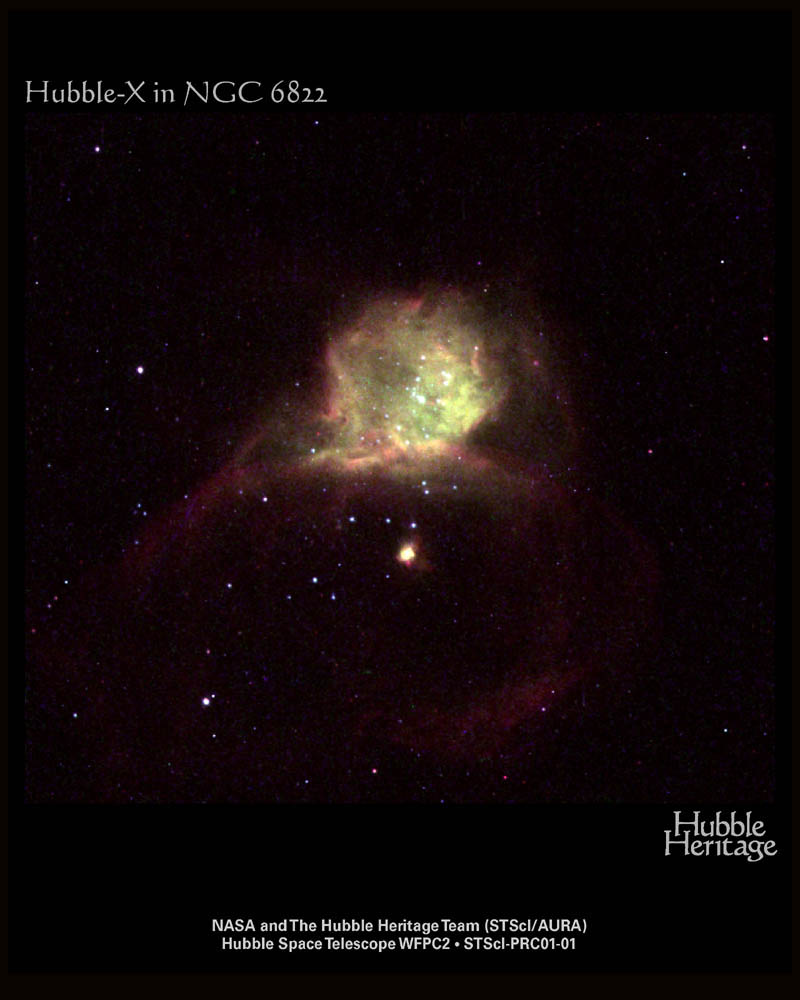
Star Forming Region Hubble-X
Explanation: In nearby galaxy NGC 6822, this glowing emission nebula complex surrounds bright, massive, newborn stars. A mere 4 million years young, these stars condensed from the galaxy's interstellar gas and dust clouds. The nebular glow is powered by the bright stars' intense ultraviolet radiation while its shape is sculpted by the interaction of stellar winds and radiation with the immense interstellar clouds themselves. Cataloged as Hubble-X , many skygazers find the appearance of this extragalactic star forming region reminiscent of the most famous stellar nursery in our own galaxy, the Orion Nebula . Hubble-X is intrinsically much brighter than Orion though, and at a distance of 1.6 million light-years it is about 1,000 times farther away. Hubble-X is also about 100 light-years across compared to 10 light-years for the Orion Nebula. Why is it called Hubble-X? X is the Roman numeral 10, this nebula's designation in a catalog of similar objects for galaxy NGC 6822 .
| Date | February 16, 2001 |
|---|---|
| Credit | Credit: C. R. O'Dell ( Vanderbilt Univ. ) et al. , Hubble Heritage Team , NASA |
| Authors & editors: | Robert Nemiroff (MTU) & Jerry Bonnell (UMCP) |
| A service of: |
ASD at NASA / GSFC, NASA Science Activation & Michigan Tech. U. |