



























APOD
Astronomy Picture of the Day
Discover the cosmos! Each day a different image or photograph of our fascinating universe is featured, along with a brief explanation written by a professional astronomer.
Black Holes Are Black
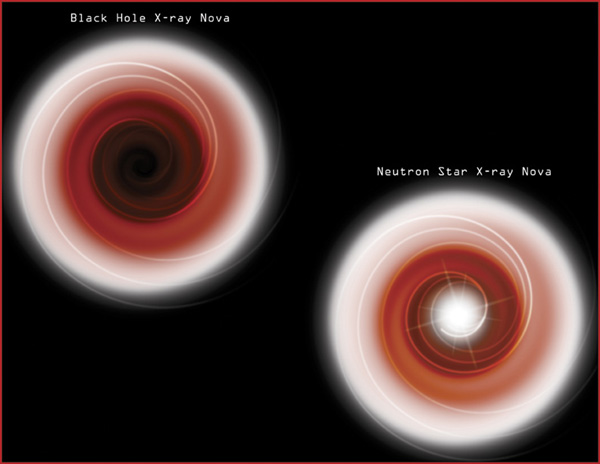
Explanation: Q: Why are black holes black? A: Because they have an event horizon . The event horizon is that one-way boundary predicted by general relativity beyond which nothing, not even light, can return. X-ray astronomers using the space-based Chandra Observatory now believe they have direct evidence for event horizons - therefore black holes - in binary star systems which can be detected in x-ray light. These binaries, sometimes called x-ray novae, are known to consist of relatively normal stars dumping material on to massive, compact companions. As illustrated , the material swirls toward the companion in an accretion disk which itself glows in x-rays. If the compact companion is a neutron star (right), the material ultimately smashes into the solid surface and glows even more brightly in high energy x-rays. But if it is indeed a black hole with a defining event horizon, then the x-ray hot material approaches the speed of light as it swirls past the surface of no return and is lost from view. Recent work describes observations of two classes of x-ray binaries , one class 100 times fainter than the other. The results imply the presence of an event horizon in the fainter class which causes the extreme difference in x-ray brightness.
| Date | January 19, 2001 |
|---|---|
| Credit |
Credit: M. Garcia , J. McClintock, R. Narayan, S. Murray ( CfA ), P. Callanan ( University College , Cork, Ireland) Illustration Credit: M. Weiss, CXC |
| Authors & editors: | Robert Nemiroff (MTU) & Jerry Bonnell (UMCP) |
| A service of: |
ASD at NASA / GSFC, NASA Science Activation & Michigan Tech. U. |