


























APOD
Astronomy Picture of the Day
Discover the cosmos! Each day a different image or photograph of our fascinating universe is featured, along with a brief explanation written by a professional astronomer.
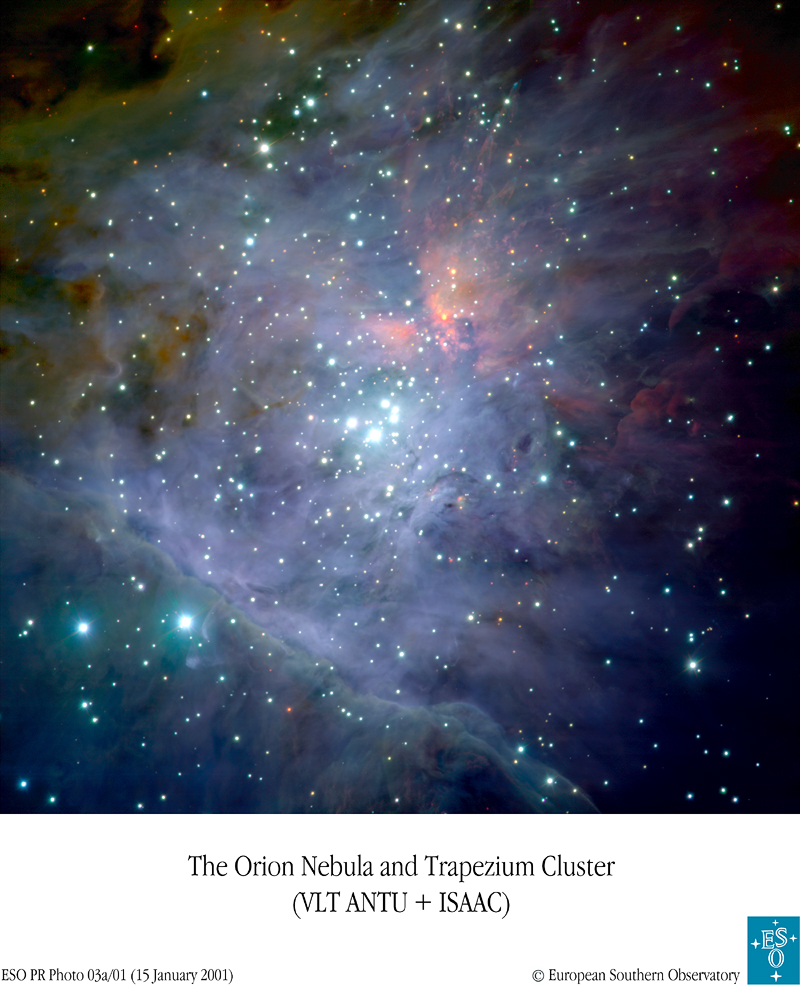
The Orion Nebula from VLT
Explanation: The Great Nebula in Orion is a colorful place. Visible to the unaided eye, it appears as a small fuzzy patch in the constellation of Orion . But this image , a representative-color composite of 81 near- infrared light images taken with VLT's ISAAC , shows the Orion Nebula to be a busy neighborhood of young stars, hot gas, and dark dust. The power behind much of the Orion Nebula (M42) is the Trapezium - four of the brightest stars in the nebula. The eerie blue glow surrounding the bright stars pictured here is their own starlight reflected by nearby dust . Dark brown dust filaments cover much of the region . The whole Orion Nebula cloud complex, which includes the Horsehead Nebula , will slowly disperse over the next 100,000 years.
| Date | January 30, 2001 |
|---|---|
| Credit | Credit: Mark McCaughrean ( AI Potsdam ) et al., ISAAC , VLT ANTU , ESO |
| Authors & editors: | Robert Nemiroff (MTU) & Jerry Bonnell (UMCP) |
| A service of: |
ASD at NASA / GSFC, NASA Science Activation & Michigan Tech. U. |