





















APOD
Astronomy Picture of the Day
Discover the cosmos! Each day a different image or photograph of our fascinating universe is featured, along with a brief explanation written by a professional astronomer.
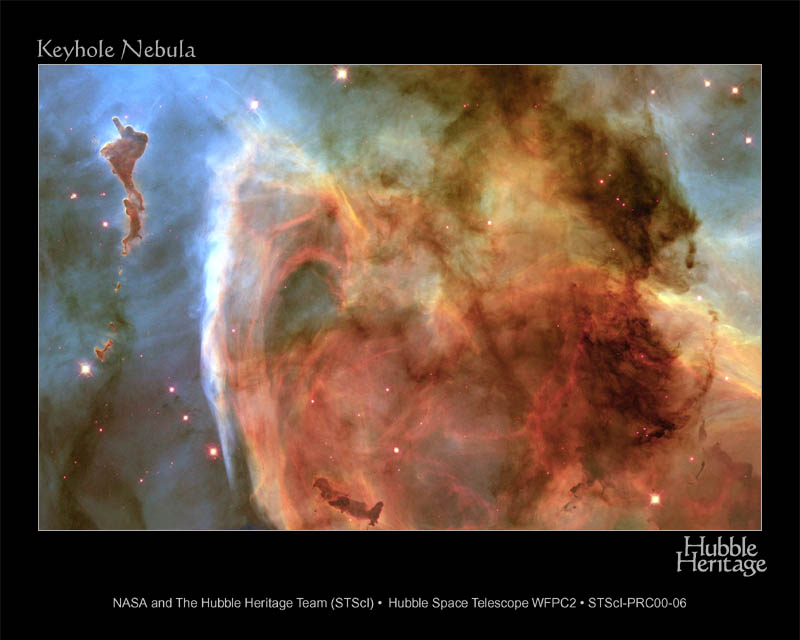
Colorful Clouds Of Carina
Explanation: Tumultuous clouds of the Carina Nebula , 8000 light-years away, glow in planet Earth's southern sky . Striking and detailed, this close-up of a portion of the famous nebula is a combination of exposures through six different filters taken with the Hubble Space Telescope 's Wide Field Planetary Camera 2 in April of 1999. Dramatic dark dust knots and complex features revealed are sculpted by the winds and radiation of Carina 's massive and energetic stars . But how were this picture's colors generated ? Astronomical images produced from Hubble Space Telescope data can be composed of exposures made using relatively narrow filters which don't match the color responses of the human eye . Some of the filters even transmit wavelengths of light outside the visible spectrum . Exposures made with different narrow filters, as in this case , are translated to a visible color where shorter wavelengths are assigned bluer and longer wavelengths assigned redder colors. This color scheme represents a “chromatically ordered” way of presenting the data rather than a natural color image.
| Date | June 17, 2001 |
|---|---|
| Credit | Credit: Hubble Heritage Team ( AURA / STScI / NASA ) |
| Authors & editors: | Robert Nemiroff (MTU) & Jerry Bonnell (UMCP) |
| A service of: |
ASD at NASA / GSFC, NASA Science Activation & Michigan Tech. U. |