


























APOD
Astronomy Picture of the Day
Discover the cosmos! Each day a different image or photograph of our fascinating universe is featured, along with a brief explanation written by a professional astronomer.
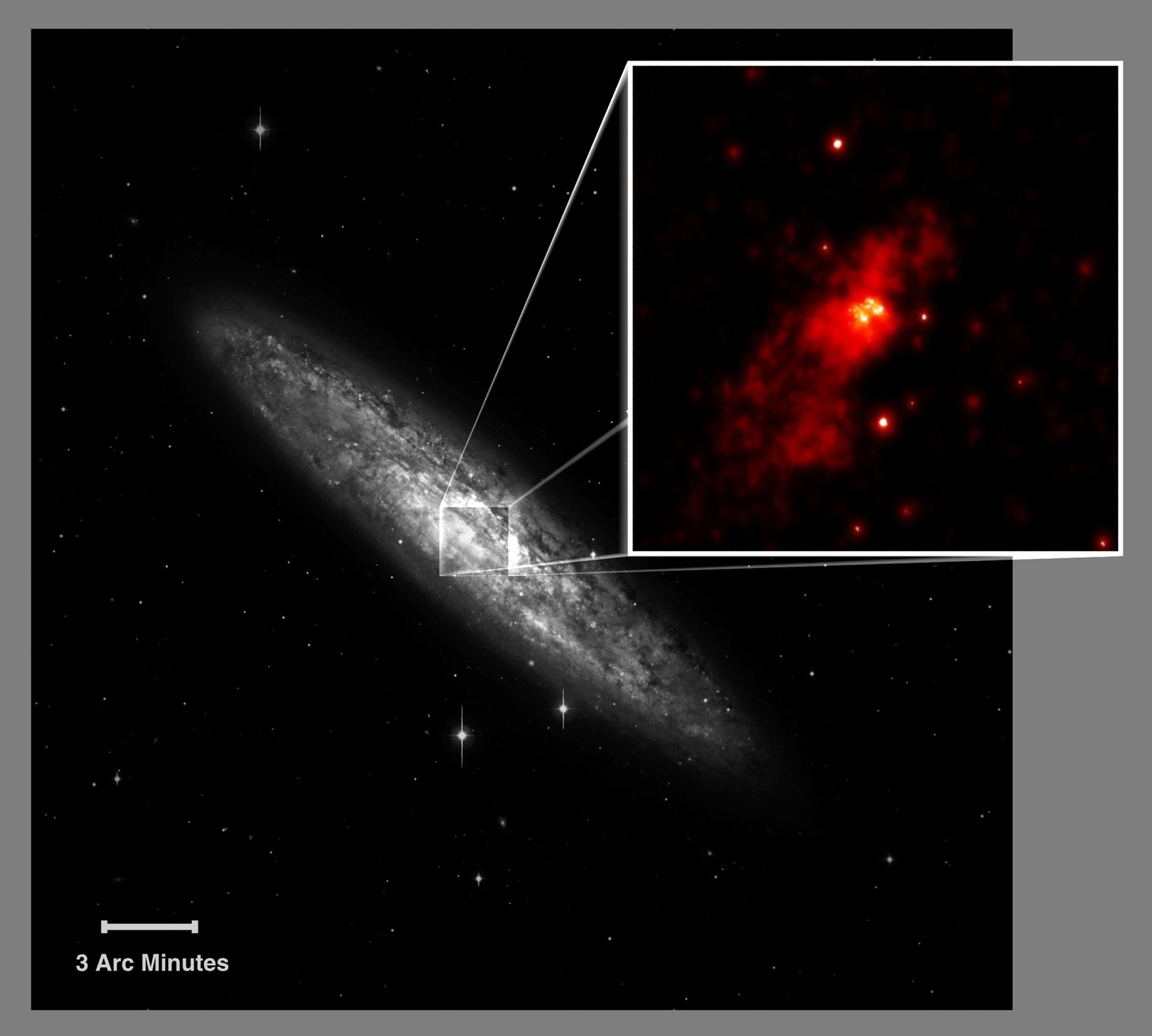
NGC 253: X-Ray Zoom
Explanation: Astronomers now report that Chandra X-ray Observatory observations of galaxies known to be frantically forming stars show that these galaxies also contain luminous x-ray sources -- thought to be intermediate mass black holes and immense clouds of superheated gas. Take the lovely island universe NGC 253 for example. At distance of a mere 8 million light-years, NGC 253's prodigious starforming activity has been well studied using high-resolution optical images like the one seen here at lower left. Zooming in on this energetic galaxy's central region, Chandra's x-ray detectors reveal hidden details indicated in the inset at right. In the false-color image , x-ray hot gas clouds glow near the core and at least four very powerful x-ray sources lie within 3,000 light-years of the center of the galaxy. Much more luminous than black hole binary star systems in our own galaxy, these extreme x-ray sources may be gravitating toward NGC 253's center. As a result , NGC 253 and other similar starforming galaxies could ultimately develop a single, central, supermassive black hole, transforming their cores into quasars .
| Date | June 7, 2001 |
|---|---|
| Credit | Credit : K. Weaver ( LHEA / GSFC ), et al.; X-ray Image: SAO , CXC , NASA ; Optical Image: ESO |
| Authors & editors: | Robert Nemiroff (MTU) & Jerry Bonnell (UMCP) |
| A service of: |
ASD at NASA / GSFC, NASA Science Activation & Michigan Tech. U. |