

























APOD
Astronomy Picture of the Day
Discover the cosmos! Each day a different image or photograph of our fascinating universe is featured, along with a brief explanation written by a professional astronomer.
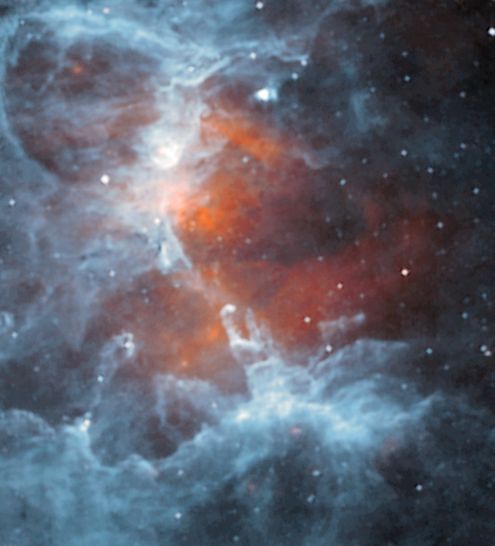
Cold Dust in the Eagle Nebula
Explanation: Stars are born in M16's Eagle Nebula , a stellar nursery 7,000 light-years from Earth toward the constellation Serpens . The striking nebula's star forming pillars of gas and dust are familiar to astronomers from images at visible wavelengths, but this false-color picture shows off the nebula in infrared light . Data from ESA's Infrared Space Observatory satellite (ISO) was used to construct the detailed two color image , dominated by infrared emission from clouds of interstellar material at temperatures below -100 degrees Celsius. Blue colors highlight emission thought to indicate the presence of complex carbon molecules , known on planet Earth as PAHs , while red colors trace emission from cold, microscopic dust grains . Hot young stars are formed as this frigid material condenses under the influence of gravity . Once begun, the process takes only tens of thousands of years for truly massive stars and up to tens of millions of years for low mass stars like the Sun.
| Date | September 14, 2001 |
|---|---|
| Credit | Credit: ESA , ISO , ISOGAL Team |
| Authors & editors: | Robert Nemiroff (MTU) & Jerry Bonnell (UMCP) |
| A service of: |
ASD at NASA / GSFC, NASA Science Activation & Michigan Tech. U. |