
























APOD
Astronomy Picture of the Day
Discover the cosmos! Each day a different image or photograph of our fascinating universe is featured, along with a brief explanation written by a professional astronomer.
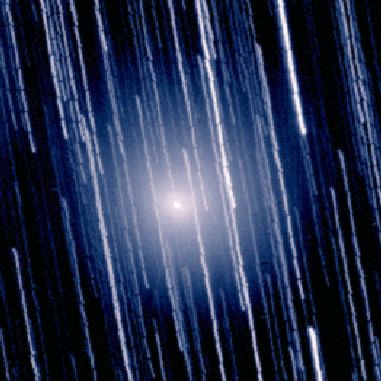
Tempel-Tuttle: The Leonid Comet
Explanation: Star trails streak this composite time exposure of comet Tempel-Tuttle recorded by Tim Puckett on January 26, 1998. Then passing through the inner solar system on its 33 year orbit around the Sun, Tempel-Tuttle brightened unexpectedly, but binoculars or small telescopes were still required to visually observe it. Tempel-Tuttle is also called “the Leonid Comet” as the yearly Leonid meteor shower results when the Earth crosses this comet's orbital plane and encounters a trail of cometary dust . So, while not rivaling spectacular naked-eye comets like Hyakutake or Hale-Bopp , Tempel-Tuttle still puts on a show. The Earth is now approaching relatively dense regions of Tempel-Tuttle's orbiting debris trail, so in the next few days, skywatchers will be searching for leonid meteors. An extremely active meteor shower is expected to be visible over Europe and North America in the early morning hours of Tuesday, November 19 , despite interference from a glaring full moon.
| Date | November 16, 2002 |
|---|---|
| Credit | Credit & Copyright: T. Puckett ( Puckett Observatory ) |
| Authors & editors: | Robert Nemiroff (MTU) & Jerry Bonnell (UMCP) |
| A service of: |
ASD at NASA / GSFC, NASA Science Activation & Michigan Tech. U. |