




























APOD
Astronomy Picture of the Day
Discover the cosmos! Each day a different image or photograph of our fascinating universe is featured, along with a brief explanation written by a professional astronomer.
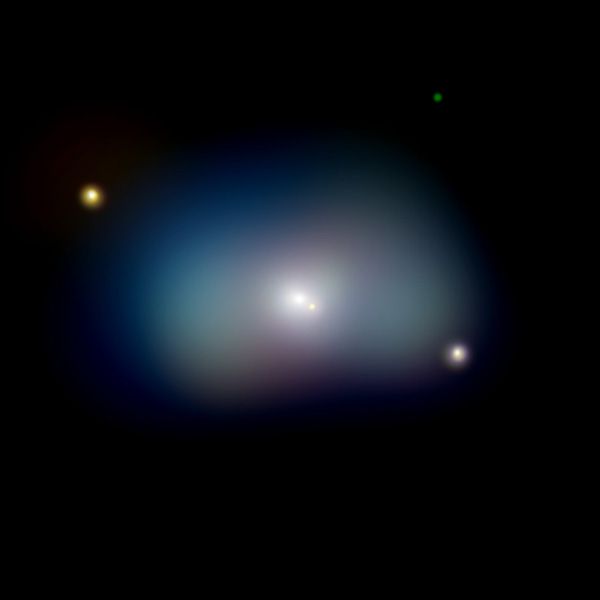
NGC 1700: Elliptical Galaxy and Rotating Disk
Explanation: In spiral galaxies, majestic winding arms of young stars and interstellar gas and dust rotate in a disk around a bulging galactic nucleus. Elliptical galaxies seem to be simpler, randomly swarming with old stars and lacking gas and dust. So astronomers were excited to find that NGC 1700, a young elliptical galaxy about 160 million light-years away, shows evidence for a 90,000 light-year wide rotating disk of multi-million degree hot gas. The evidence comes from data recorded by the orbiting Chandra Observatory, whose sharp x-ray image of NGC 1700 is seen above. Balancing gravity, the rotation of the x-ray hot disk , the largest of its type yet discovered, gives the galaxy a pronounced boxy profile in this false-color picture. Theories about the origin of the disk suggest that NGC 1700 may be the result of a cosmic scale galactic merger , perhaps between a spiral and elliptical galaxy. NGC 1700 is just visible with small telescopes toward the flowing constellation Eridanus .
| Date | January 16, 2003 |
|---|---|
| Credit | Credit: Thomas S. Statler, Brian R. McNamara ( Ohio Univ. ), CXC , NASA |
| Authors & editors: | Robert Nemiroff (MTU) & Jerry Bonnell (UMCP) |
| A service of: |
ASD at NASA / GSFC, NASA Science Activation & Michigan Tech. U. |