


























APOD
Astronomy Picture of the Day
Discover the cosmos! Each day a different image or photograph of our fascinating universe is featured, along with a brief explanation written by a professional astronomer.
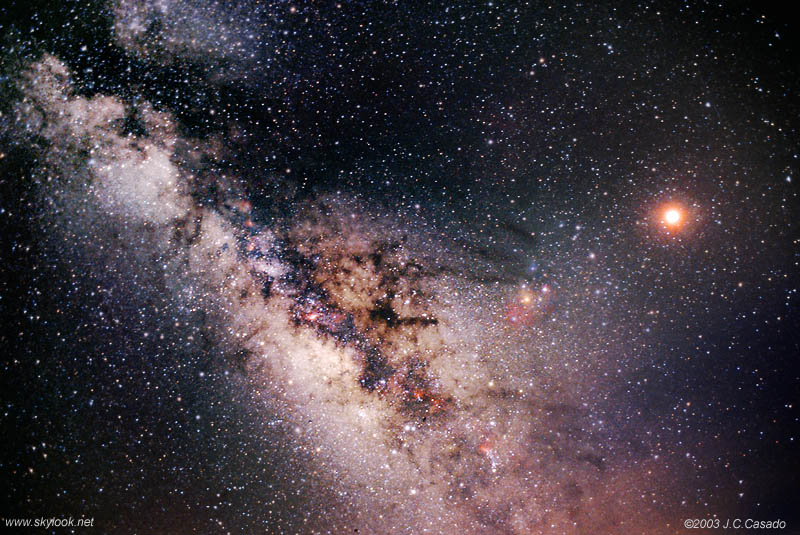
The Milky Way Behind an Eclipsed Moon
Explanation: What's behind the Moon? Each month, our Moon passes in front of -- and outshines -- many an interesting star field. Exceptions occur during a new Moon and during a total eclipse . In the background of a new Moon is usually the Sun , an even brighter orb that even more easily outshines everything behind it, except during a total solar eclipse . Even the longest total solar eclipse lasts just a few minutes, while the Sun's corona still remains bright. During a total lunar eclipse , however, the full Moon dims and a majestic star field may present itself for an hour or more. Such was the case during the middle of last month, when a rare glimpse of an eclipsed Moon superposed in front of the disk of our home Milky Way Galaxy was captured. Although fully in the Earth's shadow , the eclipsed Moon is still the brightest object on the right. The above image was captured during sub-zero weather from the Teide 2003 expedition to Mirador del Pico Viejo , a mountain in the Canary Islands , Spain , off the northwest coast of Africa .
| Date | June 3, 2003 |
|---|---|
| Credit | Credit & Copyright: Juan Carlos Casado |
| Authors & editors: | Robert Nemiroff (MTU) & Jerry Bonnell (UMCP) |
| A service of: |
ASD at NASA / GSFC, NASA Science Activation & Michigan Tech. U. |