

















APOD
Astronomy Picture of the Day
Discover the cosmos! Each day a different image or photograph of our fascinating universe is featured, along with a brief explanation written by a professional astronomer.

Gliese 876 System Includes Large Terrestrial Planet
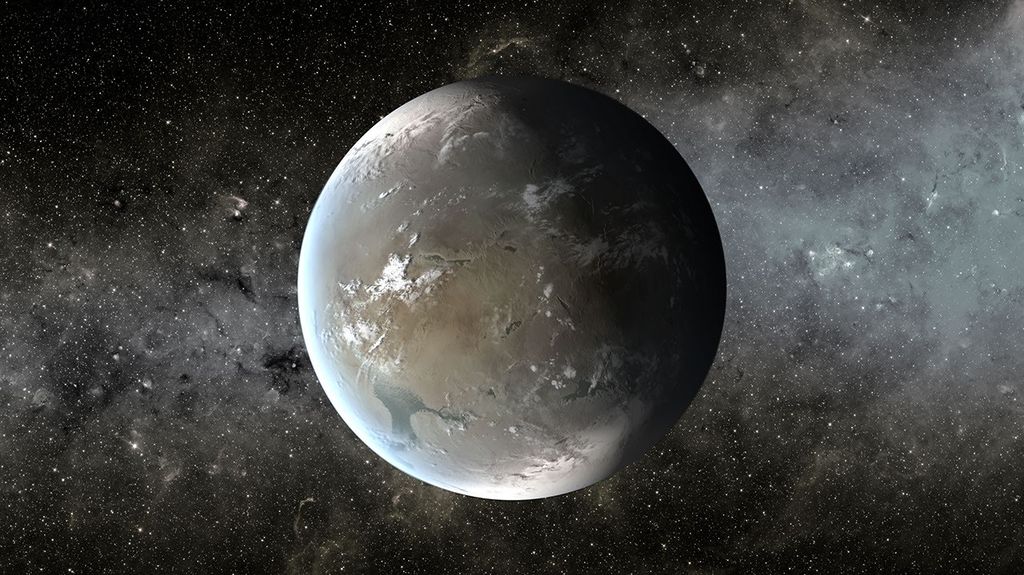
Explanation: Is our Earth unique? In continuing efforts to answer this question, astronomers have now discovered an Earth-like planet orbiting a distant normal star. Previously over 150 gas-giant planets like Jupiter had been so discovered. Slight, fast, but regular wobbles of nearby small M - dwarf star Gliese 876 showed evidence for a planet with a likely mass slightly higher than a minimum six times the mass of Earth. The planet's small mass indicates that it is likely terrestrial in nature, similar in composition to the inner planets of our Solar System . If indeed made predominantly of rock, the planet's surface gravity would not even be able to contain the gasses of a Jupiter-like planet. The newly discovered planet would not make a good vacation spot for humans, however, as it orbits so close that the surface temperature probably tops a searing 200 degrees Celsius . The system is illustrated in the above drawing as seen from a hypothetical moon orbiting one of the two Jupiter-like planets already known . The newly discovered terrestrial-like planet is depicted in the insert. Gliese 876 lies only 15 light-years away and is visible with binoculars toward the constellation of Aquarius .
| Date | June 14, 2005 |
|---|---|
| Credit |
Illustration Credit & Copyright: Lynette Cook (spaceart.org); Discovery Credit: E. Rivera ( NASA's ARC ) et al. , HIRES , Keck Obs. , NASA , NSF |
| Authors & editors: | Robert Nemiroff (MTU) & Jerry Bonnell (UMCP) |
| A service of: |
ASD at NASA / GSFC, NASA Science Activation & Michigan Tech. U. |