
























APOD
Astronomy Picture of the Day
Discover the cosmos! Each day a different image or photograph of our fascinating universe is featured, along with a brief explanation written by a professional astronomer.


Active Galaxy NGC 1275
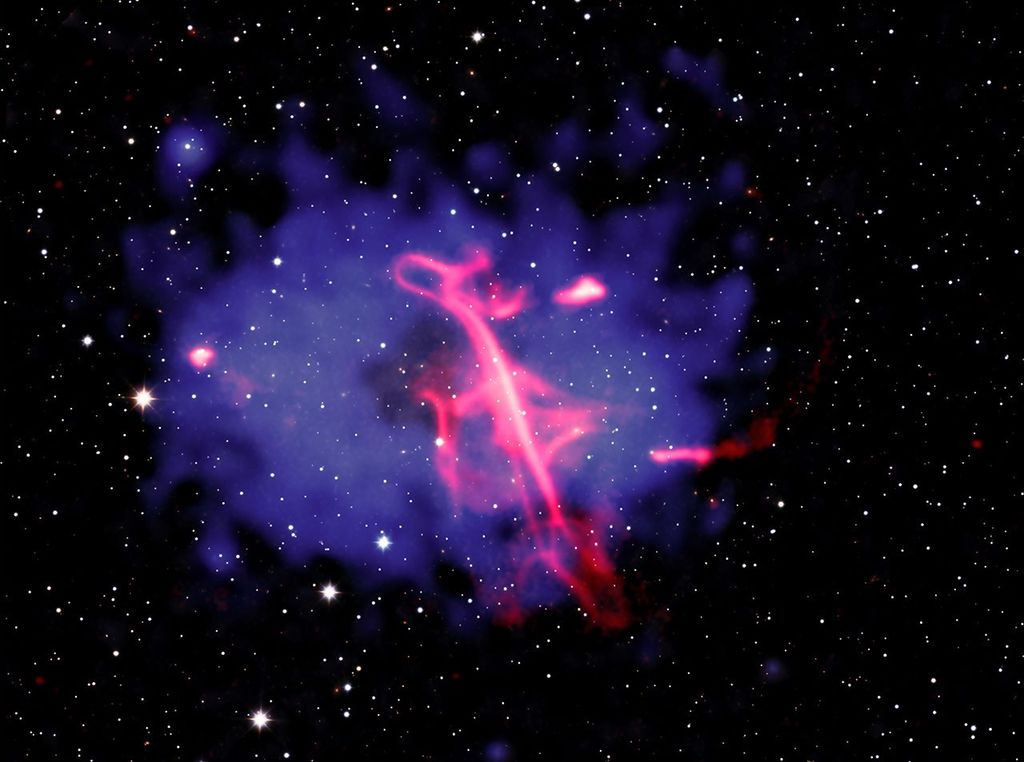
Explanation: Active galaxy NGC 1275 is the central, dominant member of the large and relatively nearby Perseus Cluster of Galaxies . A prodigious source of x-rays and radio emission, NGC 1275 accretes matter as entire galaxies fall into it, ultimately feeding a supermassive black hole at the galaxy's core. This stunning visible light image from the Hubble Space Telescope shows galactic debris and filaments of glowing gas, some up to 20,000 light-years long. The filaments persist in NGC 1275, even though the turmoil of galactic collisions should destroy them. What keeps the filaments together? Recent work indicates that the structures, pushed out from the galaxy's center by the black hole's activity, are held together by magnetic fields. To add x-ray data from the Chandra Observatory and radio data from the Very Large Array to the Hubble image, just slide your cursor over the picture. In the resulting composite , x-rays highlight the shells of hot gas surrounding the center of the galaxy, with radio emission filling giant bubble-shaped cavities. Also known as Perseus A, NGC 1275 spans over 100,000 light years and lies about 230 million light years away.
| Date | August 22, 2008 |
|---|---|
| Credit |
Credit: NASA , ESA , Hubble Heritage ( STScI / AURA ); A. Fabian ( IoA, Cambridge U. ), L. Frattare (STScI), CXC , G. Taylor, NRAO,VLA |
| Authors & editors: | Robert Nemiroff (MTU) & Jerry Bonnell (UMCP) |
| A service of: |
ASD at NASA / GSFC, NASA Science Activation & Michigan Tech. U. |