

























APOD
Astronomy Picture of the Day
Discover the cosmos! Each day a different image or photograph of our fascinating universe is featured, along with a brief explanation written by a professional astronomer.
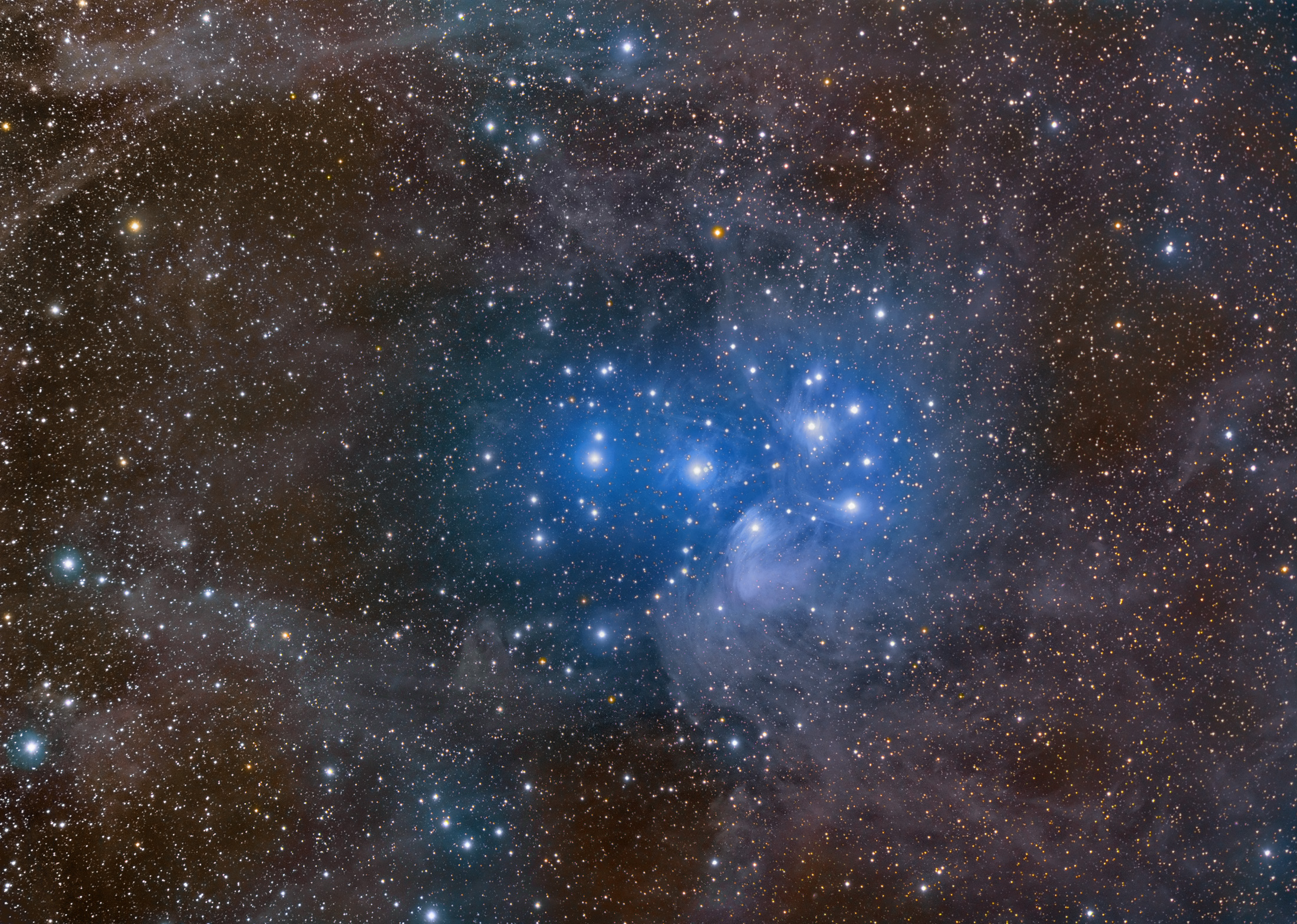
Pleiades and Stardust
Explanation: Have you ever seen the Pleiades star cluster? Perhaps the most famous star cluster on the sky, the Pleiades can be seen without binoculars from even the depths of a light-polluted city . Also known as the Seven Sisters and M45 , the Pleiades is one of the brightest and closest open clusters . Hurtling through a cosmic dust cloud a mere 400 light-years away, the Pleiades or Seven Sisters star cluster is well-known for its striking blue reflection nebulae . This remarkable wide-field (3 degree) image of the region shows the famous star cluster near the center, while highlighting lesser known dusty reflection nebulas nearby, across an area that would span over 20 light-years . In this case, the sister stars and cosmic dust clouds are not related, they just happen to be passing through the same region of space.
| Date | October 14, 2009 |
|---|---|
| Credit | Credit & Copyright: Rogelio Bernal Andreo (Deep Sky Colors) |
| Authors & editors: | Robert Nemiroff (MTU) & Jerry Bonnell (UMCP) |
| A service of: |
ASD at NASA / GSFC, NASA Science Activation & Michigan Tech. U. |