



























APOD
Astronomy Picture of the Day
Discover the cosmos! Each day a different image or photograph of our fascinating universe is featured, along with a brief explanation written by a professional astronomer.
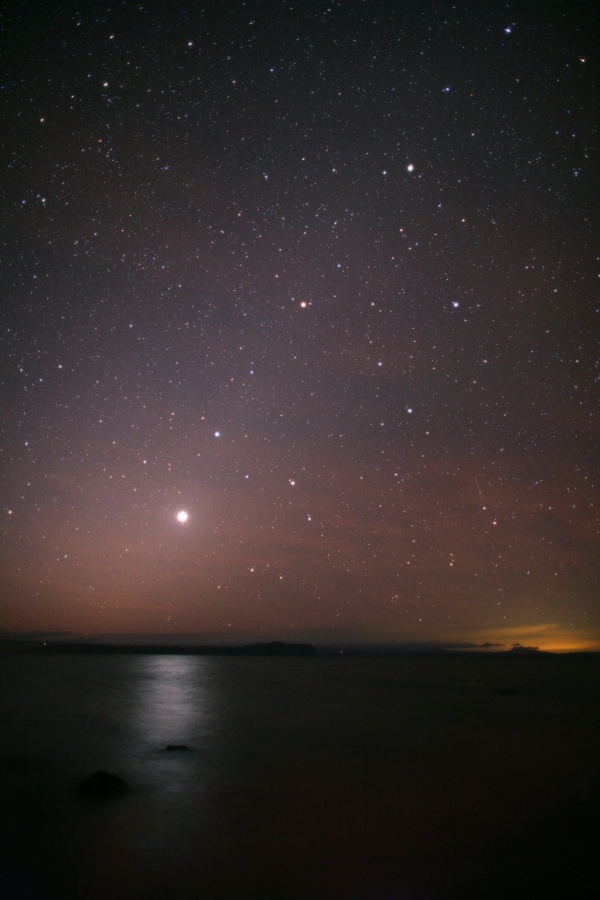
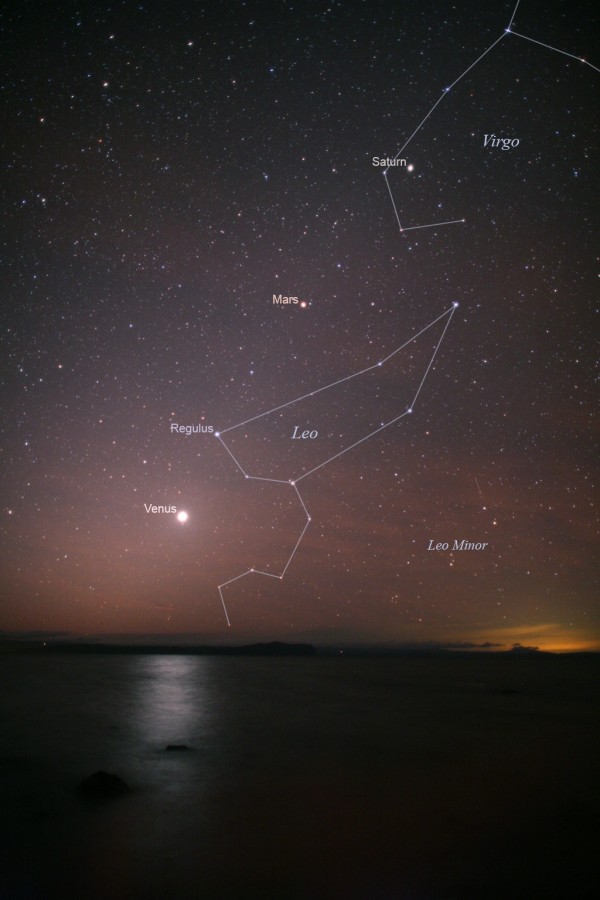
Ecliptic New Zealand
Explanation: Four bright celestial beacons and a faint triangle of light follow the plane of the ecliptic as it arcs high through this southern hemisphere night skyscape. Seen on a July winter night from Lake Taupo on New Zealand's North Island, the line-up features Venus , Regulus (alpha star of Leo), Mars , and Saturn from lower left to upper right. Just put your cursor over the picture to identify the planets and constellations. The delicate luminous glow of Zodiacal Light , sunlight scattered by dust along the ecliptic, also rises above the horizon from the lower left. Of course, defined by the path of the Sun through planet Earth's sky, the ecliptic plane rides low during July nights in the northern hemisphere's summer skies. Tomorrow, the Moon and Sun will meet on the ecliptic. Along a track across the southern Pacific Ocean, the daytime sky will feature a total solar eclipse.
Total Solar Eclipse: Times and Visibility | Webcast
| Date | July 10, 2010 |
|---|---|
| Credit | Image Credit & Copyright: Tunç Tezel ( TWAN ) |
| Authors & editors: | Robert Nemiroff (MTU) & Jerry Bonnell (UMCP) |
| A service of: |
ASD at NASA / GSFC, NASA Science Activation & Michigan Tech. U. |