




























APOD
Astronomy Picture of the Day
Discover the cosmos! Each day a different image or photograph of our fascinating universe is featured, along with a brief explanation written by a professional astronomer.
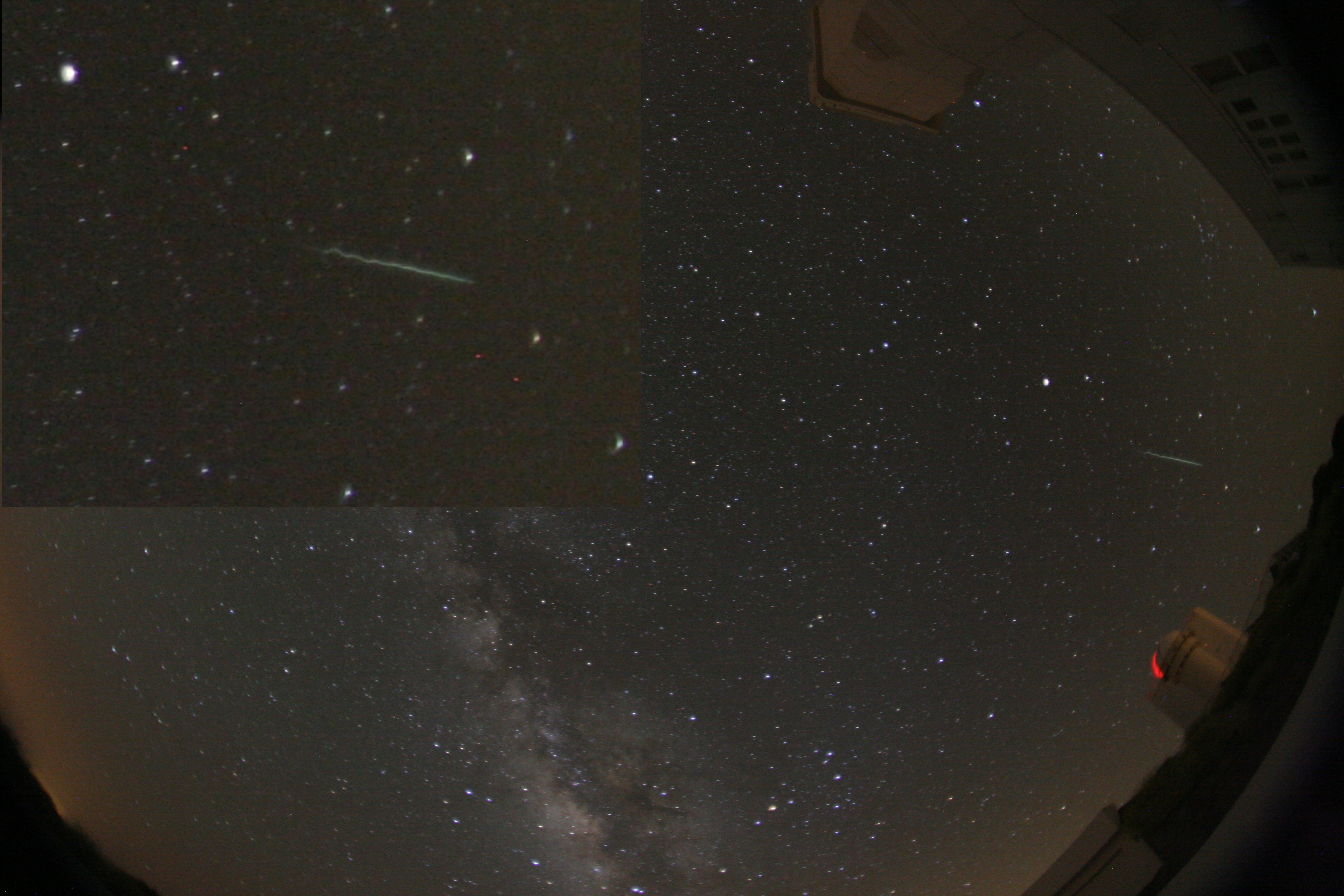
A Twisted Meteor Trail Over Tenerife
Explanation: Did this meteor take a twisting path? No one is sure. Considered opinions are solicited. Meteors, usually sand sized grains that originate in comets, will typically disintegrate as they enter the Earth's atmosphere . A fast moving meteor ionizes molecules in the Earth's atmosphere that subsequently glow when they reacquire electrons . Meteor paths that twist noticeably have been noted before , and even photographed , but attributing such behavior to the motion of the meteor itself and neither the wind-blown meteor train nor the observer remains somewhat controversial. The above meteor, imaged two weeks ago streaking over the Teide Observatory in Tenerife , Canary Islands , appears to swagger as much as several minutes of arc , which the experienced astrophotographer did not think could be attributed to drifting of the resulting train or motion of the camera mount . If truly an indication of a twisted meteor path , an underlying reason could be the pictured meteor was markedly non-spherical in shape, non-uniform in composition, or electrically charged . Non-uniform meteors , for example, may evaporate more on one side than another, causing a rotating meteor to wobble. Understanding meteors is important partly because meteors are candidates to have seeded Earth with prebiotic molecules that allowed for the development of life .
| Date | June 2, 2010 |
|---|---|
| Credit | Credit & Copyright: Juergen Rendtel ( AIP Potsdam ), IMO |
| Authors & editors: | Robert Nemiroff (MTU) & Jerry Bonnell (UMCP) |
| A service of: |
ASD at NASA / GSFC, NASA Science Activation & Michigan Tech. U. |