




























APOD
Astronomy Picture of the Day
Discover the cosmos! Each day a different image or photograph of our fascinating universe is featured, along with a brief explanation written by a professional astronomer.
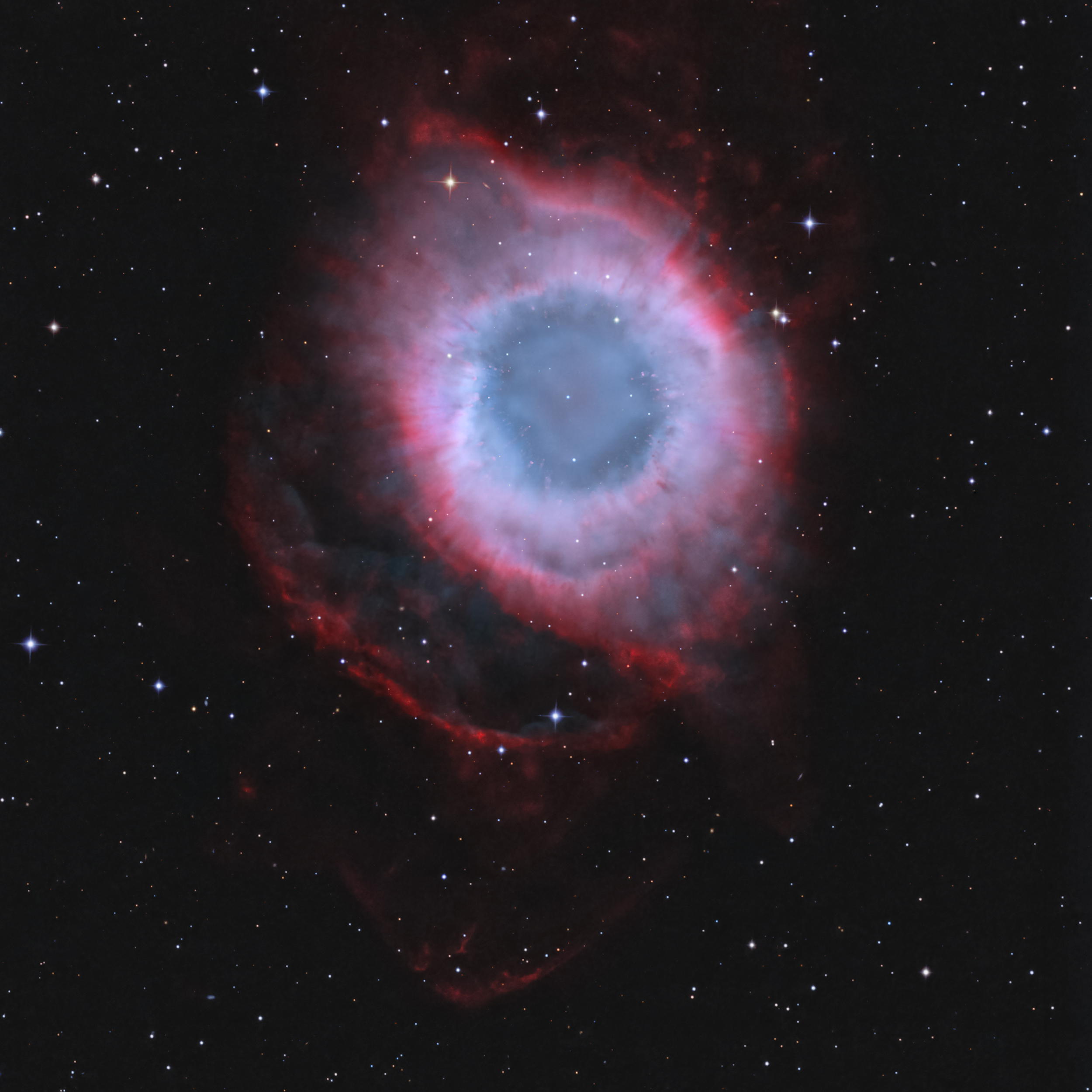
NGC 7293: The Helix Nebula
Explanation: A mere seven hundred light years from Earth, in the constellation Aquarius , a sun-like star is dying. Its last few thousand years have produced the Helix Nebula (NGC 7293), a well studied and nearby example of a Planetary Nebula , typical of this final phase of stellar evolution. A total of 28.5 hours of exposure time have gone in to creating this deep view of the nebula . Combining narrow band image data from emission lines of hydrogen atoms in red and oxygen atoms in blue-green hues, it shows remarkable details of the Helix's brighter inner region , about 3 light-years across, but also follows fainter outer halo features that give the nebula a span of well over six light-years. The white dot at the Helix's center is this Planetary Nebula's hot, central star . A simple looking nebula at first glance , the Helix is now understood to have a surprisingly complex geometry .
| Date | January 10, 2014 |
|---|---|
| Credit | Image Credit & Copyright: Don Goldman |
| Authors & editors: | Robert Nemiroff (MTU) & Jerry Bonnell (UMCP) |
| A service of: |
ASD at NASA / GSFC, NASA Science Activation & Michigan Tech. U. |