


























APOD
Astronomy Picture of the Day
Discover the cosmos! Each day a different image or photograph of our fascinating universe is featured, along with a brief explanation written by a professional astronomer.
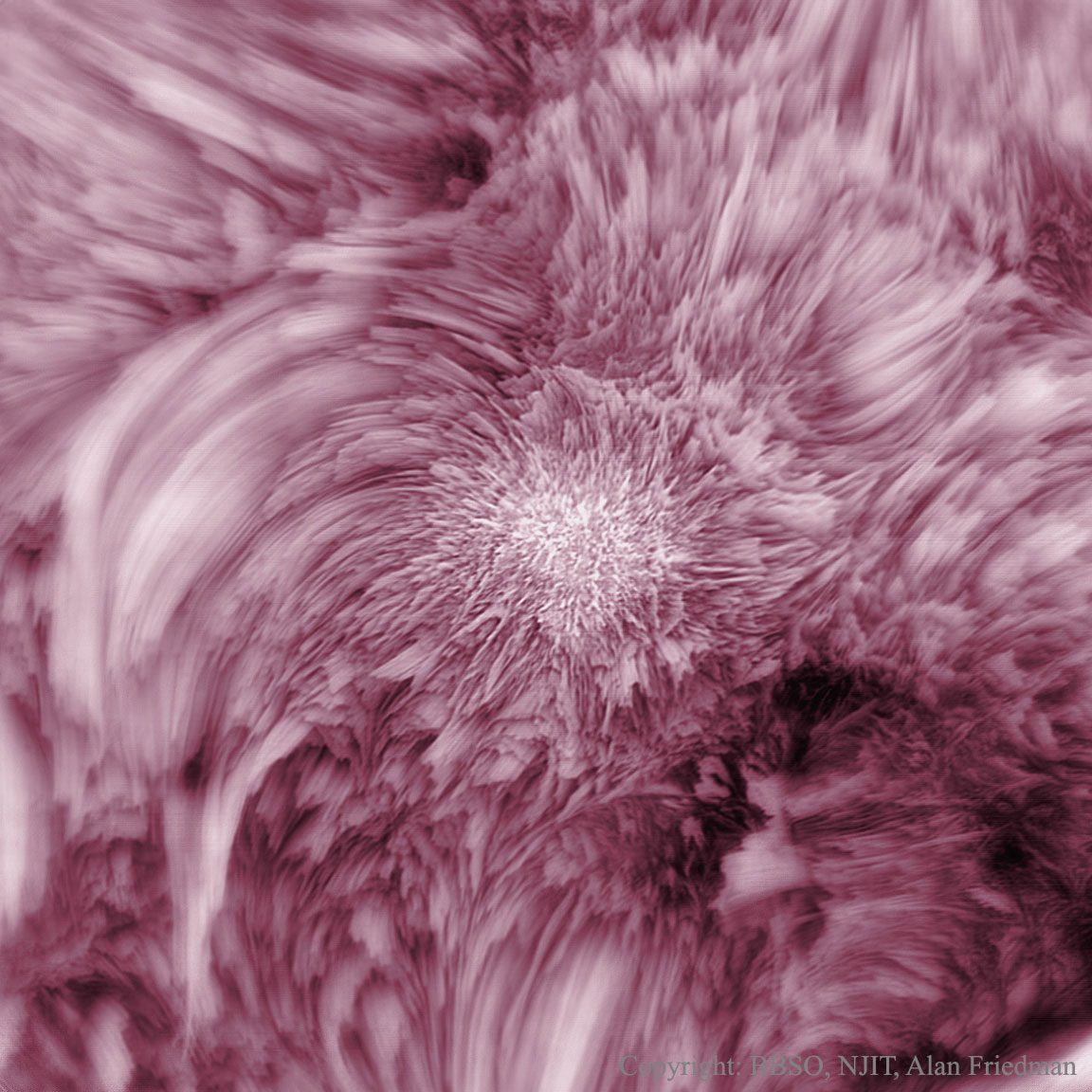
Fibrils Flower on the Sun
Explanation: When does the Sun look like a flower? In a specific color of red light emitted by hydrogen, as featured here , some regions of the solar chromosphere may resemble a rose . The color-inverted image was taken in 2014 October and shows active solar region 2177 . The petals dominating the frame are actually magnetically confined tubes of hot plasma called fibrils , some of which extend longer than the diameter of the Earth. In the central region many of these fibrils are seen end-on, while the surrounding regions are typically populated with curved fibrils. When seen over the Sun's edge, these huge plasma tubes are called spicules , and when they occur in passive regions they are termed mottles . Sunspot region 2177 survived for several more days before the complex and tumultuous magnetic field poking through the Sun's surface evolved yet again.
Follow APOD on: Facebook , Google Plus , or Twitter
| Date | February 17, 2015 |
|---|---|
| Credit | Image Credit & Copyright: Big Bear Solar Obs. , NJIT , Alan Friedman ( Averted Imagination ) |
| Authors & editors: | Robert Nemiroff (MTU) & Jerry Bonnell (UMCP) |
| A service of: |
ASD at NASA / GSFC, NASA Science Activation & Michigan Tech. U. |