



























APOD
Astronomy Picture of the Day
Discover the cosmos! Each day a different image or photograph of our fascinating universe is featured, along with a brief explanation written by a professional astronomer.

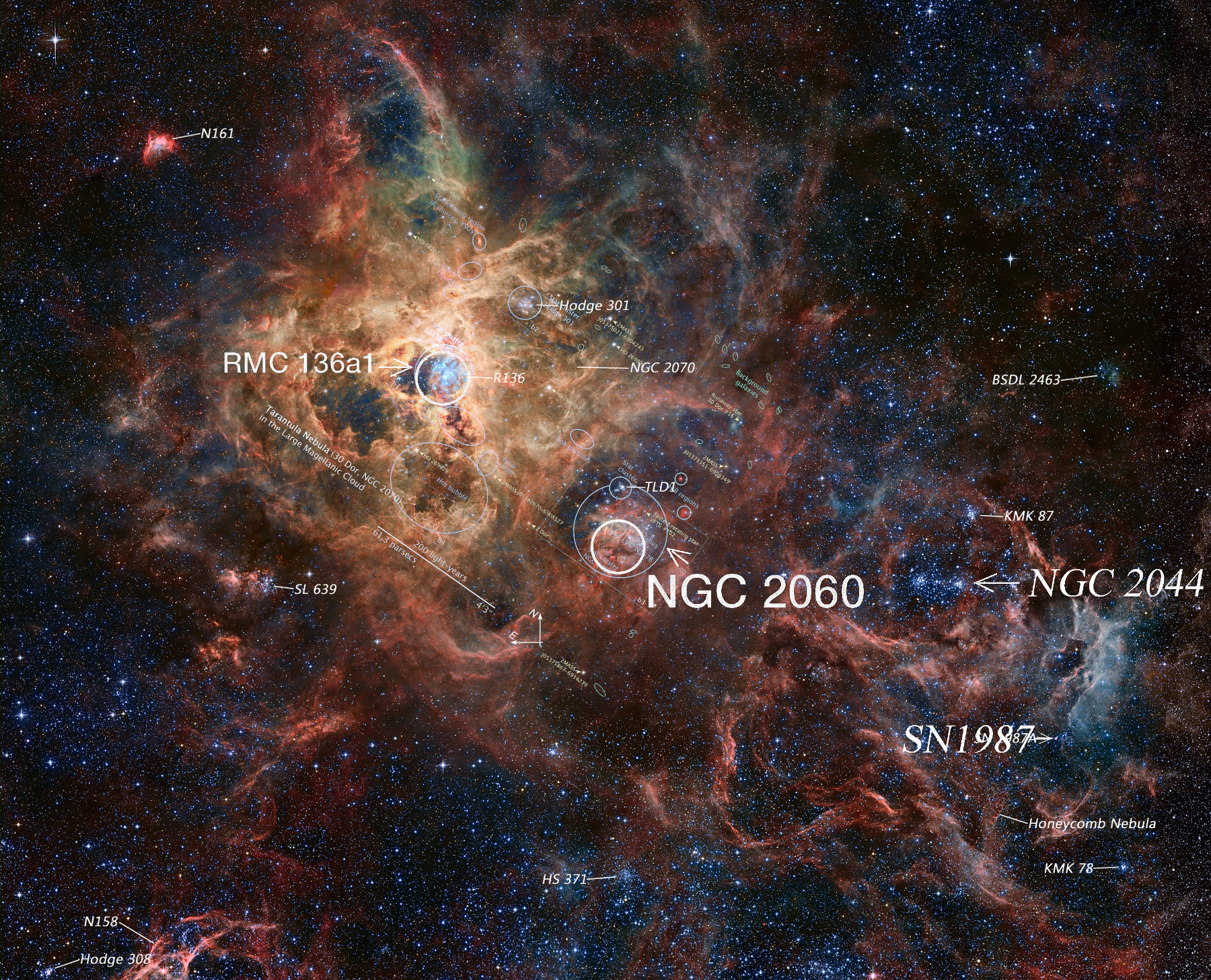
The Tarantula Nebula
Explanation: The Tarantula Nebula is more than a thousand light-years in diameter, a giant star forming region within nearby satellite galaxy the Large Magellanic Cloud , about 180 thousand light-years away. The largest, most violent star forming region known in the whole Local Group of galaxies, the cosmic arachnid sprawls across this spectacular composite view constructed with space- and ground-based image data. Within the Tarantula (NGC 2070), intense radiation, stellar winds and supernova shocks from the central young cluster of massive stars, cataloged as R136 , energize the nebular glow and shape the spidery filaments. Around the Tarantula are other star forming regions with young star clusters, filaments, and blown-out bubble-shaped clouds In fact, the frame includes the site of the closest supernova in modern times, SN 1987A , at the lower right. The rich field of view spans about 1 degree or 2 full moons, in the southern constellation Dorado . But were the Tarantula Nebula closer, say 1,500 light-years distant like the local star forming Orion Nebula , it would take up half the sky.
| Date | February 26, 2016 |
|---|---|
| Credit |
Image Credit & Copyright: Processing - Robert Gendler , Roberto Colombari Data - Hubble Tarantula Treasury , European Southern Observatory |
| Authors & editors: | Robert Nemiroff (MTU) & Jerry Bonnell (UMCP) |
| A service of: |
ASD at NASA / GSFC, NASA Science Activation & Michigan Tech. U. |