


























APOD
Astronomy Picture of the Day
Discover the cosmos! Each day a different image or photograph of our fascinating universe is featured, along with a brief explanation written by a professional astronomer.

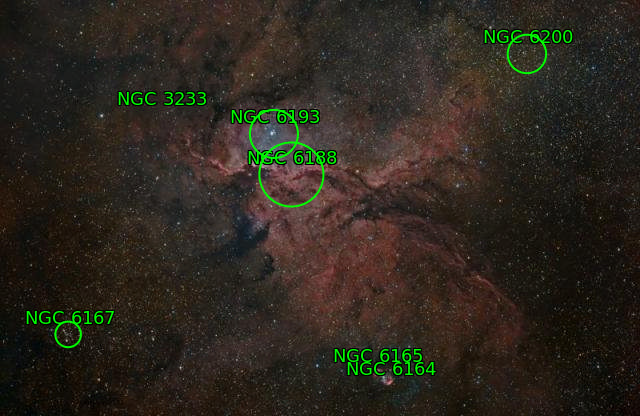
NGC 6188 and NGC 6164
Explanation: Fantastic shapes lurk in clouds of glowing gas in the giant star forming region NGC 6188. The emission nebula is found about 4,000 light years away near the edge of a large molecular cloud unseen at visible wavelengths, in the southern constellation Ara . Massive, young stars of the embedded Ara OB1 association were formed in that region only a few million years ago, sculpting the dark shapes and powering the nebular glow with stellar winds and intense ultraviolet radiation . The recent star formation itself was likely triggered by winds and supernova explosions, from previous generations of massive stars , that swept up and compressed the molecular gas. Joining NGC 6188 on this cosmic canvas, visible toward the lower right, is rare emission nebula NGC 6164 , also created by one of the region's massive O-type stars . Similar in appearance to many planetary nebulae , NGC 6164's striking, symmetric gaseous shroud and faint halo surround its bright central star near the bottom edge. The impressively wide field of view spans over 3 degrees (six full Moons), corresponding to over 200 light years at the estimated distance of NGC 6188 . Three image sets have been included in the featured composite .
| Date | March 30, 2016 |
|---|---|
| Credit | Image Credit & Copyright: Martin Pugh & Rick Stevenson |
| Authors & editors: | Robert Nemiroff (MTU) & Jerry Bonnell (UMCP) |
| A service of: |
ASD at NASA / GSFC, NASA Science Activation & Michigan Tech. U. |