


























APOD
Astronomy Picture of the Day
Discover the cosmos! Each day a different image or photograph of our fascinating universe is featured, along with a brief explanation written by a professional astronomer.
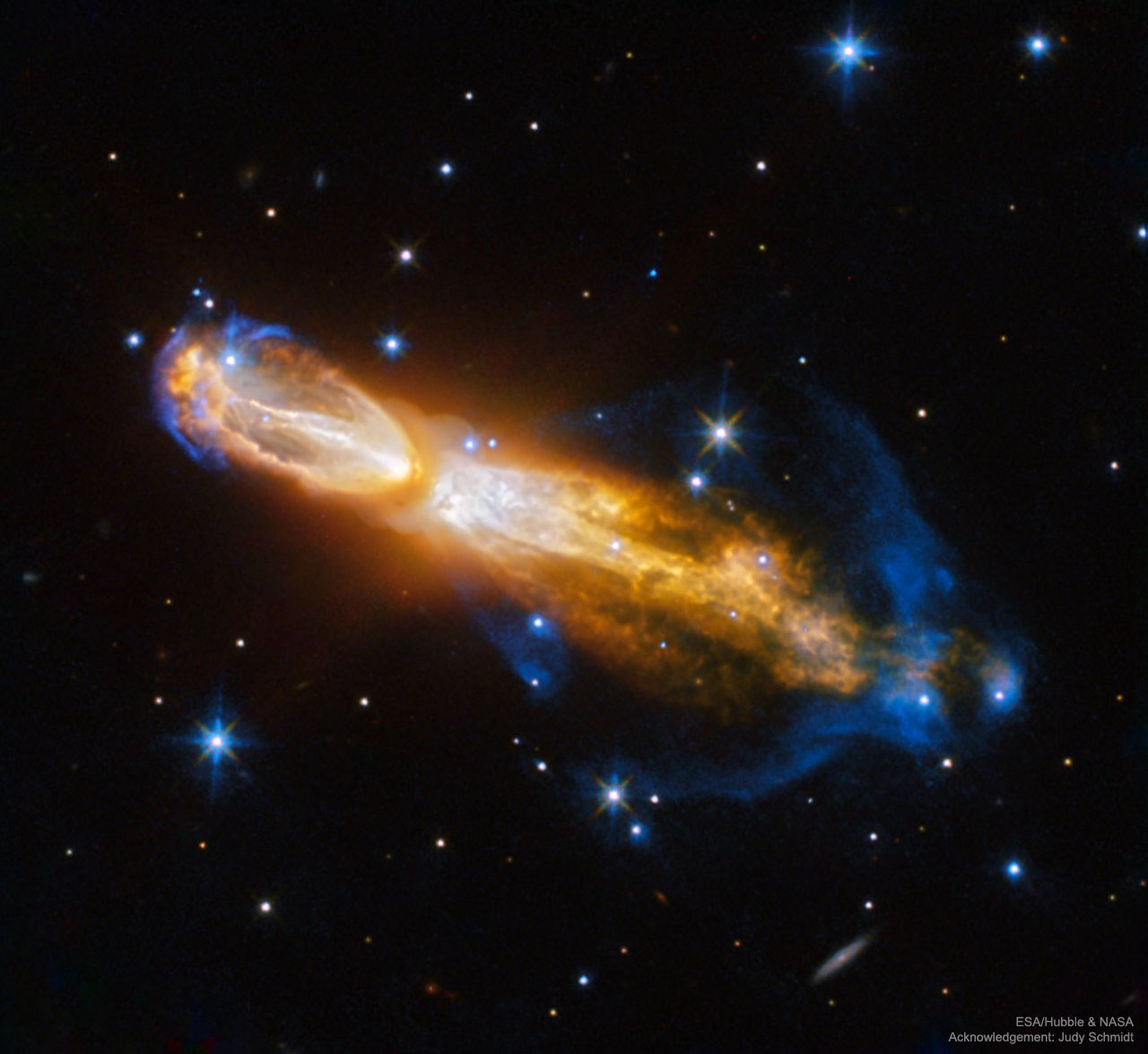
The Calabash Nebula from Hubble
Explanation: Fast expanding gas clouds mark the end for a central star in the Calabash Nebula. The once-normal star has run out of nuclear fuel , causing the central regions to contract into a white dwarf . Some of the liberated energy causes the outer envelope of the star to expand. In this case, the result is a photogenic proto- planetary nebula . As the million-kilometer per hour gas rams into the surrounding interstellar gas , a supersonic shock front forms where ionized hydrogen and nitrogen glow blue. Thick gas and dust hide the dying central star. The Calabash Nebula , also known as the Rotten Egg Nebula and OH231.8+4.2, will likely develop into a full bipolar planetary nebula over the next 1000 years. The nebula, featured here , is about 1.4 light-years in extent and located about 5000 light-years away toward the constellation of Puppis .
| Date | February 15, 2017 |
|---|---|
| Credit | Image Credit: NASA , ESA , Hubble , MAST ; Acknowledgement: Judy Schmidt |
| Authors & editors: | Robert Nemiroff (MTU) & Jerry Bonnell (UMCP) |
| A service of: |
ASD at NASA / GSFC, NASA Science Activation & Michigan Tech. U. |