























APOD
Astronomy Picture of the Day
Discover the cosmos! Each day a different image or photograph of our fascinating universe is featured, along with a brief explanation written by a professional astronomer.
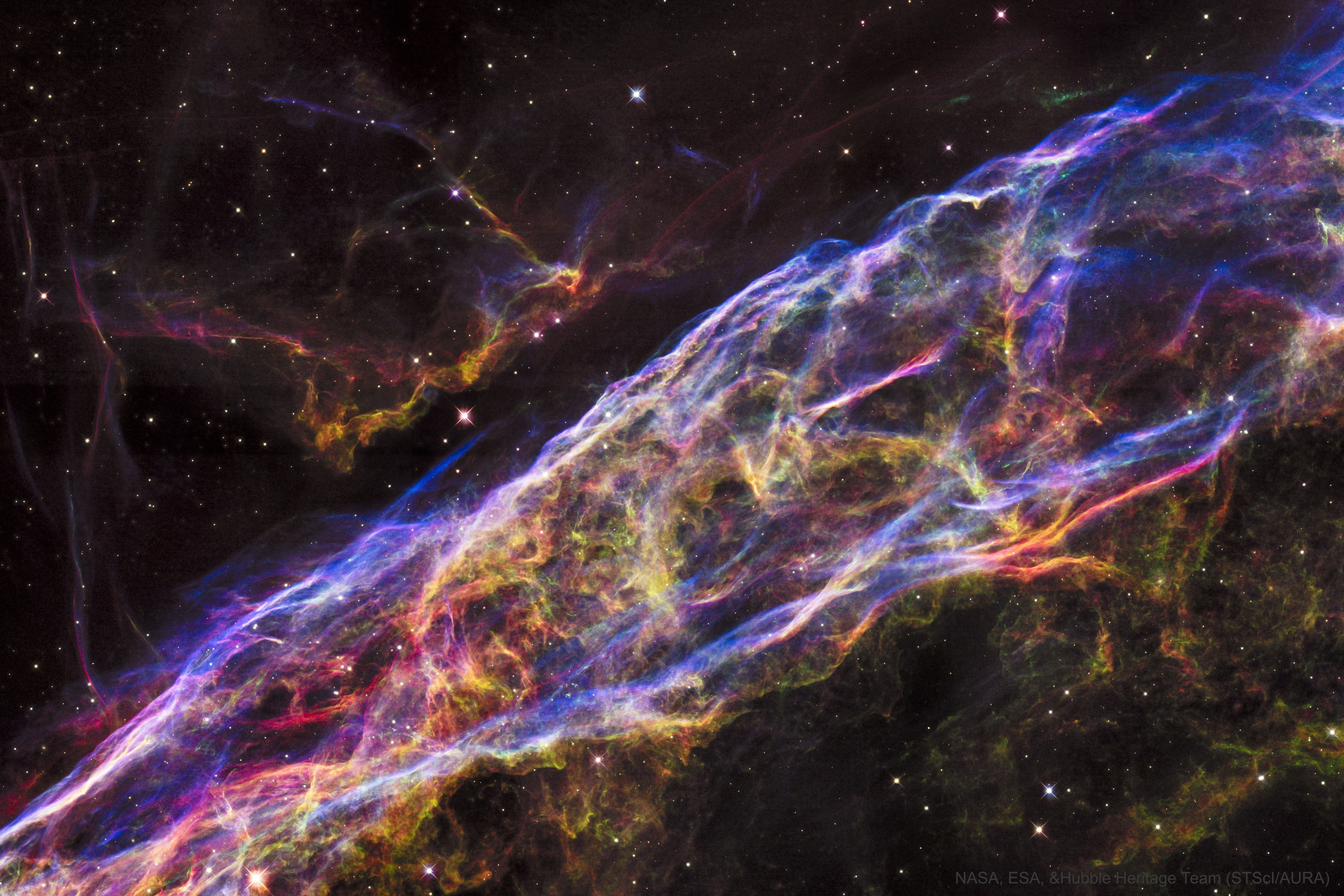
Veil Nebula: Wisps of an Exploded Star
Explanation: Wisps like this are all that remain visible of a Milky Way star. About 7,000 years ago that star exploded in a supernova leaving the Veil Nebula . At the time, the expanding cloud was likely as bright as a crescent Moon , remaining visible for weeks to people living at the dawn of recorded history . Today, the resulting supernova remnant , also known as the Cygnus Loop , has faded and is now visible only through a small telescope directed toward the constellation of the Swan ( Cygnus ). The remaining Veil Nebula is physically huge, however, and even though it lies about 1,400 light-years distant, it covers over five times the size of the full Moon . The featured picture is a Hubble Space Telescope mosaic of six images together covering a span of only about two light years, a small part of the expansive supernova remnant. In images of the complete Veil Nebula , even studious readers might not be able to identify the featured filaments .
| Date | September 19, 2017 |
|---|---|
| Credit | Image Credit: NASA , ESA , and the Hubble Heritage Team ( STScI / AURA ) |
| Authors & editors: | Robert Nemiroff (MTU) & Jerry Bonnell (UMCP) |
| A service of: |
ASD at NASA / GSFC, NASA Science Activation & Michigan Tech. U. |