

























APOD
Astronomy Picture of the Day
Discover the cosmos! Each day a different image or photograph of our fascinating universe is featured, along with a brief explanation written by a professional astronomer.
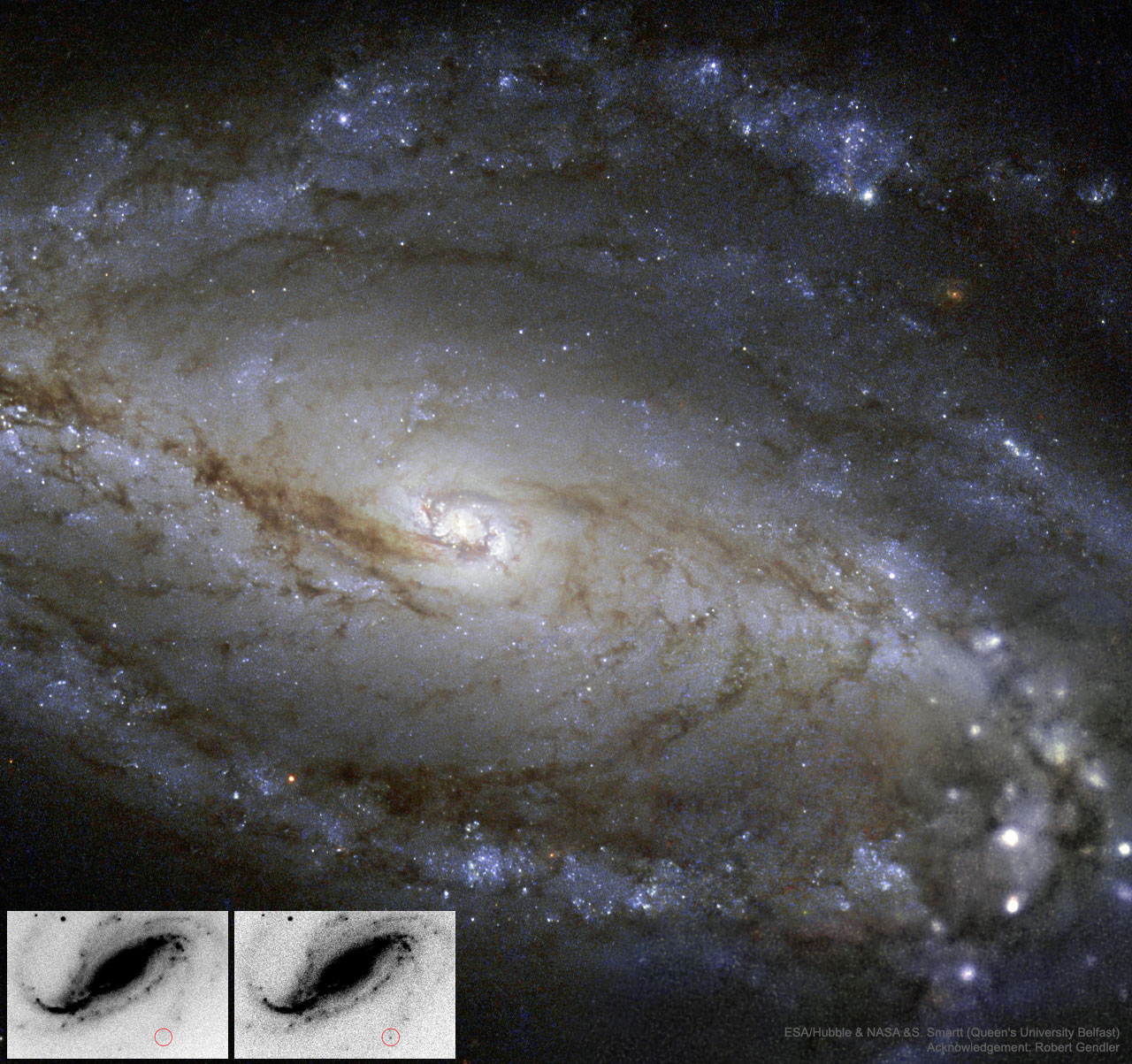
NGC 613 in Dust, Stars, and a Supernova
Explanation: Where did that spot come from? Amateur astronomer Victor Buso was testing out a new camera on his telescope in 2016 when he noticed a curious spot of light appear -- and remain. After reporting this unusual observation , this spot was determined to be light from a supernova just as it was becoming visible -- in an earlier stage than had ever been photographed optically before. The discovery before and after images, taken about an hour apart, are shown in the inset of a more detailed image of the same spiral galaxy, NGC 613 , taken by the Hubble Space Telescope . Follow-up observations show that SN 2016gkg was likely the explosion of a supergiant star , and Buso likely captured the stage where the outgoing detonation wave from the stellar core broke through the star's surface. Since astronomers have spent years monitoring galaxies for supernovas without seeing such a “break out” event , the odds of Buso capturing this have been compared to winning a lottery .
| Date | February 28, 2018 |
|---|---|
| Credit | Image Credit: NASA , ESA , Hubble , S. Smartt ( QUB ); Acknowledgement: Robert Gendler ; Insets: Victor Buso |
| Authors & editors: | Robert Nemiroff (MTU) & Jerry Bonnell (UMCP) |
| A service of: |
ASD at NASA / GSFC, NASA Science Activation & Michigan Tech. U. |