


























APOD
Astronomy Picture of the Day
Discover the cosmos! Each day a different image or photograph of our fascinating universe is featured, along with a brief explanation written by a professional astronomer.
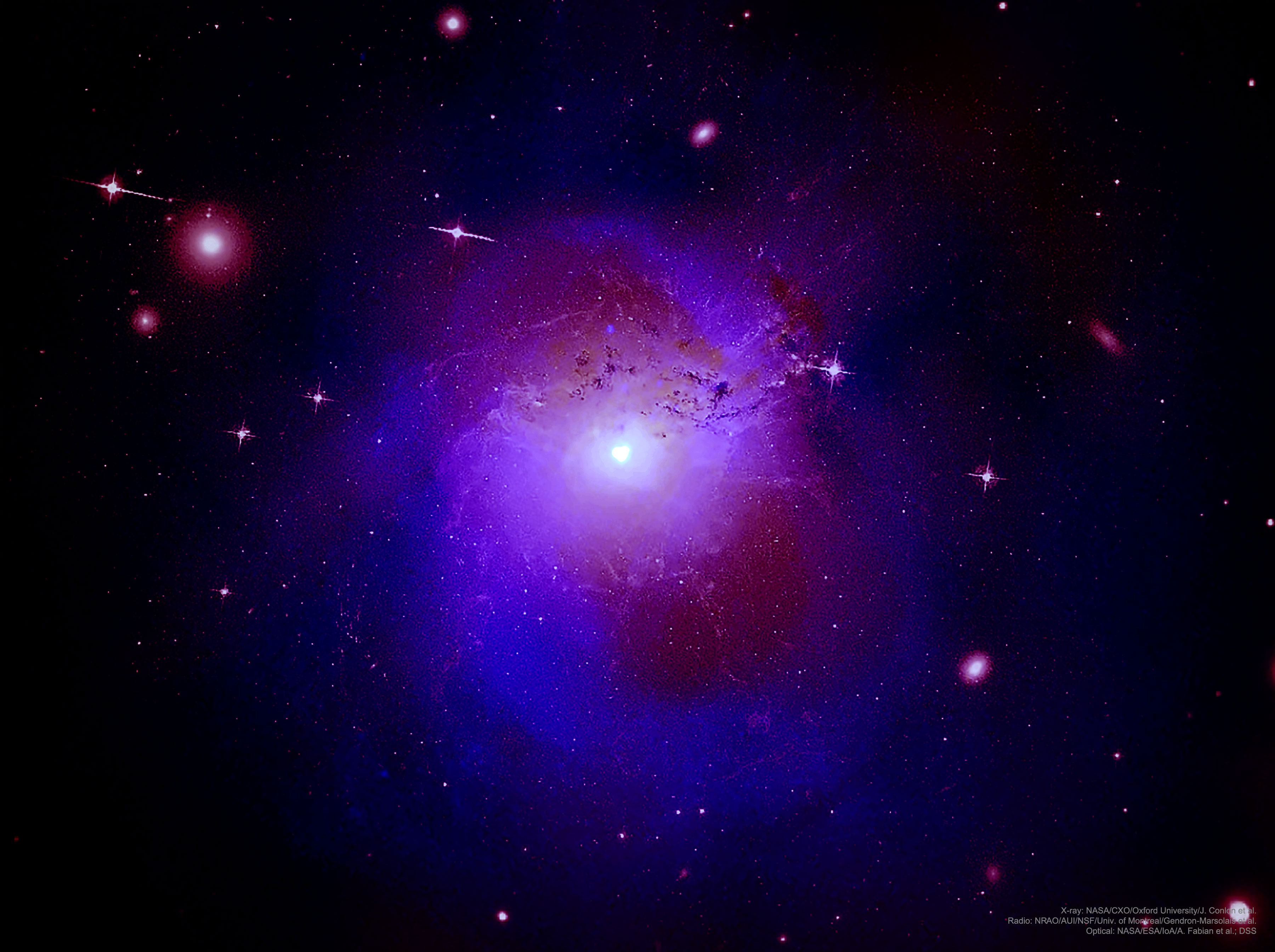
Unexpected X-Rays from Perseus Galaxy Cluster
Explanation: Why does the Perseus galaxy cluster shine so strangely in one specific color of X-rays? No one is sure, but a much-debated hypothesis holds that these X-rays are a clue to the long-sought identity of dark matter . At the center of this mystery is a 3.5 Kilo- electronvolt (KeV) X-ray color that appears to glow excessively only when regions well outside the cluster center are observed, whereas the area directly surrounding a likely central supermassive black hole is actually deficient in 3.5 keV X-rays. One proposed resolution -- quite controversial -- is that something never seen before might be present: fluorescent dark matter (FDM). This form of particle dark matter might be able to absorb 3.5 keV X-radiation. If operating, FDM , after absorption, might later emit these X-rays from all over the cluster, creating an emission line . However, when seen superposed in front of the central region surrounding the black hole , FDM's absorption would be more prominent, creating an absorption line . Pictured , a composite image of the Perseus galaxy cluster shows visible and radio light in red, and X-ray light from the Earth-orbiting Chandra Observatory in blue.
Free APOD Lectures: January 5 in NYC & January 9 in DC
| Date | January 2, 2018 |
|---|---|
| Credit | Image Credit: X-ray: NASA/CXO/Oxford University/J. Conlon et al.; Radio: NRAO/AUI/NSF/Univ. of Montreal/Gendron-Marsolais et al.; Optical: NASA/ESA/IoA/A. Fabian et al.; DSS |
| Authors & editors: | Robert Nemiroff (MTU) & Jerry Bonnell (UMCP) |
| A service of: |
ASD at NASA / GSFC, NASA Science Activation & Michigan Tech. U. |