




























APOD
Astronomy Picture of the Day
Discover the cosmos! Each day a different image or photograph of our fascinating universe is featured, along with a brief explanation written by a professional astronomer.
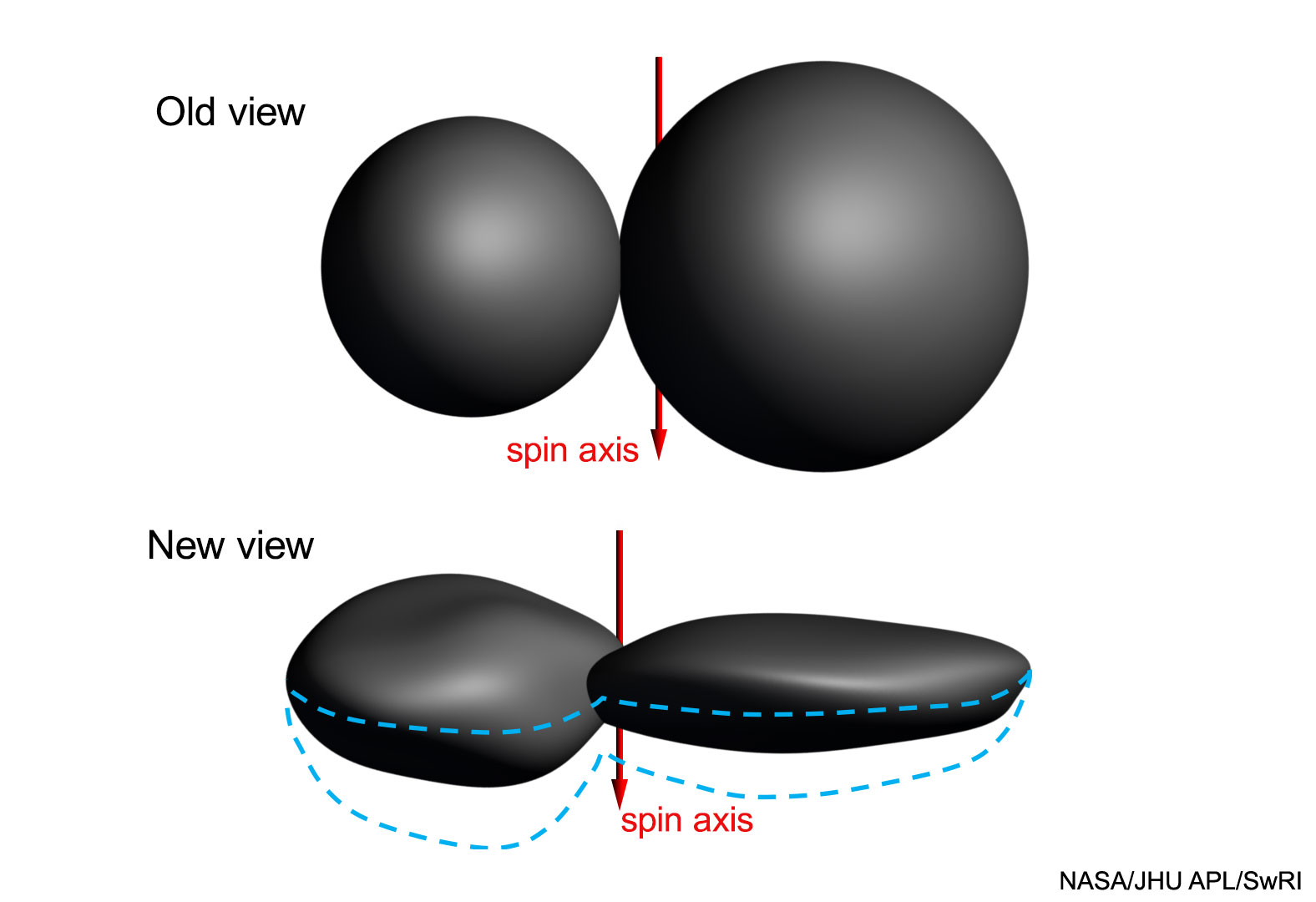
New Data: Ultima Thule Surprisingly Flat
Explanation: Ultima Thule is not the object humanity thought that it was last month. When the robotic New Horizons spacecraft zoomed past the distant asteroid Ultima Thule (officially 2014 MU69 ) in early January, early images showed two circular lobes that when most simply extrapolated to 3D were thought to be, roughly, spheres. However, analyses of newly beamed-back images -- including many taken soon after closest approach -- shows eclipsed stars re-appearing sooner than expected . The only explanation possible is that this 30-km long Kuiper belt object has a different 3D shape than believed only a few weeks ago. Specifically, as shown in the featured illustration , it now appears that the larger lobe -- Ultima -- is more similar to a fluffy pancake than a sphere, while the smaller lobe -- Thule -- resembles a dented walnut . The remaining uncertainty in the outlines are shown by the dashed blue lines. The new shape information indicates that gravity -- which contracts more massive bodies into spheres -- played perhaps less of a role in contouring the lobes of Ultima Thule than previously thought. The New Horizons spacecraft continued on to Ultima Thule after passing Pluto in mid-2015. New data and images are still being received.
| Date | February 11, 2019 |
|---|---|
| Credit | Illustration Credit: NASA , JHU's APL , SwRI |
| Authors & editors: | Robert Nemiroff (MTU) & Jerry Bonnell (UMCP) |
| A service of: |
ASD at NASA / GSFC, NASA Science Activation & Michigan Tech. U. |