





















APOD
Astronomy Picture of the Day
Discover the cosmos! Each day a different image or photograph of our fascinating universe is featured, along with a brief explanation written by a professional astronomer.
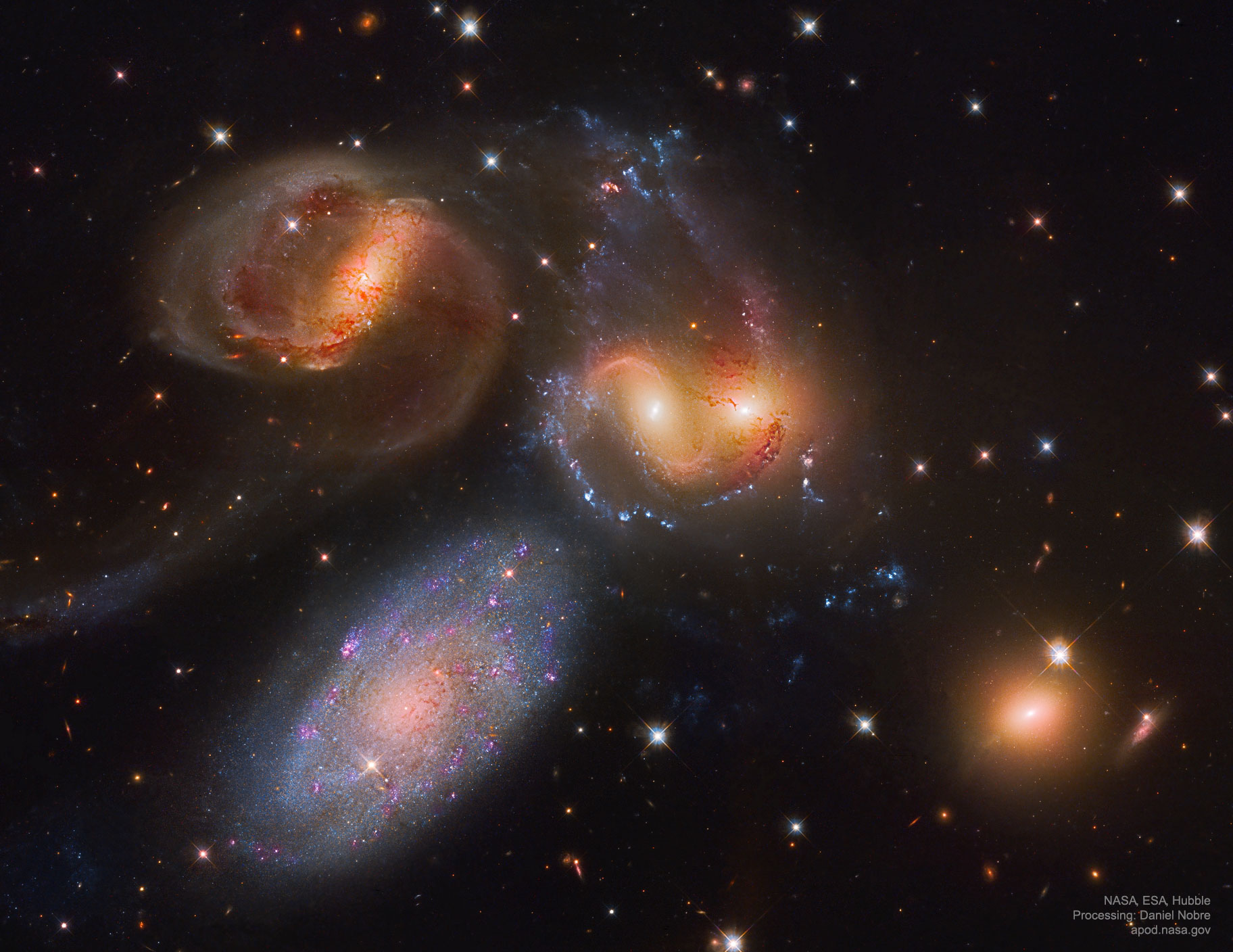
Stephan's Quintet from Hubble
Explanation: When did these big galaxies first begin to dance? Really only four of the five of Stephan's Quintet are locked in a cosmic tango of repeated close encounters taking place some 300 million light-years away. The odd galaxy out is easy to spot in this recently reprocessed image by the Hubble Space Telescope -- the interacting galaxies , NGC 7319, 7318B, 7318A, and 7317 (left to right), have a more dominant yellowish cast. They also tend to have distorted loops and tails , grown under the influence of disruptive gravitational tides . The mostly bluish galaxy, large NGC 7320 on the lower left, is in the foreground at about 40 million light-years distant, and so is not part of the interacting group . Data and modeling indicate that NGC 7318B is a relatively new intruder. A recently-discovered halo of old red stars surrounding Stephan's Quintet indicate that at least some of these galaxies started tangling over a billion years. Stephan's Quintet is visible with a moderate sized-telescope toward the constellation of Winged Horse ( Pegasus ).
| Date | June 3, 2019 |
|---|---|
| Credit | Image Credit: NASA , ESA , Hubble ; Processing: Daniel Nobre |
| Authors & editors: | Robert Nemiroff (MTU) & Jerry Bonnell (UMCP) |
| A service of: |
ASD at NASA / GSFC, NASA Science Activation & Michigan Tech. U. |