

























APOD
Astronomy Picture of the Day
Discover the cosmos! Each day a different image or photograph of our fascinating universe is featured, along with a brief explanation written by a professional astronomer.
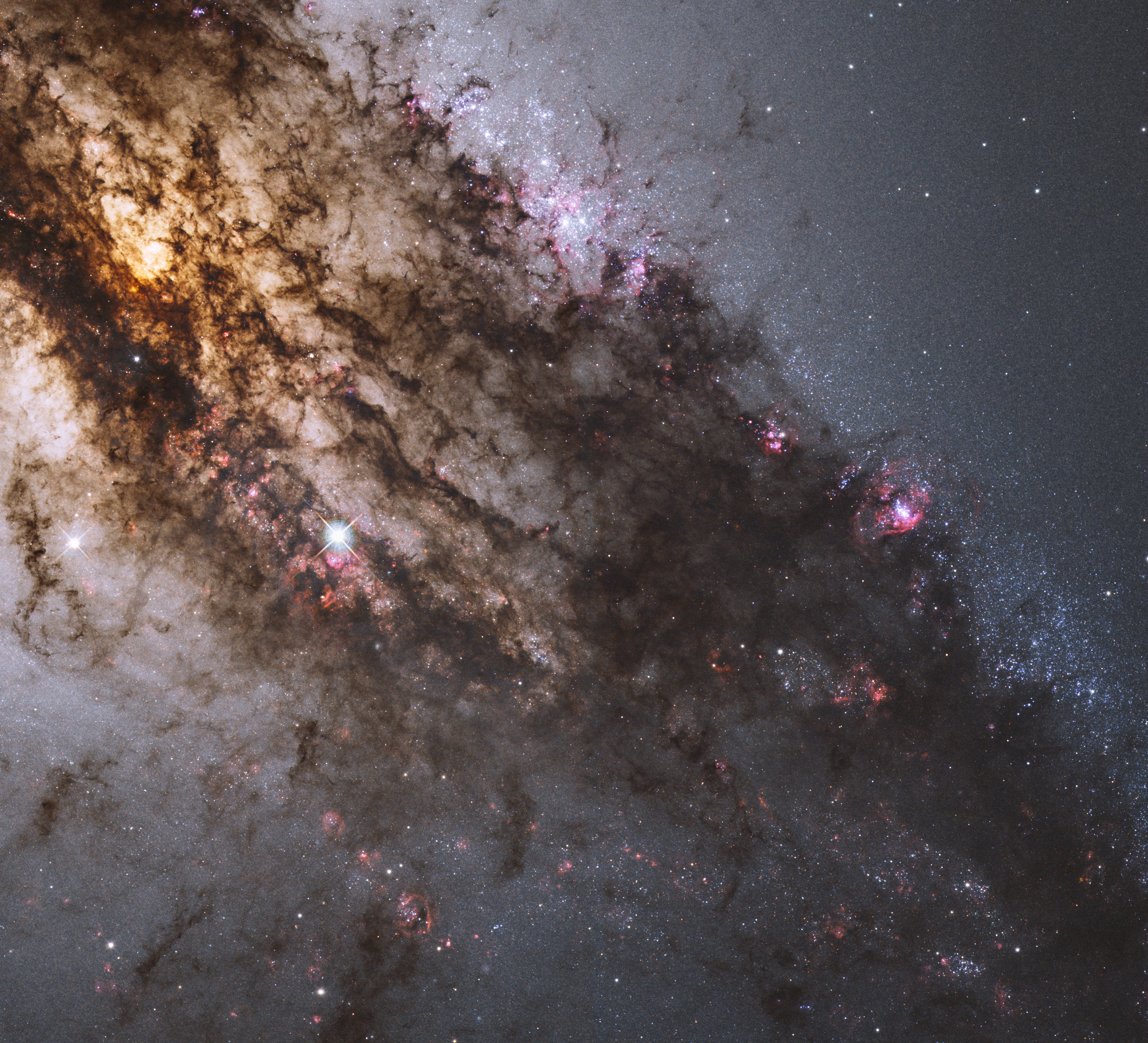
Central Centaurus A
Explanation: A mere 11 million light-years away, Centaurus A is the closest active galaxy to planet Earth. Also known as NGC 5128 , the peculiar elliptical galaxy is over 60,000 light-years across. A region spanning about 8,500 light-years, including the galaxy's center (upper left), is framed in this sharp Hubble Space telescope close-up . Centaurus A is apparently the result of a collision of two otherwise normal galaxies resulting in a violent jumble of star forming regions, massive star clusters, and imposing dark dust lanes. Near the galaxy's center , left over cosmic debris is steadily being consumed by a central black hole with about 60 million times the mass of the Sun. As in other active galaxies, that process likely generates the radio, X-ray, and gamma-ray energy radiated by Centaurus A .
| Date | February 22, 2020 |
|---|---|
| Credit | Image Credit: NASA , ESA , Hubble Heritage ( STScI / AURA )-ESA/Hubble Collaboration |
| Authors & editors: | Robert Nemiroff (MTU) & Jerry Bonnell (UMCP) |
| A service of: |
ASD at NASA / GSFC, NASA Science Activation & Michigan Tech. U. |