





















APOD
Astronomy Picture of the Day
Discover the cosmos! Each day a different image or photograph of our fascinating universe is featured, along with a brief explanation written by a professional astronomer.
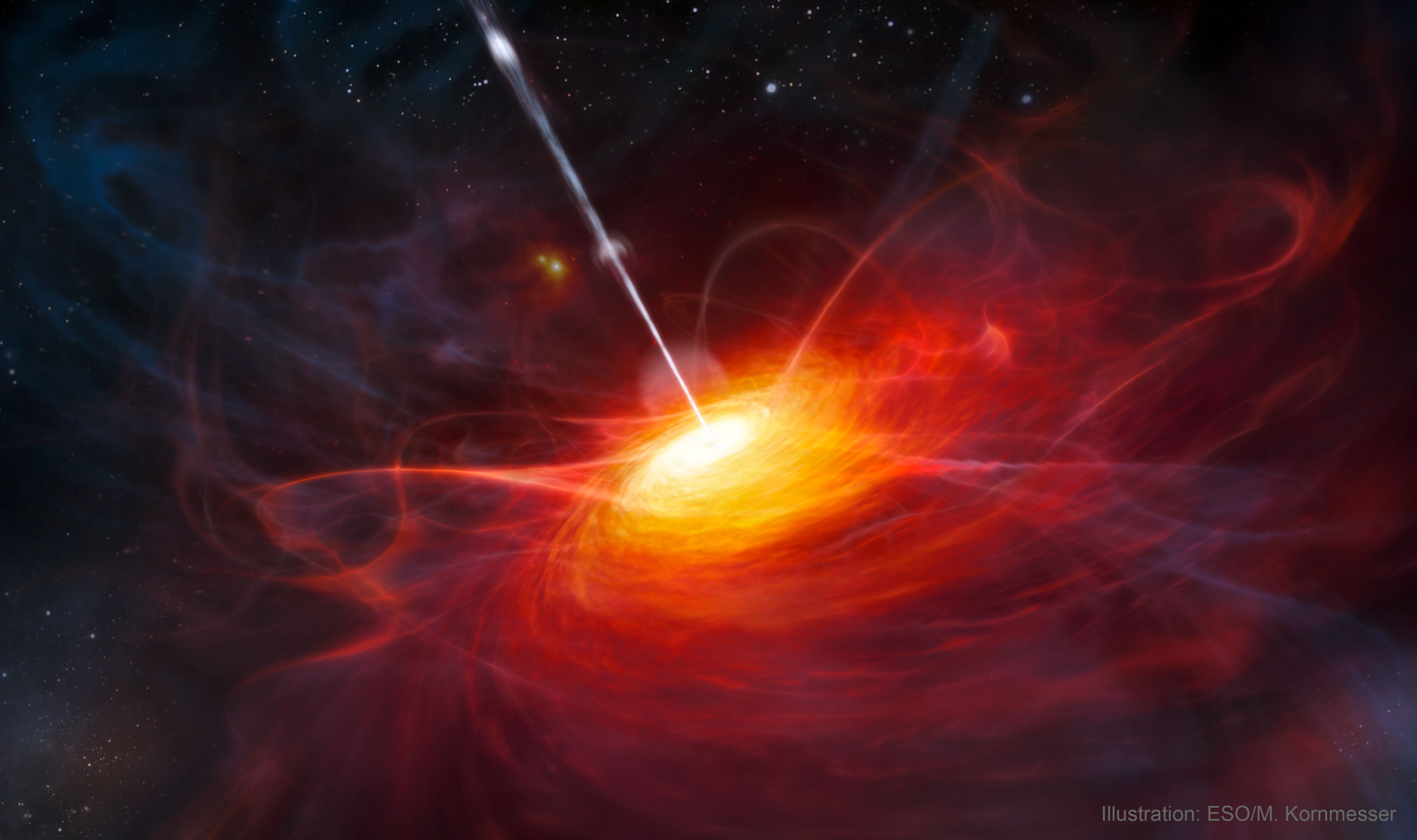
Illustration: An Early Quasar
Explanation: What did the first quasars look like? The nearest quasar s are now known to involve supermassive black hole s in the centers of active galaxies . Gas and dust that falls toward a quasar glows brightly, sometimes outglowing the entire home galaxy. The quasars that formed in the first billion years of the universe are more mysterious, though. Featured , recent data has enabled an artist's impression of an early-universe quasar as it might have been: centered on a massive black hole, surrounded by sheets of gas and an accretion disk , and expelling a powerful jet . Quasars are among the most distant objects we see and give humanity unique information about the early and intervening universe . The oldest quasars currently known are seen at just short of redshift 8 -- only 700 million years after the Big Bang -- when the universe was only a few percent of its current age.
| Date | February 22, 2022 |
|---|---|
| Credit | Illustration Credit & License: ESO , M. Kornmesser |
| Authors & editors: | Robert Nemiroff (MTU) & Jerry Bonnell (UMCP) |
| A service of: |
ASD at NASA / GSFC, NASA Science Activation & Michigan Tech. U. |