






















APOD
Astronomy Picture of the Day
Discover the cosmos! Each day a different image or photograph of our fascinating universe is featured, along with a brief explanation written by a professional astronomer.
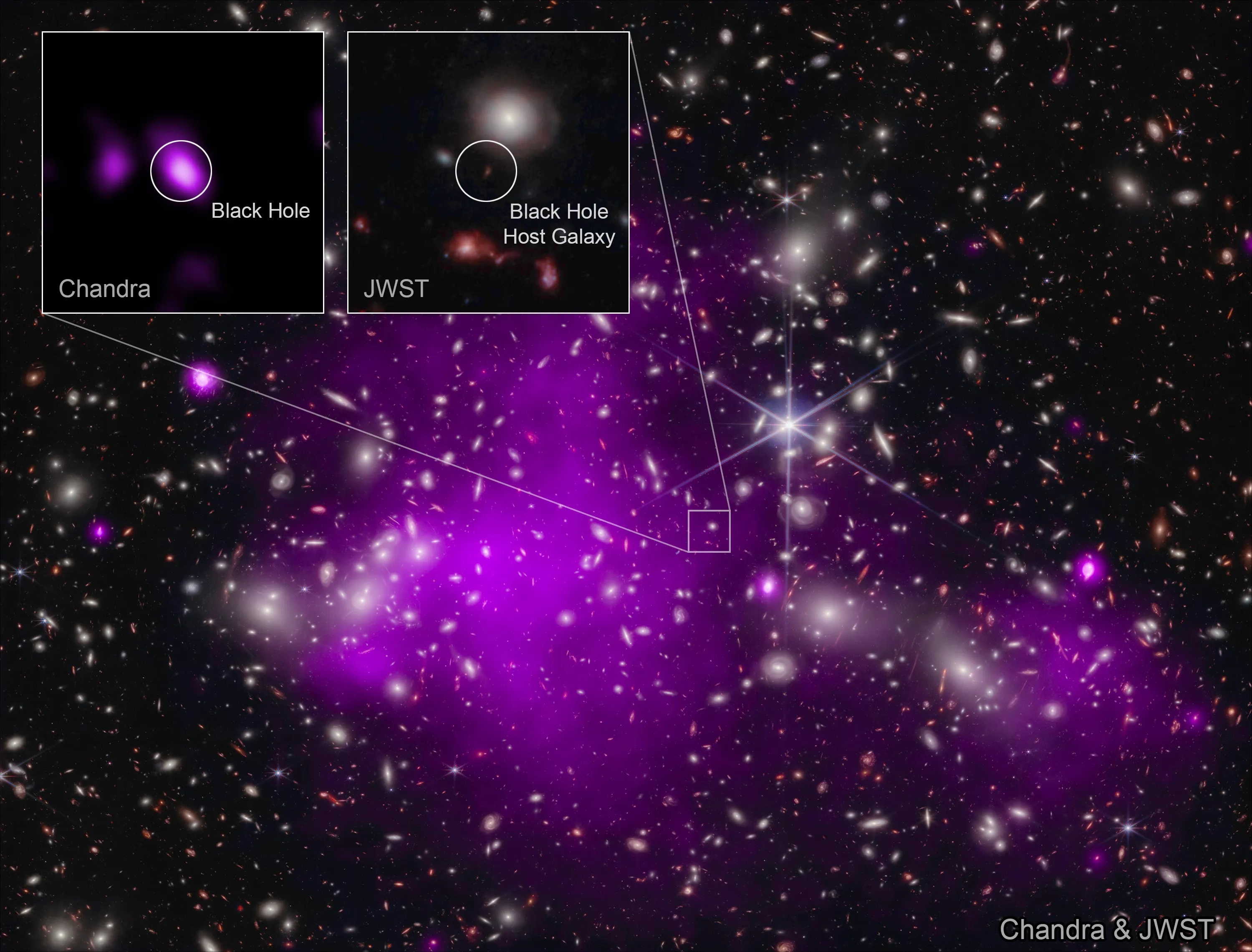
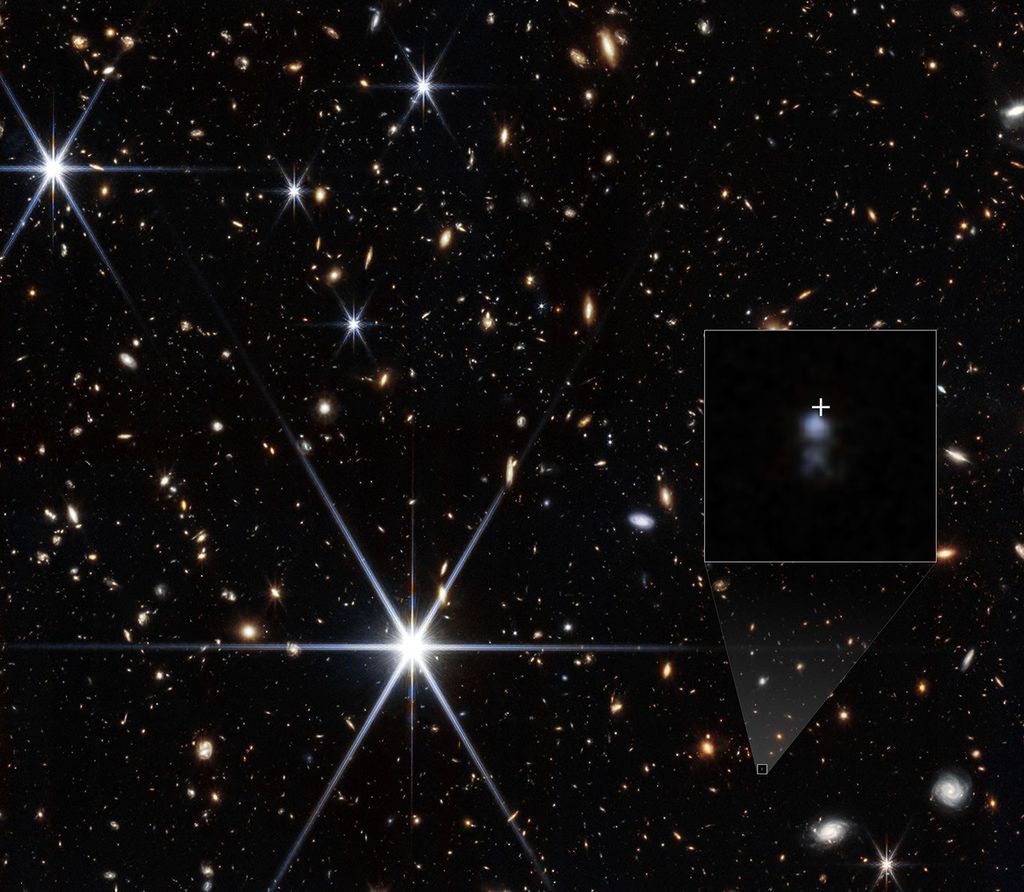
UHZ1: Distant Galaxy and Black Hole
Explanation: Dominated by dark matter , massive cluster of galaxies Abell 2744 is known to some as Pandora's Cluster . It lies 3.5 billion light-years away toward the constellation Sculptor. Using the galaxy cluster's enormous mass as a gravitational lens to warp spacetime and magnify even more distant objects directly behind it, astronomers have found a background galaxy, UHZ1, at a remarkable redshift of Z=10.1 . That puts UHZ1 far beyond Abell 2744, at a distance of 13.2 billion light-years, seen when our universe was about 3 percent of its current age. UHZ1 is identified in the insets of this composited image combining X-rays (purple hues) from the spacebased Chandra X-ray Observatory and infrared light from the James Webb Space Telescope. The X-ray emission from UHZ1 detected in the Chandra data is the telltale signature of a growing supermassive black hole at the center of the ultra high redshift galaxy. That makes UHZ1's growing black hole the most distant black hole ever detected in X-rays, a result that now hints at how and when the first supermassive black holes in the universe formed .
| Date | November 10, 2023 |
|---|---|
| Credit |
Image Credit: X-ray: NASA/CXC/SAO/Ákos Bogdán; Infrared: NASA/ESA/CSA/STScI; Image Processing: NASA/CXC/SAO/L. Frattare & K. Arcand |
| Authors & editors: | Robert Nemiroff (MTU) & Jerry Bonnell (UMCP) |
| A service of: |
ASD at NASA / GSFC, NASA Science Activation & Michigan Tech. U. |