






























APOD
Astronomy Picture of the Day
Discover the cosmos! Each day a different image or photograph of our fascinating universe is featured, along with a brief explanation written by a professional astronomer.
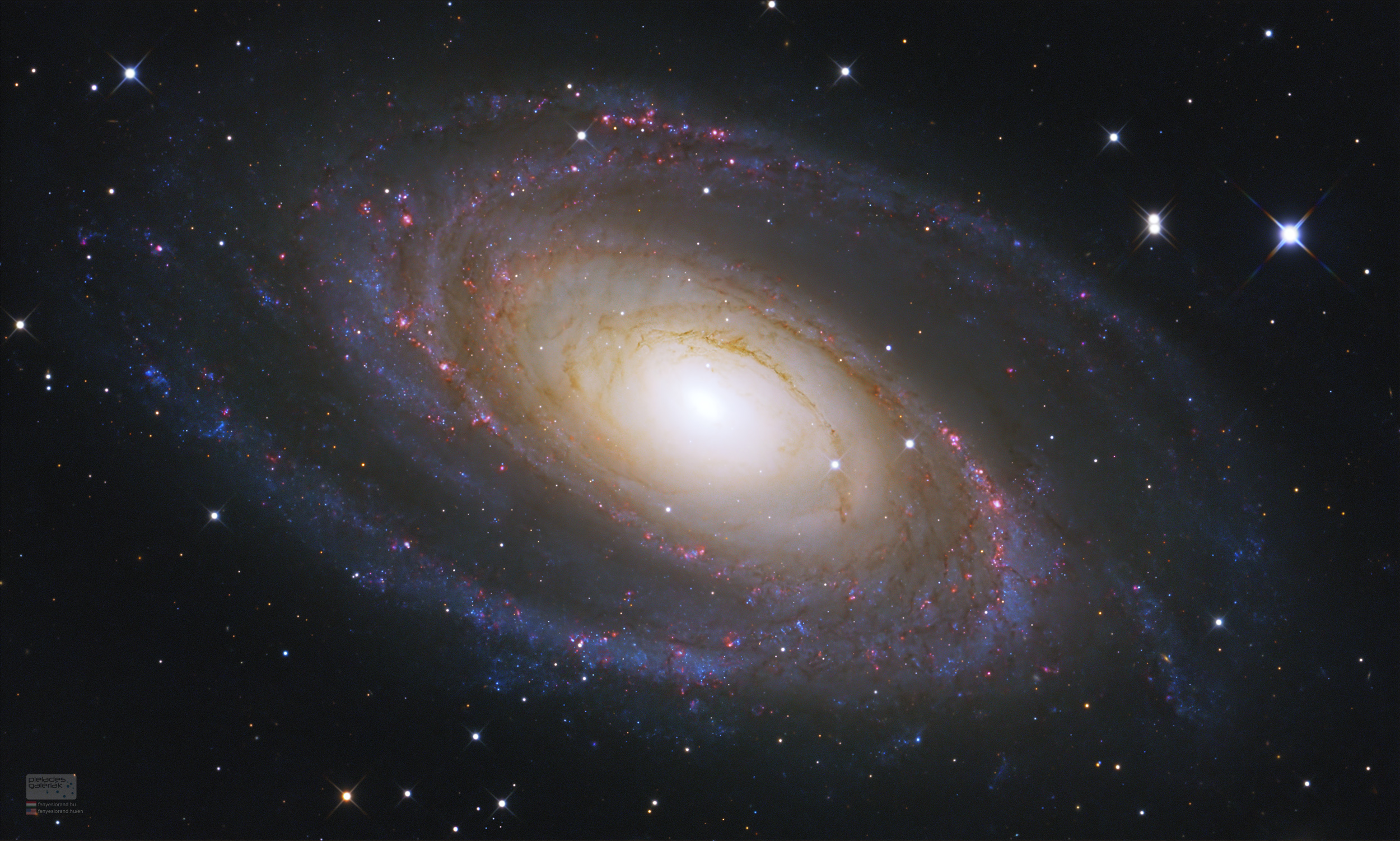
Messier 81
Explanation: One of the brightest galaxies in planet Earth's sky is similar in size to our Milky Way Galaxy: big, beautiful Messier 81 . Also known as NGC 3031 or Bode's galaxy for its 18th century discoverer, this grand spiral can be found toward the northern constellation of Ursa Major, the Great Bear. The sharp, detailed telescopic view reveals M81's bright yellow nucleus, blue spiral arms, pinkish starforming regions, and sweeping cosmic dust lanes . But some dust lanes actually cut across the galactic disk (left of center), contrary to other prominent spiral features. The errant dust lanes may be the lingering result of a close encounter between M81 and the nearby galaxy M82 lurking outside of this frame. Scrutiny of variable stars in M81 has yielded a well-determined distance for an external galaxy -- 11.8 million light-years.
| Date | March 27, 2025 |
|---|---|
| Credit | Image Credit & Copyright: Lorand Fenyes |
| Authors & editors: | Robert Nemiroff (MTU) & Jerry Bonnell (UMCP) |
| A service of: |
ASD at NASA / GSFC, NASA Science Activation & Michigan Tech. U. |