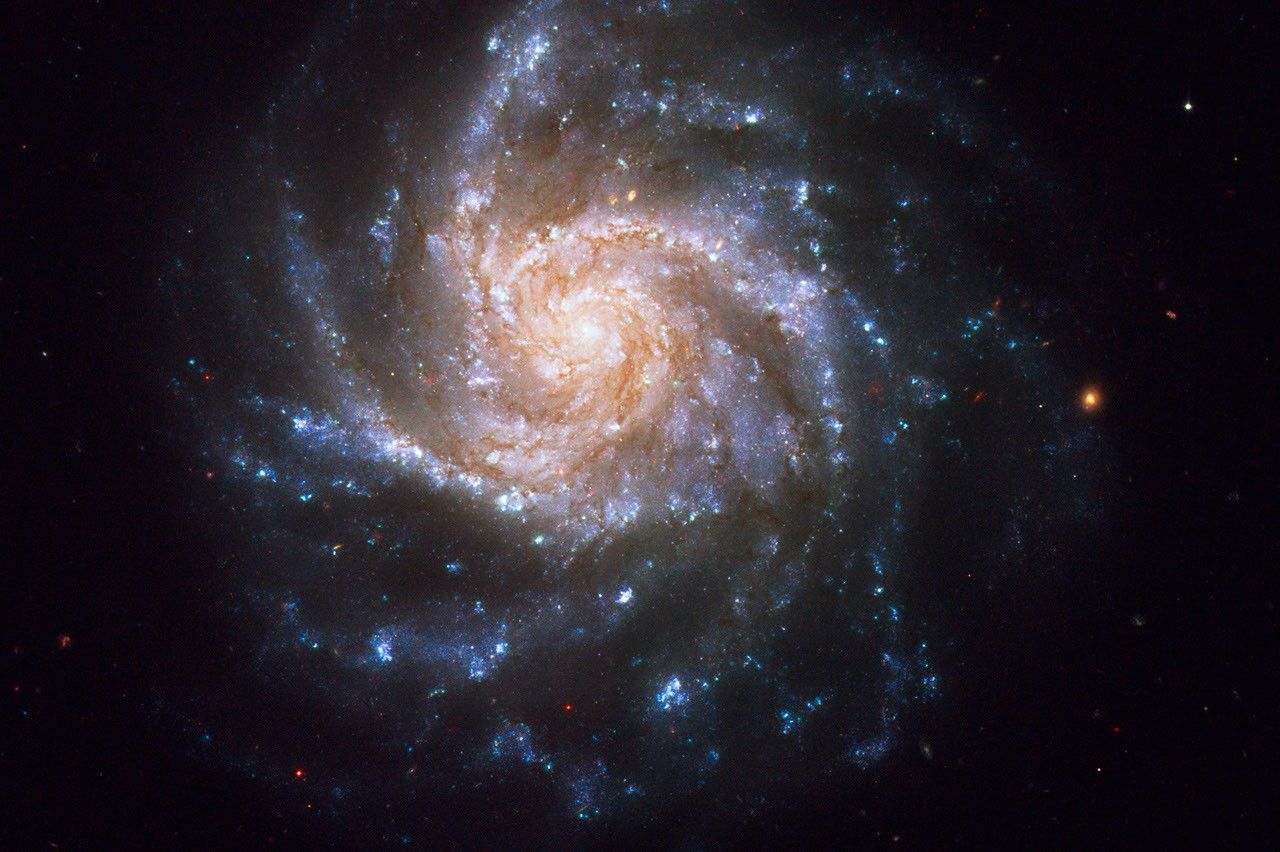






















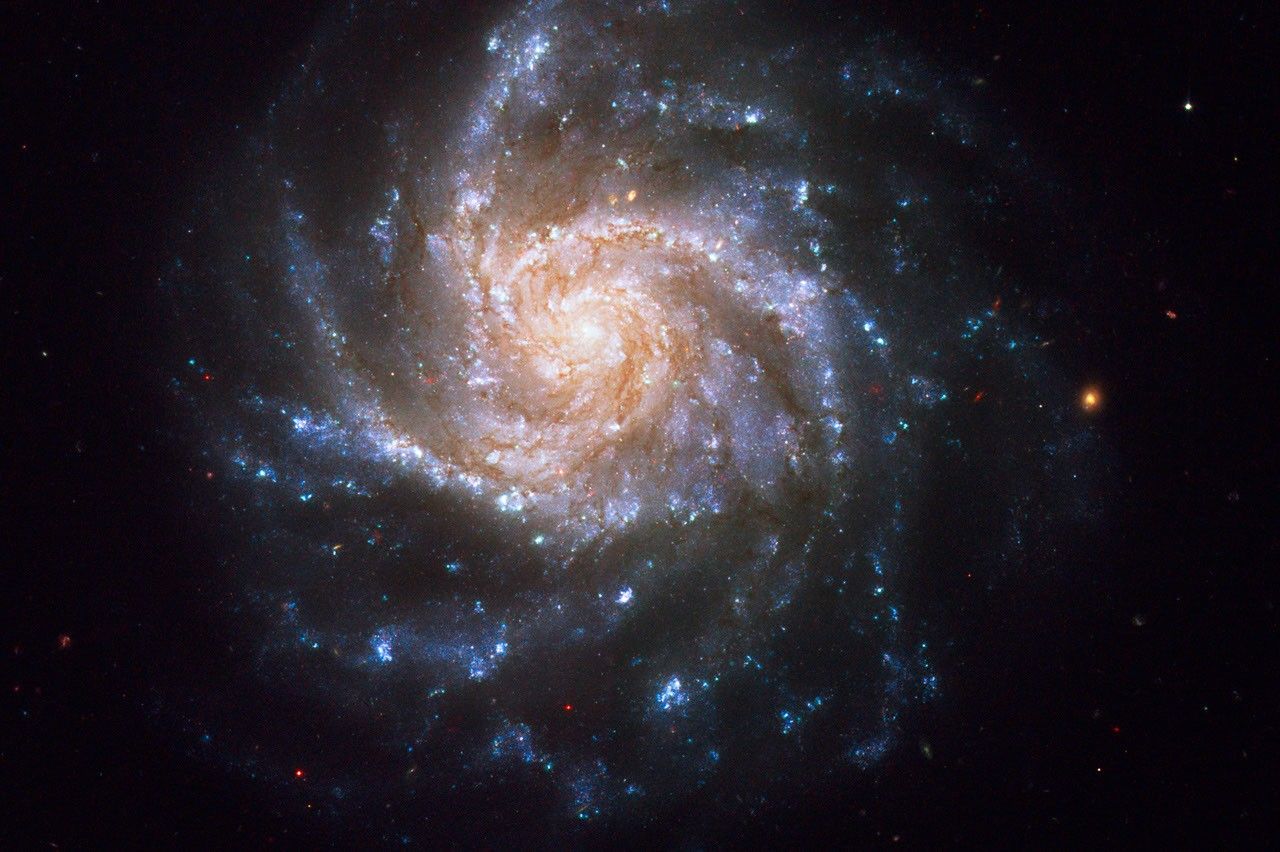
Spiral galaxy NGC 1376
The beautiful face-on spiral galaxy, NGC 1376, lies over 180 million light-years from Earth in the direction of the southern constellation Eridanus, the River. Concentrated along its spiral arms are bright, blue knots of glowing gas that mark areas of active star formation. These regions show an excess of light at ultraviolet (UV) wavelengths because they contain brilliant clusters of hot, newborn stars that preferentially emit UV light. The less intense, red areas near the core and between the arms consist mainly of older stars. The reddish dust lanes delineate cooler, denser regions where interstellar clouds may collapse to form new stars. This image of NGC 1376 is the result of a long-running science-operations program to conduct, wherever possible, parallel observations with the telescope’s instruments. In this case, a researcher using the Near Infrared Camera and Multi-Object Spectrometer (NICMOS) instrument, pointed the observatory toward a spot on the sky where NGC 1376 moved into the field of view of the Advanced Camera for Surveys, enabling this exposure. Utilizing this technique helps to keep the Hubble observatory as productive as possible.
Image Credit: NASA, ESA, and the Hubble Heritage Team (STScI/AURA); Acknowledgment: R. Thompson (University of Arizona)
- X
https://science.nasa.gov/image-detail/amf-542e6354-cfae-494e-8fd0-c52d02f44c27/
Image CreditNASA, ESA, and the Hubble Heritage Team (STScI/AURA); Acknowledgment: R. Thompson (University of Arizona)
Size1280x852px