


















Galaxy in a Cosmic Dance
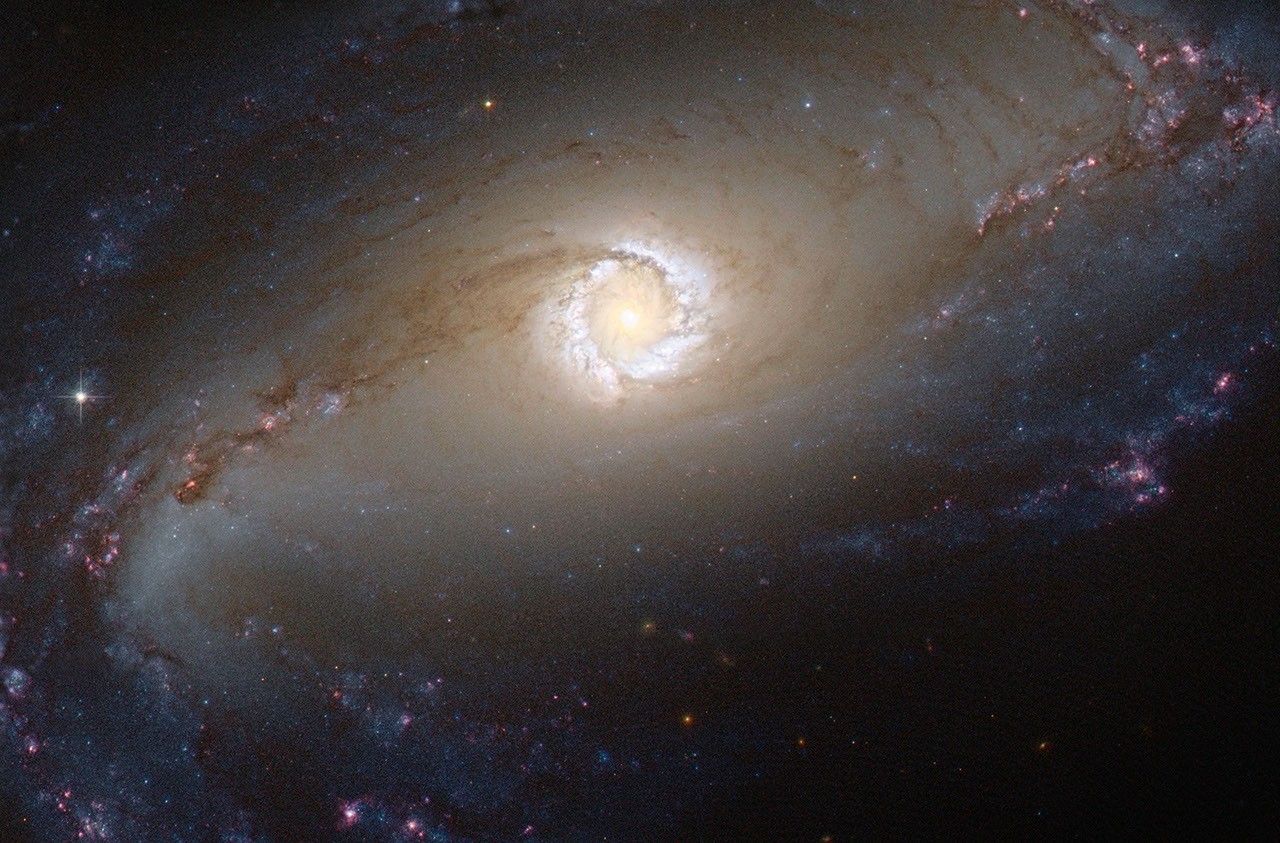
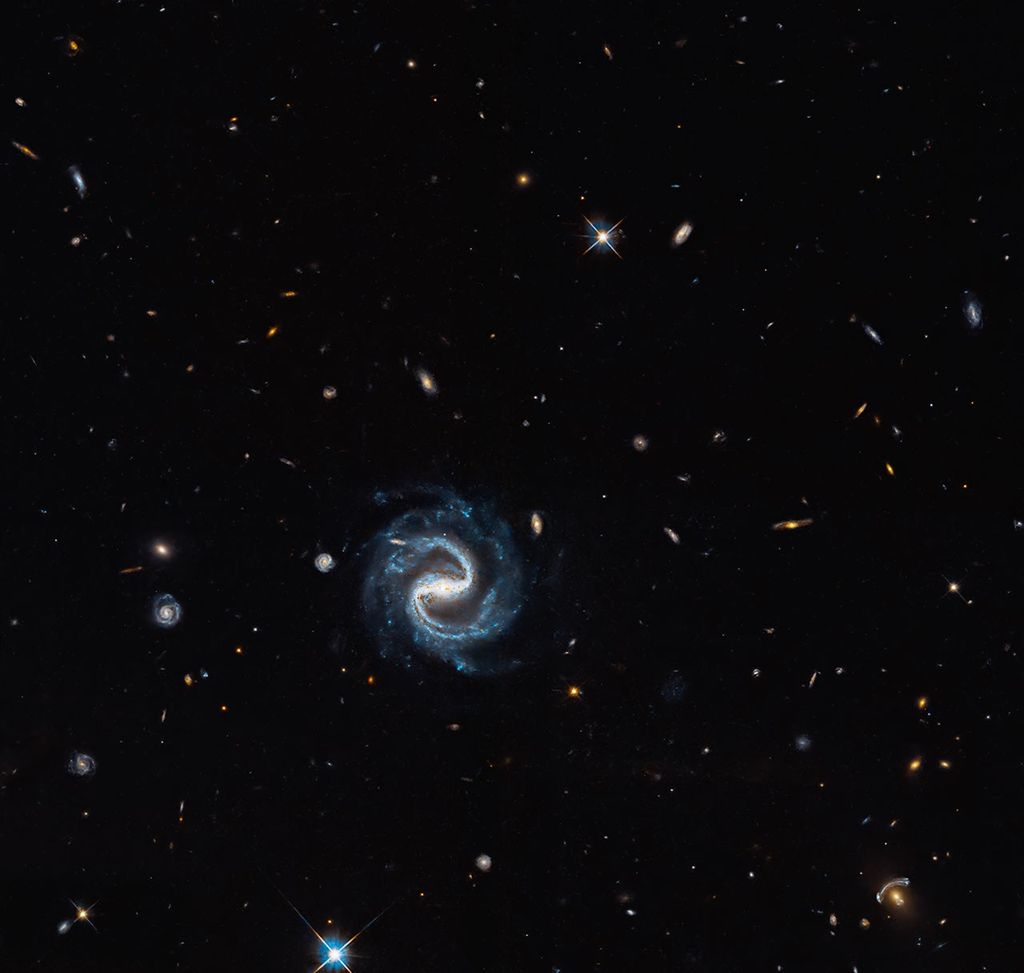
Hubble captured this spectacular image of the bright star-forming ring that surrounds the heart of the barred spiral galaxy NGC 1097. In this image, the larger-scale structure of the galaxy is barely visible: its comparatively dim spiral arms, which surround its heart in a loose embrace, reach out beyond the edges of this frame. This face-on galaxy, lying 45 million light-years away from Earth in the southern constellation of Fornax (The Furnace), is particularly attractive for astronomers. NGC 1097 is a Seyfert galaxy. Lurking at the very center of the galaxy, a supermassive black hole 100 million times the mass of our Sun is gradually consuming the matter around it. The area immediately around the black hole shines powerfully with radiation coming from the material falling in. The distinctive ring around the black hole is bursting with new star formation due to an inflow of material toward the central bar of the galaxy. These star-forming regions are glowing brightly thanks to emission from clouds of ionized hydrogen. The ring is around 5000 light-years across, although the spiral arms of the galaxy extend tens of thousands of light-years beyond it. NGC 1097 is not wandering alone through space. It has two small galaxy companions, which dance "the dance of stars and the dance of space" like the gracious dancer of the famous poem The Dancer by Khalil Gibran. The satellite galaxies are NGC 1097A, an elliptical galaxy orbiting 42,000 light-years from the center of NGC 1097 and a small dwarf galaxy named NGC 1097B. Both galaxies are located out beyond the frames of this image.
Image Credit: ESA/Hubble & NASA; Acknowledgement: E. Sturdivant
- X
https://science.nasa.gov/image-detail/amf-f1e64b9b-75cd-4d98-b8dd-4fd9bcd19aeb/
Image CreditESA/Hubble & NASA; Acknowledgement: E. Sturdivant
Size4090x2694px