















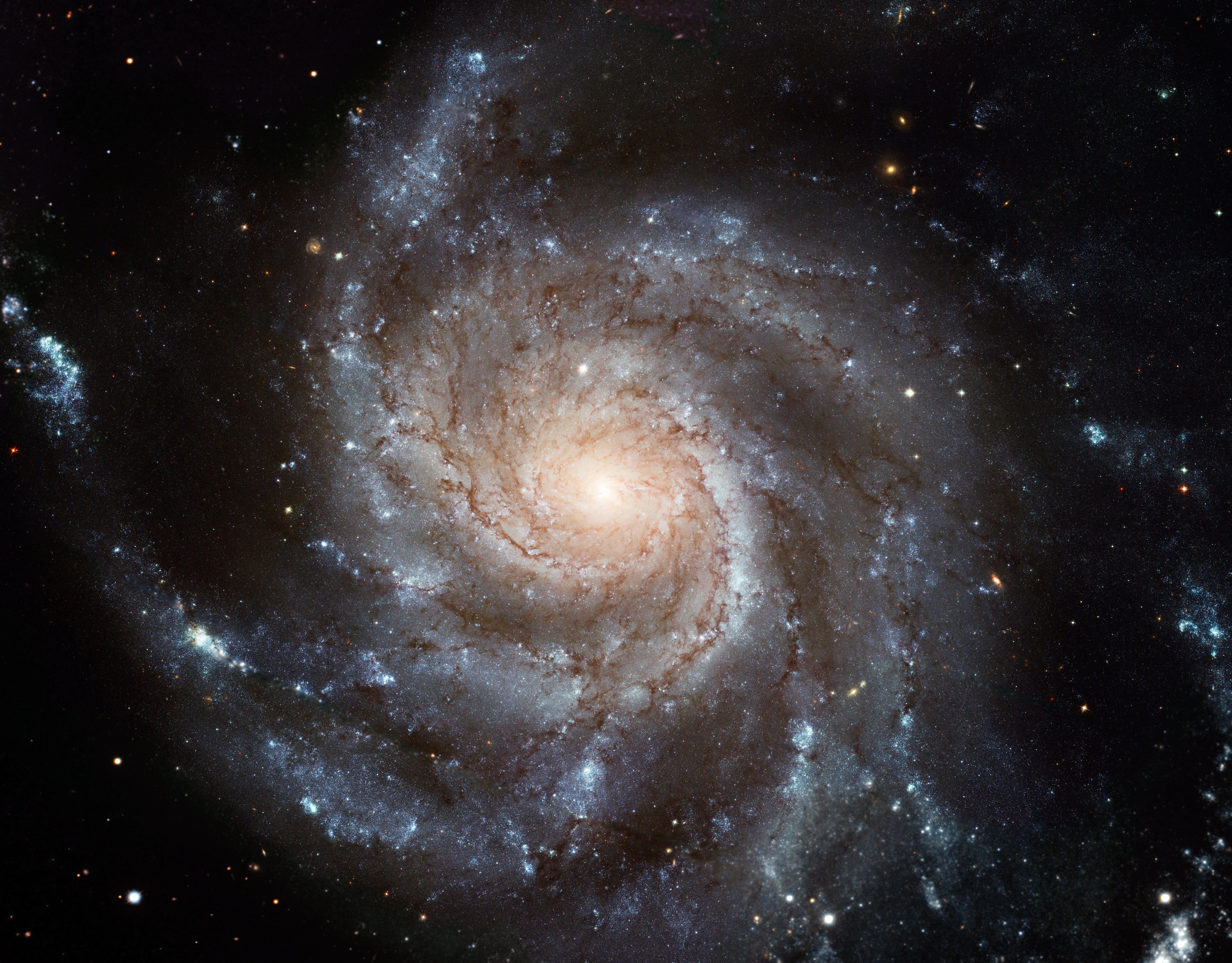
Face-on Spiral Galaxy Messier 101 (M101)
This giant spiral disk of stars, dust, and gas is 170,000 light-years across or nearly twice the diameter of our galaxy, the Milky Way. The Pinwheel Galaxy, or Messier 101 (M101), is estimated to contain at least one trillion stars. Approximately 100 billion of these stars could be like our Sun in terms of temperature and lifetime. The galaxy's spiral arms are sprinkled with large regions of star-forming nebulas. These are areas of intense star formation within giant molecular hydrogen clouds. Brilliant young clusters of hot, blue stars trace out the spiral arms. The disk of M101 is so thin that Hubble easily sees many more distant galaxies lying behind the galaxy. The galaxy's portrait is actually composed of 51 individual Hubble exposures, in addition to elements from images from ground-based photos.
Image Credit: Hubble Image: NASA, ESA, K. Kuntz (JHU), F. Bresolin (University of Hawaii), J. Trauger (Jet Propulsion Lab), J. Mould (NOAO), Y.-H. Chu (University of Illinois, Urbana) and STScI; CFHT Image: Canada-France-Hawaii Telescope/J.-C. Cuillandre/Coelum; NOAO Image: G. Jacoby, B. Bohannan, M. Hanna/NOAO/AURA/NSF
- X
https://science.nasa.gov/image-detail/m101/
Image CreditHubble Image: NASA, ESA, K. Kuntz (JHU), F. Bresolin (University of Hawaii), J. Trauger (Jet Propulsion Lab), J. Mould (NOAO), Y.-H. Chu (University of Illinois, Urbana) and STScI; CFHT Image: Canada-France-Hawaii Telescope/J.-C. Cuillandre/Coelum; NOAO Image: G. Jacoby, B. Bohannan, M. Hanna/NOAO/AURA/NSF
Size6000x4690px