










Mission Timeline
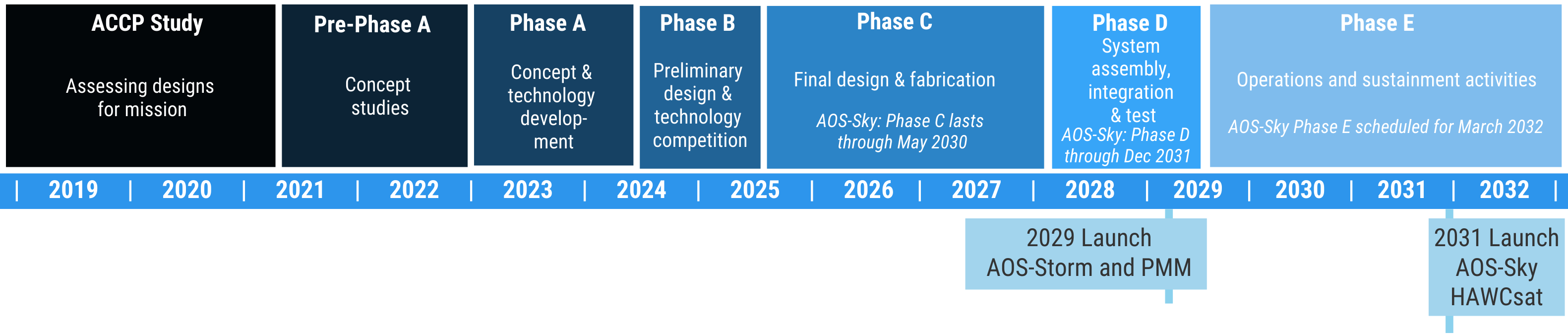
A high-level overview of the AOS mission timeline is presented here. The AOS mission was preceded by the Aerosols, Cloud, Convection and Precipitation (ACCP) Study. The nominal phases shown apply to AOS satellites in an inclined orbit (AOS-Storm). The timing of mission phases associated with the polar AOS satellite (AOS-Sky) are noted in italics.

Decadal Survey
Jul 2017
Decadal Survey - The report, The Thriving on Our Changing Planet: A Decadal Strategy for Earth Observation from Space (2017 – 2027) provided recommendations for the environmental monitoring and Earth science and applications communities for an integrated and sustainable approach to the conduct of the U.S. government’s civilian space-based Earth-system science programs.
ACCP Study and Impacts
October 2018
ACCP Study (Assessing designs for mission) A multi-NASA center study following Decadal Survey recommendations for Aerosols and CCP into a set of coupled ACCP science objectives, desired measurement capabilities, and a multitude of potential observing system architectures. A value framework geared toward assessment and optimization of science benefit guided recommendations for a final architecture.
ACCP will investigate the impacts of particle-transforming processes across time (temporal) and distance (spatial) scales - ranging in time from seconds to minutes and capturing distance scales from several kilometers to less than a kilometer.
The three “most-important” Decadal Study questions serve as the underpinning for the ACCP science objectives, adapted for ACCP as:
- Question 1: Why do convective storms, heavy precipitation, and clouds occur exactly when and where they do?
- Question 2: Where and when do air quality events occur that adversely impact human health, agriculture, and ecosystems and what causes them?
- Question 3: What is the role of clouds and aerosols in determining the global climate sensitivity and the amount of future warming of Earth?
Pre-Phase A
April 2021
Pre-Phase A (Concept studies) During Pre–Phase A, the program initiates development of the plans and resources required for evaluating the feasibility of the proposed mission concept(s) and how well the concept(s) fulfill the program’s needs and objectives.
ACCP Becomes AOS
May 2021
With the Aerosols, Cloud, Convection and Precipitation (ACCP) Study complete, the recommended constellation is renamed the Atmosphere Observing System (AOS).
NASA announces that it will put into orbit the Earth System Observatory (ESO) before the end of this decade. The ESO is a single observation system comprised of 5 areas of focus: Aerosols (as part of AOS) Cloud, Convection, and Precipitation (as part of AOS), Mass Change (MC), Surface Biology and Geology (SBG), and Surface Deformation and Change (SDC).
AOS Passes Mission Concept Review
May 2022
The MCR review board puts forward one Request for Action and fourteen advisories, most of which focus on topics associated with mission scheduling, risk assessment/mitigation, and interfaces with non-Project entities. The review board noted the "Compelling and transformative science with excellent synergy that addresses objectives of the Decadal Survey."
Key Decision Point - Phase A
January 2023
A NASA project life cycle is arranged in Phases that are separated by Key Decision Points (KDPs). KDPs are the events at which the readiness of the project is determined to either be ready to progress to the next phase of the life cycle (or to the next KDP) or terminated.
Phase A is the concept and technology development phase. The purpose of Phase A is to develop a proposed mission/system architecture that is credible and responsive to program requirements and constraints on the project, including resources.
Mission System Requirements Review
December 2023
The MSRR is conducted to evaluate whether the functional and performance requirements defined for the AOS system are responsive to the program's requirements on the project and represent achievable capabilities.
Key Decision Point - Phase B
July 2024
A NASA project life cycle, arranged in Phases, are separated by Key Decision Points (KDPs). KDPs are the events at which the readiness of the project is determined to either to progress to the next phase of the life cycle (or to the next KDP) or terminated.
AOS - STORM & SKY Orbits : The AOS program development timelines begin to diverge in Phase B. The inclined orbit spacecraft (AOS-Storm) will launch in mid 2028, while the polar orbit spacecraft (AOS-Sky) will launch in late 2031. The inclined orbit (Storm) instruments will improve the understanding of smaller time scale atmospheric processess (weather), while the polar orbit (Sky) instruments will improve the understanding of longer time scale atmospheric processess (climate).
Phase B is the preliminary design and technology completion phase. During Phase B, the project team completes their technology development, engineering prototyping, heritage hardware and software assessments, and other risk-mitigation activities.
Key Decision Point - Phase C
March 2025
The KDP-C determines whether the planning, technical, cost, and schedule baselines developed during Mission Formulation are complete and consistent. It also assesses whether the preliminary design complies with its requirements. At this point, the project is sufficiently mature to begin Phase C, and the cost and schedule are adequate to enable mission success with acceptable risk. Note that KDP-C for the AOS-Sky mission is scheduled for March 2027.
PHASE C - Storm: Phase C is the final design and fabrication phase which includes completion of final system design and the fabrication, assembly, and test of components, assemblies, and subsystems. Note that PHASE-C for the AOS-Sky mission is scheduled for April 2027.
Key Decision Point - Phase D
Scheduled for March 2028
The KDP-D determines whether the AOS-Storm is still on plan, the risk is commensurate with the project's payload classification, and the project is ready for assembly, integration, and test with acceptable risk within its agency baseline commitment.
Note that KDP-D for the AOS-Sky mission is scheduled for April 2030.
PHASE D - Storm: Phase D is the system assembly, integration and test, and launch and checkout phase. Phase D includes system assembly, integration, and test (AI&T),verification/certification, prelaunch activities, launch, and checkout. Note that PHASE-D for the AOS-Sky mission is scheduled for May 2030.
PMM Launch
Scheduled for July 2028
The Japan Aerospace Exploration Agency (JAXA) has had a long-term collaboration with NASA and other space agencies to better understand precipitation on our planet. Such efforts include the Tropical Rainfall Measuring Mission (TRMM) and Global Precipitation Measurement (GPM). JAXA’s Precipitation Measuring Mission (PMM) spacecraft will be in an inclined orbit with the AOS-Storm spacecraft as part of the AOS constellation.
Key Decision Point - Phase E
Scheduled for March 2029
KDP-E marks approval to launch. After successful on-orbit checkout or initial operations, the project transitions to Phase E. The start of Phase E (Operations and Sustainment) marks the transition from system development and acquisition activities to primarily systems operations and sustainment activities. Note that KDP-E for the AOS-Sky mission is scheduled for December 2031.
PHASE E – Storm: Phase E is the operations and sustainment activities phase. The start of Phase E (Operations and Sustainment) marks the transition from system development and acquisition activities to primarily system operations and sustainment activities. Note that PHASE-E for the AOS-Sky mission is scheduled for March 2032.
HAWCSAT Launch
Scheduled for March 2032
The Canadian Space Agency (CSA) is collaborating with NASA on the AOS Mission. CSA’s High altitude Aerosol Water vapor Clouds satellite (HAWCsat) spacecraft will be added to the AOS constellation in a polar orbit with the to AOS-Sky spacecraft. Instruments on HAWCsat will measure aerosols, clouds and water vapor.
/Tropical%20Rainfall%20Measuring%20Mission%20(TRMM).png?w=1920&h=1080&fit=clip&crop=faces%2Cfocalpoint)

/Cloud-Aerosol%20Lidar%20and%20Infrared%20Pathfinder%20Satellite%20(CALIPSO).png?w=1920&h=1080&fit=clip&crop=faces%2Cfocalpoint)