



















Mars Exploration Rovers: Spirit and Opportunity
Occurred 6 years ago
NASA’s Spirit and Opportunity rovers were identical twin robots that helped rewrite our understanding of the early history of Mars.
Mission Type
Rover pair
Objective
Look for signs of past water on Mars
Destination
Mars
LandingS
(Spirit) Jan. 3, 2004 and (Opportunity) Jan. 24, 2004

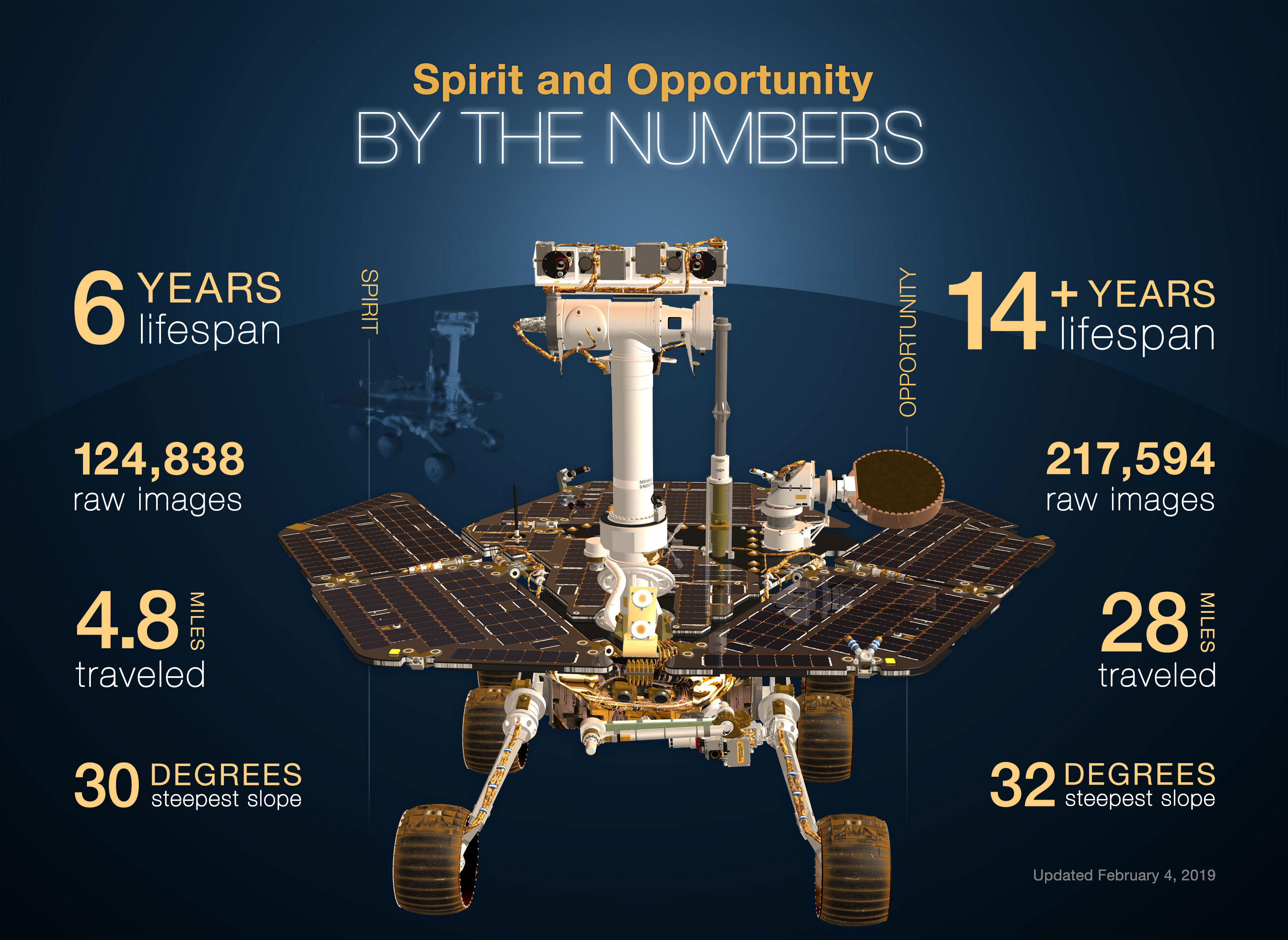
This infographic highlights NASA’s twin robot geologists, the Mars Exploration Rovers (MER) Spirit and Opportunity. The rovers landed on the Red Planet in 2004, in search of answers about the history of water on Mars. Spirit concluded its mission in 2010. Opportunity last communicated with Earth on June 10, 2018, as a planet-wide dust storm blanketed the solar-powered rover’s location on Mars.
NASA/JPL-Caltech
Meet Spirit and Opportunity
Mars Exploration Rovers In Depth
Landing Sites
The rovers were targeted to land at sites on opposite sides of Mars that looked as though they were affected by liquid water in the past. Spirit landed at Gusev Crater, a possible former lake in a giant impact crater. Opportunity landed at Meridiani Planum, a place where mineral deposits suggested that Mars had a wet history.
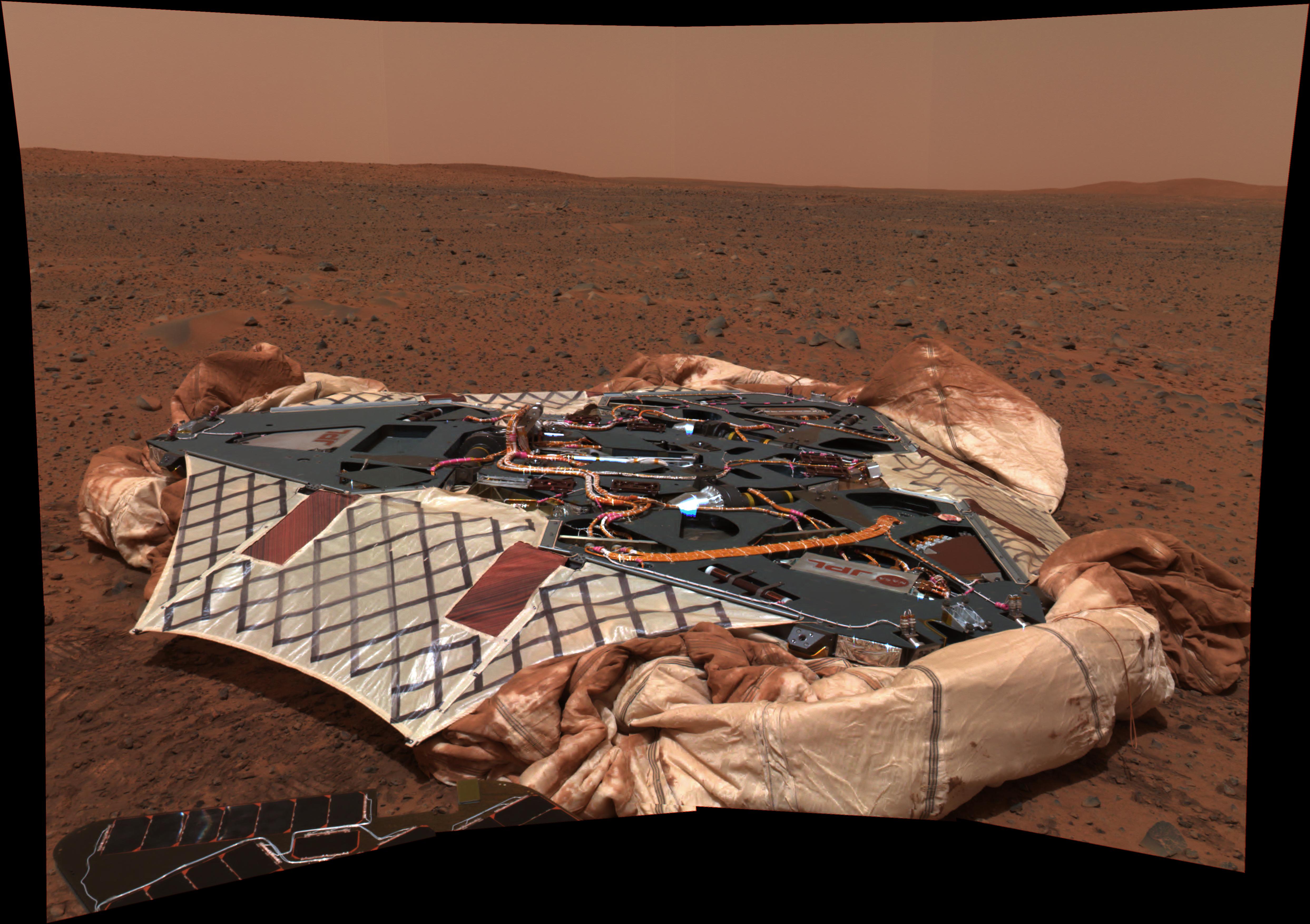
This image mosaic taken by the panoramic camera onboard the Mars Exploration Rover Spirit shows the rover’s landing site, the Columbia Memorial Station, at Gusev Crater, Mars. This spectacular view may encapsulate Spirit’s entire journey, from lander to its possible final destination toward the east hills. On its way, the rover will travel 250 meters (820 feet) northeast to a large crater approximately 200 meters (660 feet) across, the ridge of which can be seen to the left of this image. To the right are the east hills, about 3 kilometers (2 miles) away from the lander. The picture was taken on the 16th martian day, or sol, of the mission (Jan. 18/19, 2004). A portion of Spirit’s solar panels appear in the foreground. Data from the panoramic camera’s green, blue and infrared filters were combined to create this approximate true color image.
NASA/JPL-Caltech/Cornell

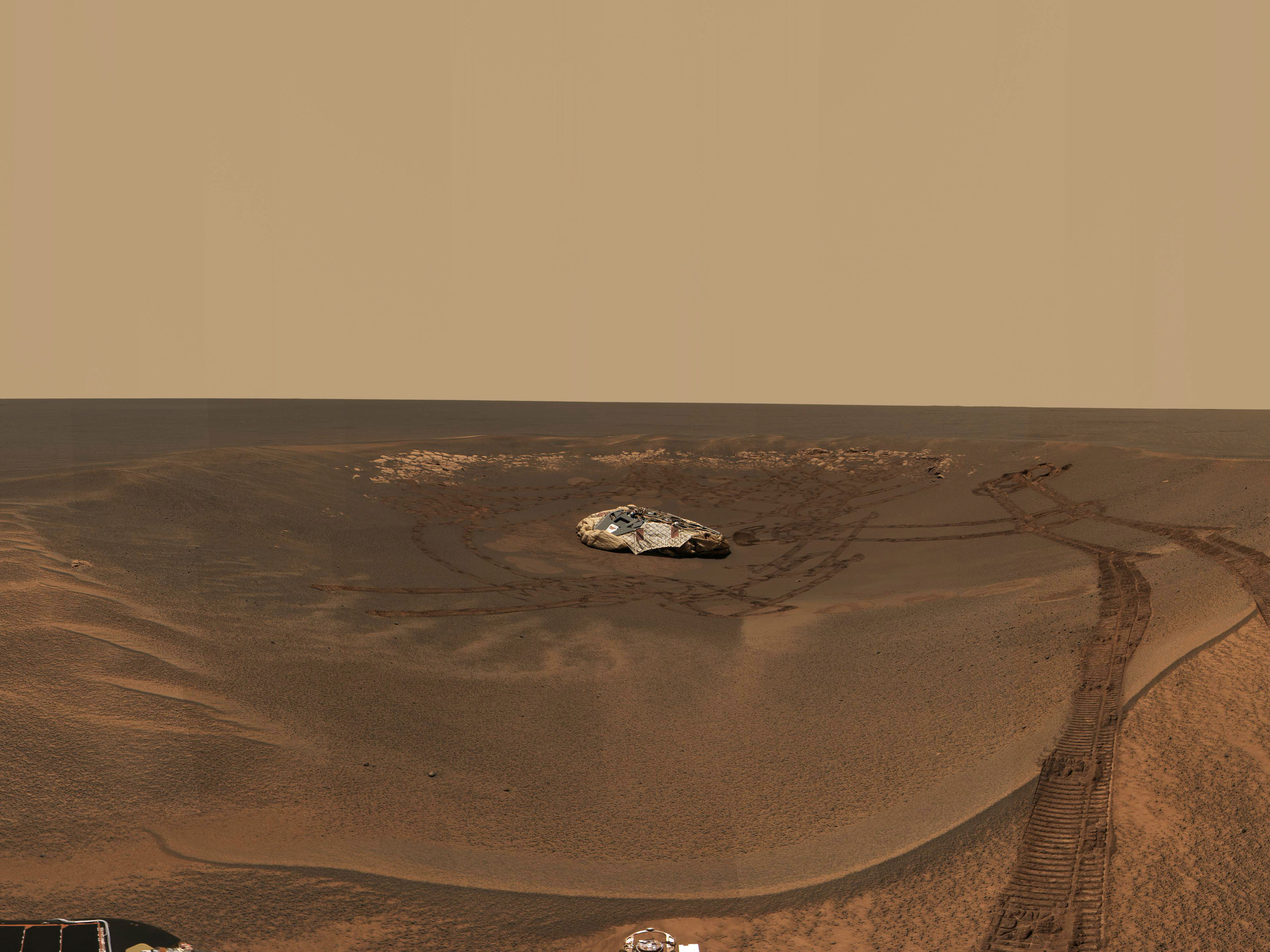
This image shows the middle section of an approximate true-color panorama, dubbed “Lion King,” showing “Eagle Crater” and the surrounding plains of Meridiani Planum. It was obtained by the Mars Exploration Rover Opportunity’s panoramic camera on sols 58 and 60 using infrared (750-nanometer), green (530-nanometer) and blue (430-nanometer) filters. The full panorama comprises 558 images and more than 75 megabytes of data, the largest panorama captured by either of the Mars Exploration Rovers in 2004. It depicts a story of exploration including the Opportunity rover’s lander, a thorough examination of the outcrop behind, a study of the soils at the near-side of the lander, a successful exit from Eagle Crater, and finally the rover’s next desination, the large crater dubbed “Endurance.” Original image and full panorama: https://photojournal.jpl.nasa.gov/catalog/PIA05755
NASA/JPL/Cornell
Going the Distance
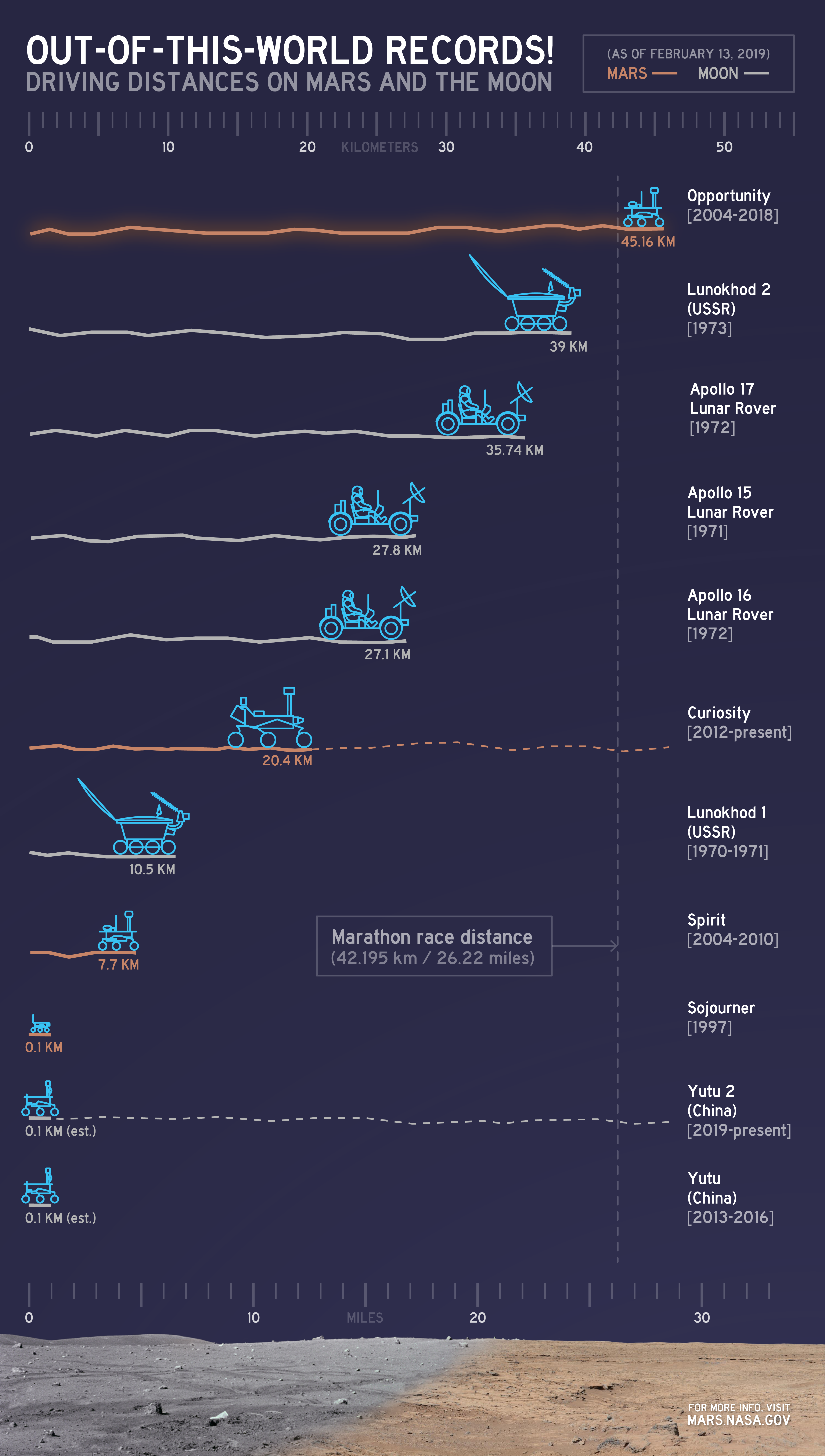
By the end of its mission, Spirit journeyed 4.8 miles (7.7 kilometers) on Mars. Opportunity holds the off-Earth roving distance record after accruing 28.06 miles (45.16 kilometers) of driving on Mars.