


















Description
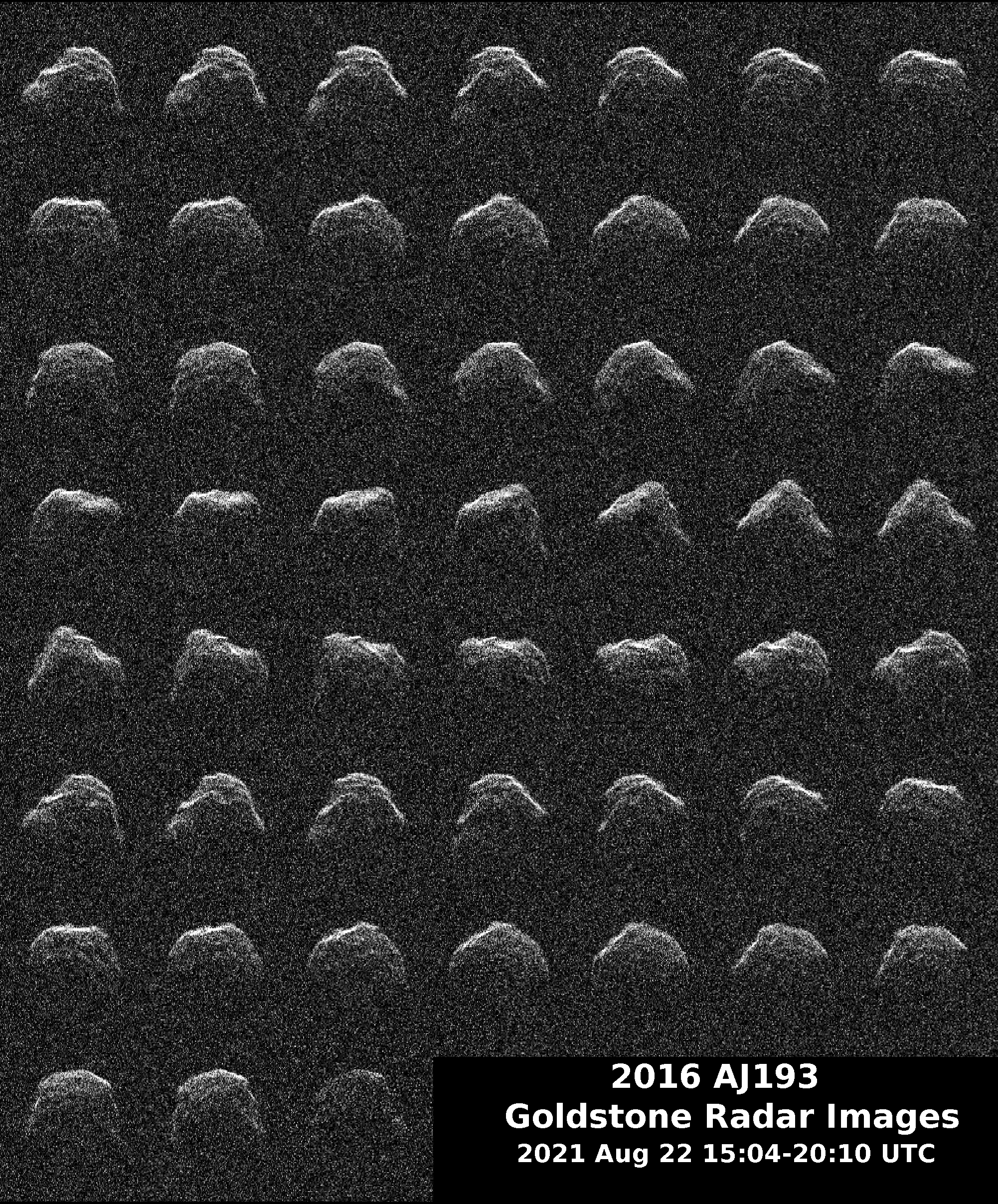
Figure 1
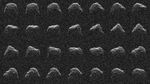
Between Aug. 20 and 24, near-Earth asteroid (NEA) 2016 AJ193 drifted past Earth at a distance of 2.1 million miles (about 3.4 million kilometers), creating an opportunity for planetary radar to image its surface for the first time since its discovery in 2016. Using the 70-meter (230-foot) Deep Space Station 14 antenna at the Deep Space Network's Goldstone Deep Space Complex near Barstow, California, considerable detail in the asteroid's surface was revealed, including ridges, small hills, flat areas, concavities, and possible boulders. In addition, the radar observations of 2016 AJ193 confirmed that it is about three-quarters-of-a-mile (1.3-kilometers) wide. This series of images show the asteroid rotate (with a period of 3.5 hours) as each radar observation was made.
2016 AJ193 is the 1,001st asteroid to be observed by planetary radar, making its close approach with Earth only seven days after the 1,000th NEA to be observed by radar – asteroid 2021 PJ1, which measures between 65 and 100 feet (20 and 30 meters) wide – approached Earth at a distance of 1 million miles (about 1.7 million kilometers).