


























Description
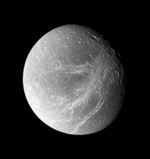
Bright, wispy fractures streak across Dione's trailing side. Following the Voyager flybys of the early 1980s, scientists considered the possibility that the streaks were bright material extruded by cryovolcanism. A quarter-century later, Cassini's close passes and sharp vision showed these features to be a system of braided canyons with bright walls.
North on Dione (1,126 kilometers, or 700 miles across) is up.
The image was taken in visible light with the Cassini spacecraft wide-angle camera on Sept. 30, 2007. The view was acquired at a distance of approximately 45,000 kilometers (28,000 miles) from Dione and at a Sun-Dione-spacecraft, or phase, angle of 36 degrees. Image scale is 3 kilometers (2 miles) per pixel.
The Cassini-Huygens mission is a cooperative project of NASA, the European Space Agency and the Italian Space Agency. The Jet Propulsion Laboratory, a division of the California Institute of Technology in Pasadena, manages the mission for NASA's Science Mission Directorate, Washington, D.C. The Cassini orbiter and its two onboard cameras were designed, developed and assembled at JPL. The imaging operations center is based at the Space Science Institute in Boulder, Colo.
For more information about the Cassini-Huygens mission visit http://saturn.jpl.nasa.gov/home/index.cfm. The Cassini imaging team homepage is at http://ciclops.org.