























Imagine a fleet of 100 Hubble Space Telescopes, deployed in a strategic space-invader-shaped array a million miles from Earth, scanning the universe at warp speed.
With NASA's Wide Field Infrared Survey Telescope, scheduled for launch in the mid-2020s, this vision will (effectively) become reality.
WFIRST will capture the equivalent of 100 high-resolution Hubble images in a single shot, imaging large areas of the sky 1,000 times faster than Hubble. In several months, WFIRST could survey as much of the sky in near-infrared light — in just as much detail — as Hubble has over its entire three decades.
NASA's Goddard Space Flight Center
Elisa Quintana, WFIRST Deputy Project Scientist for Communications at NASA's Goddard Space Flight Center in Greenbelt, Maryland, is confident that WFIRST will have the power to transform astrophysics. "To answer fundamental questions like: How common are planets like those in our solar system? How do galaxies form, evolve, and interact? Exactly how — and why — has the universe's expansion rate changed over time? We need a tool that can give us both a broad and detailed view of the sky. WFIRST will be that tool."
Although WFIRST has not yet opened its wide, keen eyes on the universe, astronomers are already running simulations to demonstrate what it will be able to see and plan their observations.
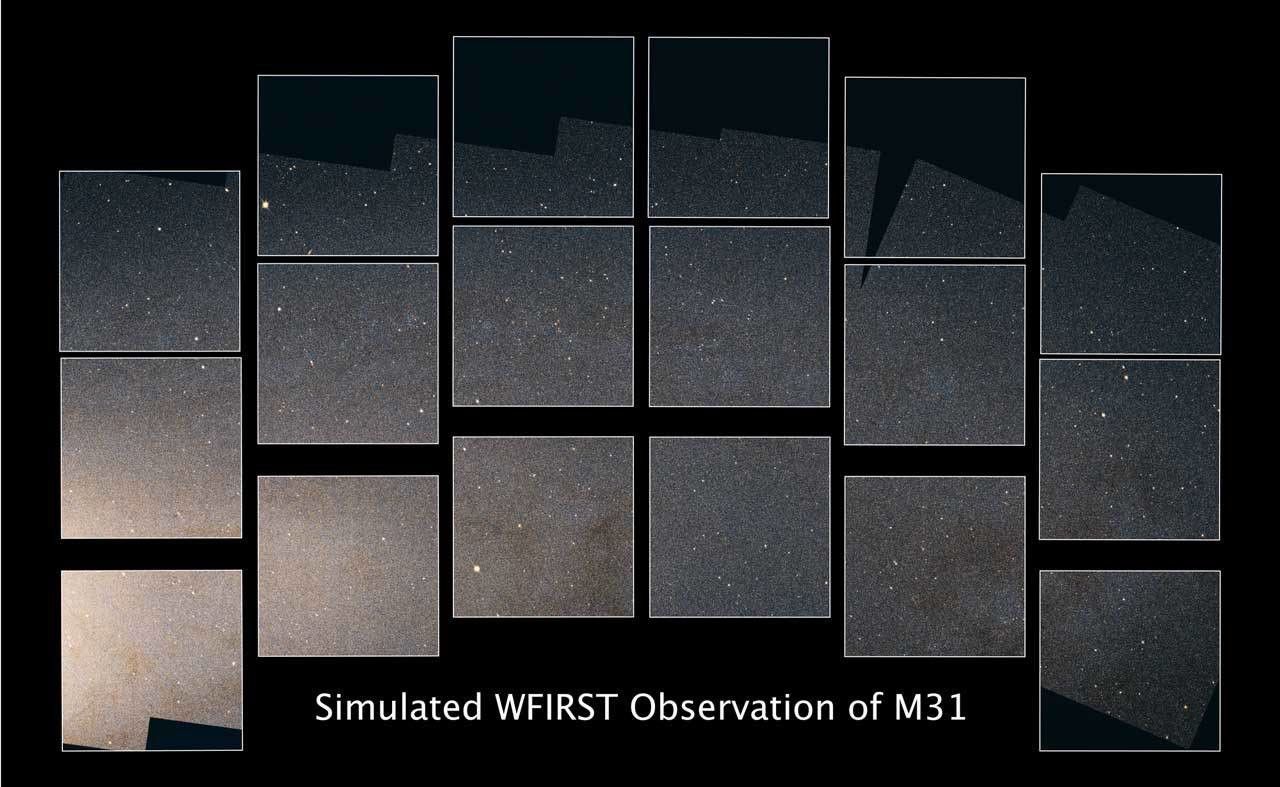
This simulated image of a portion of our neighboring galaxy, Andromeda (M31), provides a preview of the vast expanse and fine detail that can be covered with just a single pointing of WFIRST. Using information gleaned from hundreds of Hubble observations, the simulated image covers a swath roughly 34,000 light-years across, showcasing the red and infrared light of more than 50 million individual stars detectable with WFIRST.
While it may appear to be a somewhat haphazard arrangement of 18 separate images, the simulation actually represents a single shot. Eighteen square detectors, 4096 by 4096 pixels each, make up WFIRST’s Wide Field Instrument (WFI) and give the telescope its unique window into space.
With each pointing, WFIRST will cover an area roughly 1⅓ times that of the full Moon. By comparison, each individual infrared Hubble image covers an area less than 1% of the full Moon.
The Advantages of Speed
WFIRST is designed to collect the big data needed to tackle essential questions across a wide range of topics, including dark energy, exoplanets, and general astrophysics spanning from our solar system to the most distant galaxies in the observable universe. Over its 5-year planned lifetime, WFIRST is expected to amass more than 20 petabytes of information on thousands of planets, billions of stars, millions of galaxies, and the fundamental forces that govern the cosmos.
For astronomers like Ben Williams of the University of Washington in Seattle, who generated the simulated data set for this image, WFIRST will provide a valuable opportunity to understand large nearby objects like Andromeda, which are otherwise extremely time-consuming to image because they take up such a large portion of the sky.
"We have spent the last couple of decades getting images at high resolution in small parts of nearby galaxies. With Hubble you get these really tantalizing glimpses of very complex nearby systems. With WFIRST, all of a sudden you can cover the whole thing without spending lots of time," Williams said.
The ability to image such a large area will provide astronomers with important context needed to understand how stars form and how galaxies change over time. Williams explained that with a wide field, "you get the individual stars, you get the structures they live in, and the structures that surround them in their environment."
Julianne Dalcanton of the University of Washington, who led the Panchromatic Hubble Andromeda Treasury (PHAT) program that the simulated data are based on, also believes that WFIRST's combination of ultra-telephoto and super-wide-angle capabilities will be ground-breaking. "The PHAT survey of Andromeda was a tremendous investment of time, requiring careful justification and forethought. This new simulation shows how easy an equivalent observation could be for WFIRST." WFIRST could survey Andromeda nearly 1,500 times faster than Hubble, building a panorama of the main disk of the galaxy in just a few hours.
WFIRST's extraordinary survey speed is a result of its wide field of view, its agility, and its orbit. Williams explained that by covering more area in one field and being able to switch fields more quickly, "you're avoiding all those overheads that are associated with repointing the telescope so many times." In addition, WFIRST's orbit one million miles out will provide a view that is generally unobstructed by Earth. While Hubble is often able to collect data during only half of its low-Earth orbit 350 miles up, WFIRST will be able to observe more-or-less continuously.