

















Uranus Moons: Facts
Uranus has 29 known moons, as of August 2026, including five major moons: Miranda, Ariel, Umbriel, Titania, and Oberon.
Contents
Introduction
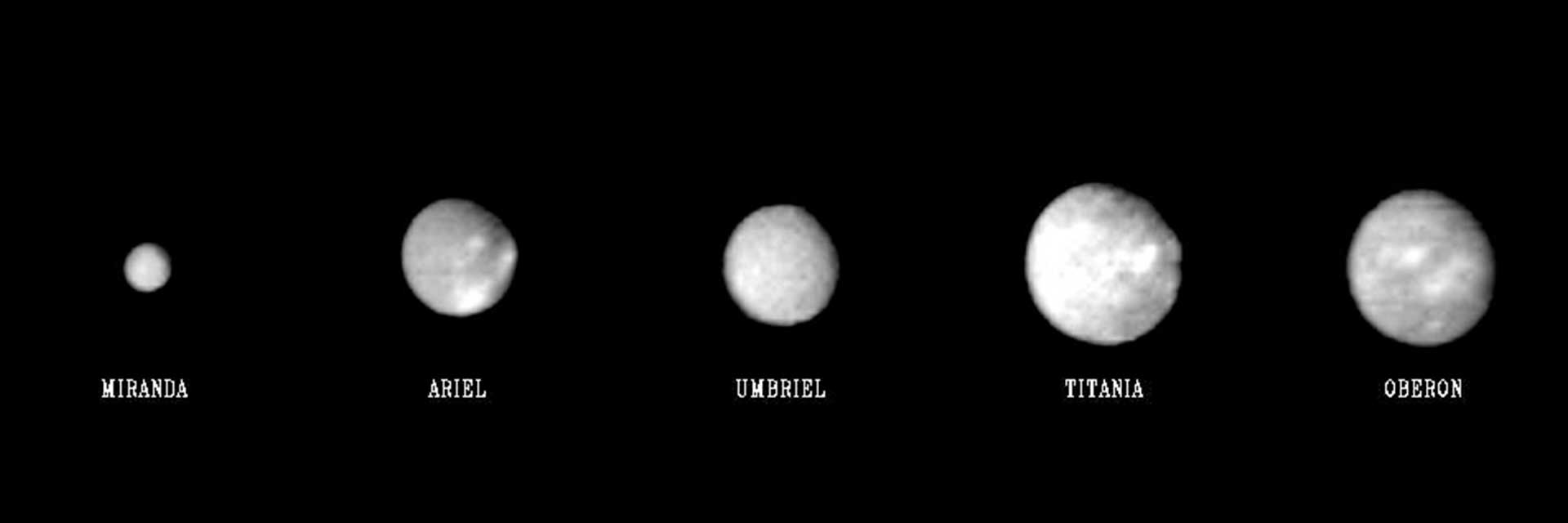
Uranus has 29 known moons, including five major moons:
| Name | Diameter (miles) | Diameter (kilometers) |
| Titania | 980.4 | 1,577.8 |
| Oberon | 946.2 | 1,522.8 |
| Umbriel | 726.6 | 1,169.4 |
| Ariel | 719.4 | 1,157.8 |
| Miranda | 293.0 | 471.6 |
Source: JPL Solar System Dynamics
Titania and Oberon were the first to be discovered — by William Herschel in 1787. William Lassell, who had been the first to see a moon orbiting Neptune, discovered the next two, Ariel and Umbriel. Nearly a century passed before Gerard Kuiper found Miranda in 1948.
The Voyager 2 spacecraft visited the Uranian system in 1986 and found 10 moons, just 16-96 miles (26-154 km) in diameter: Juliet, Puck, Cordelia, Ophelia, Bianca, Desdemona, Portia, Rosalind, Cressida, and Belinda.
Since then, astronomers using the Hubble Space Telescope, and improved ground-based telescopes have raised the known total. Spotting the post-Voyager moons is an impressive feat. The moons are tiny — as small as 8 to 10 miles (12-16 km) across, and blacker than asphalt. And of course, they're about 1.8 billion miles (2.9 billion km) away from the Sun.
All of Uranus's inner moons (those observed by Voyager 2) appear to be roughly half water ice and half rock. The composition of the moons outside the orbit of Oberon remains unknown, but they are likely captured asteroids.
How They Were Named
"Sweet Moon," William Shakespeare wrote in "A Midsummer Night's Dream," "I thank thee for thy sunny beams; I thank thee, Moon, for shining now so bright."
Centuries later, the moons of Uranus are sometimes called the "literary moons" because they are named for Shakespearean characters, along with a couple of the moons being named for characters from the works of Alexander Pope.
Features
Here's a sampling of some of the unique aspects of the moons:
Miranda, the innermost and smallest of the five major satellites, has a surface unlike any other moon that's been seen. It has giant fault canyons as much as 12 times as deep as the Grand Canyon, terraced layers and surfaces that appear very old, and others that look much younger.
Ariel has the brightest and possibly the youngest surface among all the moons of Uranus. It has few large craters and many small ones, indicating that fairly recent low-impact collisions wiped out the large craters that would have been left by much earlier, bigger strikes. Intersecting valleys pitted with craters scar its surface.
Umbriel is ancient, and the darkest of the five large moons. It has many old, large craters and sports a mysterious bright ring on one side.
Oberon, the outermost of the five major moons, is old, heavily cratered, and shows little signs of internal activity. Unidentified dark material appears on the floors of many of its craters.
Moons of Uranus

Here on Earth, we're lucky to get total solar eclipses from time to time. But did you know that eclipses…
D.21 U.S. Contributions to Ariel Preparatory Science (US-CAPS) was established to solicit proposals from the US community for investigations that…
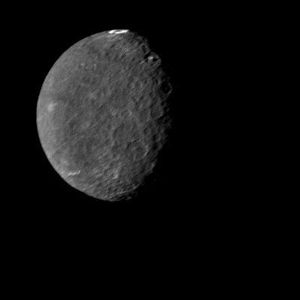
Discovery Umbriel was discovered on Oct. 24, 1851 by English astronomer William Lassell. Overview Umbriel is the darkest of Uranus’…
Discovery Trinculo was discovered on Aug. 13, 2001 by Matthew Holman, John J. Kavelaars and Dan Milisavljevic at the Dominion…
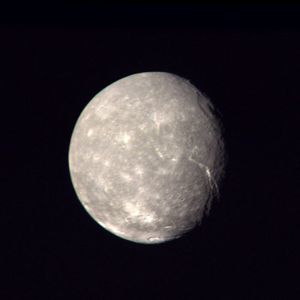
Discovery Titania was discovered on Jan. 11, 1787 by British astronomer William Herschel. Overview Titania is Uranus’ largest moon. Images…
DiscoverySycorax was discovered on Sept. 6, 1997 by Philip D. Nicholson, Brett J. Gladman, Joseph A. Burns and John J.…
Discovery Stephano was discovered on July 18, 1999 by Brett Gladman, Matthew Holman, John J. Kavelaars, Jean-Marc Petit, and Hans…
Discovery Setebos was discovered on July 18, 1999 by John J. Kavelaars, Brett Gladman, Matthew Holman, Jean-Marc Petit, and Hans…