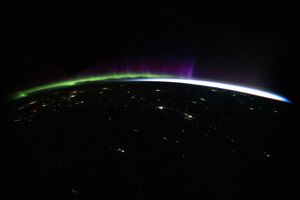




















Astronauts aboard the STS-97 Space Shuttle mission in December observed and photographed the northern lights after undocking from the International Space Station. This image was taken on December 11, 2000. At the time, the Shuttle was just east of Newfoundland at 49.7N 51.6 W, at an altitude of 362 km. The image view is to the north (Polaris, the North Star, is visible), and shows two separate atmospheric optical phenomena. The faint, thin greenish band stretching across and above the horizon is airglow; radiation emitted by the atmosphere from a layer about 30 km thick and about 100 km altitude. The predominant emission in airglow is the green 5577 Angstrom wavelength emission from oxygen atoms. Airglow is always and everywhere present in the atmosphere; it results from the recombination of molecules that have been broken apart by solar radiation during the day. But the phenomenon is so faint that it can only be seen at night by looking "edge on" at the emission layer, such as the view astronauts have in orbit. Astronaut Tom Jones gives a nice astronaut perspective of airglow on the web at http://neurolab.jsc.nasa.gov/jones.htm
The other phenomenon in the photo (the green blob to the left of center) is the aurora. Green aurora occur from about 100 km to 250 km altitude only in the auroral zones at polar latitudes. They are also caused by the emission of 5577 Angstrom wavelength light from oxygen atoms that have been raised to a higher energy level (excited) by collisions with energetic electrons pouring down from the Earth's magnetosphere. The light is emitted when the atoms return to their original unexcited state.
References & Resources
Image STS097-354-36 was provided by the Earth Science and Image Analysis Laboratory, Johnson Space Center. Additional images taken by astronauts can be viewed at NASA-JSC's Gateway to Astronaut Photography of Earth at http://eol.jsc.nasa.gov.
None