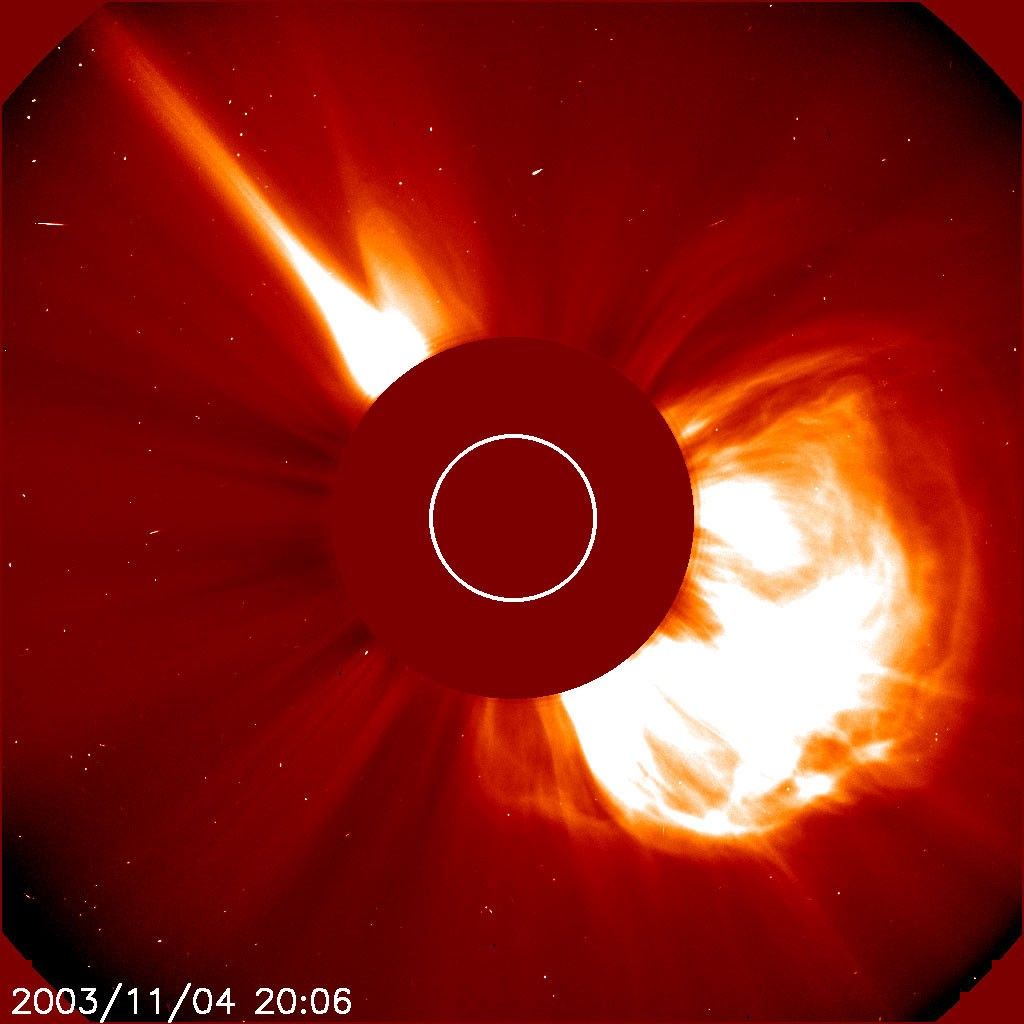

























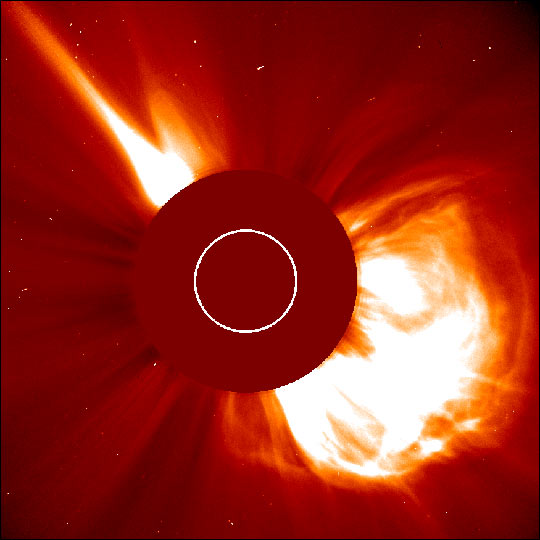
Just one week after the Sun sent billions of tons of gas hurtling at the Earth, it burst forth with the largest flare observed to date. The flare started on November 4, 2003, at 19:29 UTC and quickly saturated the NOAA GOES-12 X-ray sensor that was observing it. Associated with the flare was an ejection of a billion tons or more of gas from the Sunâs tenuous outer atmosphere, or corona. But because the flare occurred on the limb of the sun, pointing away from the Earth, the charged particles it emits will probably only glance off the Earth.
The image above was acquired by the Large Angle and Spectrometric Coronagraph (LASCO), aboard NASAâs Solar and Heliospheric Observatory (SOHO) satellite. In the center of the image is an occultation disc, which allows the sensor to focus on the scattering of light from the Sunâs surface off the free electrons in the Sunâs corona. This light appears as the orange halo seemingly radiating outward from the Sun. (The white circle on the occultation disc shows the actual size and location of the solar disc). The bright white features extending from beneath and to the right of the Sun are the coronal mass ejections associated with the flare. The gas is being pushed out at over five million miles per hour.
For more images of this event from the SOHO mission, please see the SOHO web site. To learn more about NASAâs ongoing studies of the Sun-Earth connection, please read A Violent Sun Affects the Earthâs Ozone.
References & Resources
Images courtesy Solar & Heliospheric Observatory