


















Phytoplankton are sometimes called “the grass of the sea.” Like green plants on land, these floating, microscopic organisms play several key roles in making life on Earth possible. First, they are a source of food for zooplankton, shellfish, and marine creatures that eventually become food for other, larger creatures. They also produce a sizable amount of the oxygen in our oceans and atmosphere. And phytoplankton help remove carbon dioxide from Earth’s atmosphere, consuming it during photosynthesis and sinking it to the ocean depths in decaying cells and fecal matter from marine life (a phenomenon known as marine snow).
In January 2022, the Atlantic Ocean off of South America was teeming with phytoplankton, as it does most austral summers. On January 24, the Moderate Resolution Imaging Spectroradiometer (MODIS) on NASA’s Terra satellite acquired a natural-color image (above) of blooms stretching across hundreds of kilometers. The closeup below was captured the same day by the MODIS sensor on NASA’s Aqua satellite. MODIS sensors have been observing nearly continuous blooms in the area since the end of November.
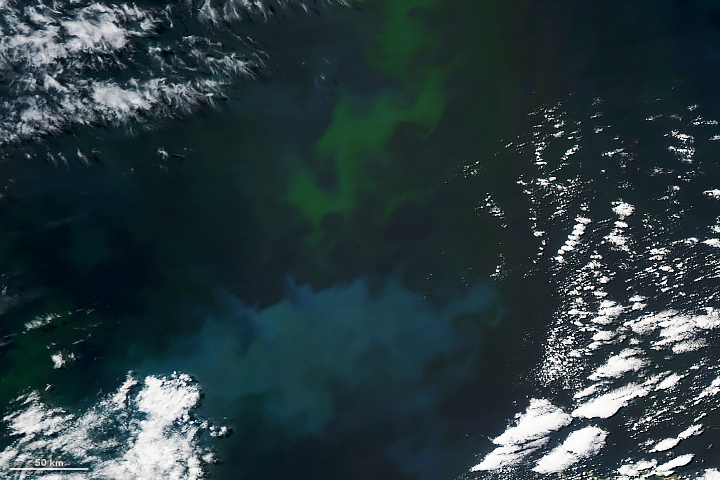
It is not possible to detect specific species from space, but the aquamarine stripes and swirls are likely coccolithophores—phytoplankton with microscopic calcite shells that give water a chalky color. The various shades of green are probably diatoms, dinoflagellates, and related species. Ship-based studies have shown that Emiliania huxleyi coccolithophores and Prorocentrum sp. dinoflagellates tend to dominate in this region. Imagers planned for future satellite missions should make it easier to identify types of phytoplankton from space.
The patches of color not only reveal the presence of phytoplankton, but also trace the edges of the dynamic eddies and currents that carry them. Off the coast of Argentina, Uruguay, and Brazil, warm currents from the tropics flow south and run into cooler currents flowing north from the Southern Ocean. They meet in a place known as the Brazil-Malvinas Confluence. At least seven different water masses of varying temperature, depth, and salinity arrive at this turbulent intersection, leading to vertical and horizontal mixing. With all of the churning—plus nutrient-rich outflows from rivers (such as Rio de la Plata) and windblown dust from Patagonia—this patch of ocean is incredibly productive and home to one of the richest fisheries in the world.
References & Resources
- Almandoz, G.O. et al. (2007) The genus Pseudo-nitzschia (Bacillariophyceae) in continental shelf waters of Argentina (Southwestern Atlantic Ocean, 38â55°S). Harmful Algae 6 (1), 93â103.
- Balch, W.M. et al. (2019) Coccolithophore distributions of the North and South Atlantic Ocean. Deep Sea Research Part I: Oceanographic Research Papers 151 (2019), 103066.
- Balch, W.M. et al. (2016) Factors regulating the Great Calcite Belt in the Southern Ocean and its biogeochemical significance. Global Biogeochemical Cycles 30 (8), 1124â1144.
- Balch, W.M. et al. (2014) Surface biological, chemical, and optical properties of the Patagonian Shelf coccolithophore bloom, the brightest waters of the Great Calcite Belt. Limnology and Oceanography 59 (5), 1715â1732.
- Garcia, V.M.T., et al. (2008). Environmental factors controlling the phytoplankton blooms at the Patagonia shelf-break in spring. Deep-Sea Research I, 55, (9), 1150â1166.
- Lutz, V. A. et al. (2010) Primary production in the Argentine Sea during spring estimated by field and satellite models. Journal of Plankton Research 32 (2), 37â56.
- NASA Earth Observatory (2021, August 6) Feeding the Sea.
- NASA Earth Observatory (2019, April 30) Seeing the Sea Through the Years.
- NASA Earth Observatory (2013, October 22) Something Fishy in the Atlantic Night.
- NASA Earth Observatory (2010, July 13) What are Phytoplankton?
- Painter, S.C., et al. (2010). The COPASâ08 expedition to the Patagonian Shelf: Physical and environmental conditions during the 2008 coccolithophore bloom. Continental Shelf Research, 30 (18), 1907â1923.
- Piola, A.R. et al. (2018) Physical Oceanography of the SW Atlantic Shelf: A Review. Plankton Ecology of the Southwestern Atlantic, 37â56.
- Woods Hole Oceanographic Institution (2018, July 16) Forecasting Where Ocean Life Thrives. Accessed January 27, 2022.
NASA Earth Observatory images by Lauren Dauphin, using MODIS data from NASA EOSDIS LANCE and GIBS/Worldview . Story by Michael Carlowicz .