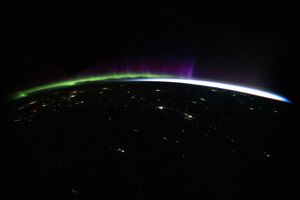















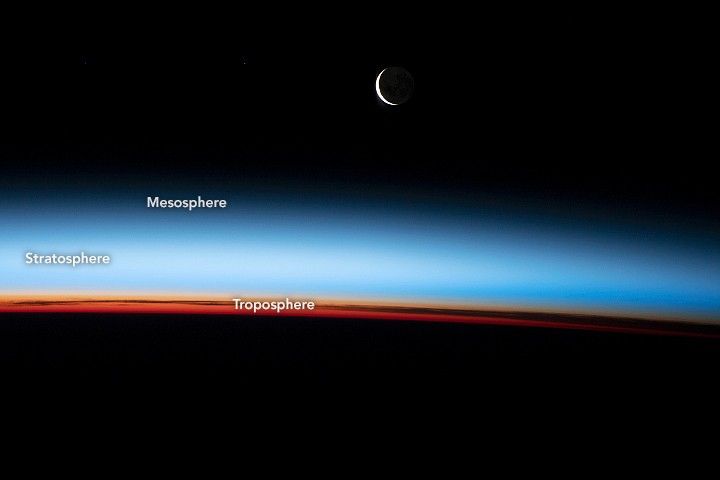
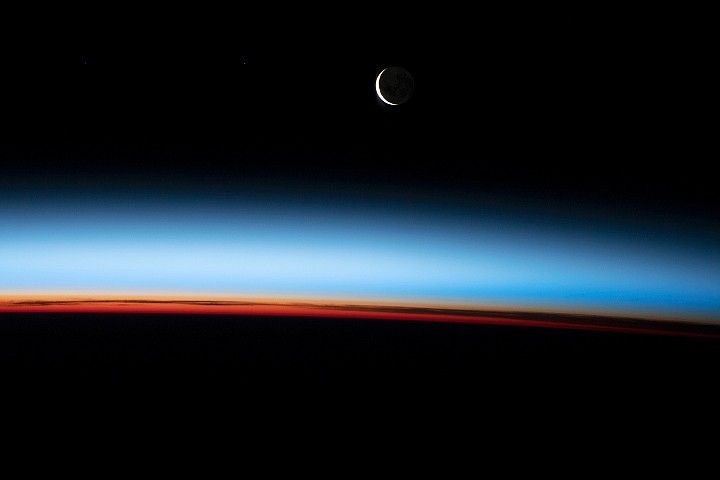


An astronaut onboard the International Space Station (ISS) took this photograph of Earth’s horizon—also known as Earth’s limb—and a cross-section of atmospheric layers. With a waxing crescent moon above, the ISS was located over the southwestern Pacific Ocean about 1100 kilometers (700 miles) east of New Zealand.
The lowest layer of the atmosphere, known as the troposphere, shows orange and red hues because particles of dust, smoke, and smog scatter these wavelengths of light. It is also known as the “weather layer” because it is where almost all cloud and weather systems operate. Clouds appear as dark streaks in the photo, especially on the right side. The troposphere is roughly 15 kilometers (10 miles) thick and supports most life on Earth. Astronauts and researchers use the characteristic “warm” colors, combined with its distinct upper surface, as the visual indicators of this layer.
Directly above the troposphere, but less dense, is the stratosphere. This blue layer is usually cloud-free and extends as much as 50 kilometers (30 miles) above the surface of Earth. The region directly above the stratosphere is known as the mesosphere.
Scientists are interested in documenting the rare occasions when aerosols and moisture penetrate the stratosphere because of the heating and cooling effects these can have for the Earth. In 1991, for example, Mount Pinatubo in the Philippines erupted with such force that it injected ash well into the stratosphere. The volcanic ash particles circled the Earth for months; astronauts were able to photograph two dark ash layers at 20–25 kilometers altitude two months after the eruption. Ash in the stratosphere can cool the Earth slightly for weeks and even months after major eruptions.
References & Resources
Astronaut photograph ISS066-E-86970 was acquired on December 6, 2021, with a Nikon D5 digital camera using a focal length of 200 millimeters. It is provided by the ISS Crew Earth Observations Facility and the Earth Science and Remote Sensing Unit, Johnson Space Center. The image was taken by a member of the Expedition 66 crew. The image has been cropped and enhanced to improve contrast, and lens artifacts have been removed. The International Space Station Program supports the laboratory as part of the ISS National Lab to help astronauts take pictures of Earth that will be of the greatest value to scientists and the public, and to make those images freely available on the Internet. Additional images taken by astronauts and cosmonauts can be viewed at the NASA/JSC Gateway to Astronaut Photography of Earth. Caption by Justin Wilkinson, Texas State University, JETS Contract at NASA-JSC.