





![Request for Information – Potential [Placeholder for Prize]](https://assets.science.nasa.gov/dynamicimage/assets/science/missions/a-step/FFR_Earth_Background_20251120%20.png?w=1024)










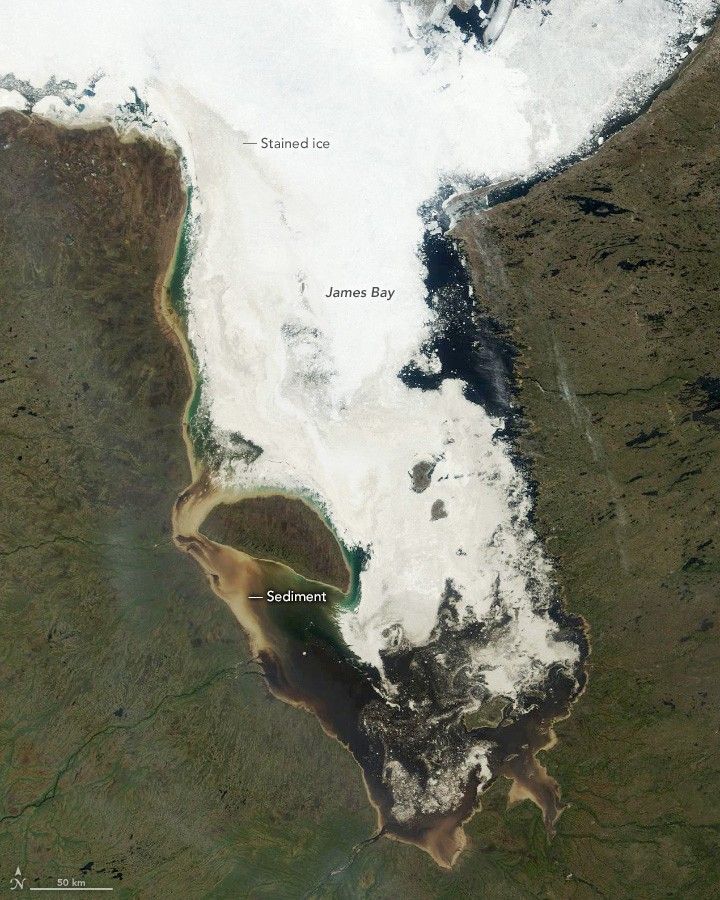
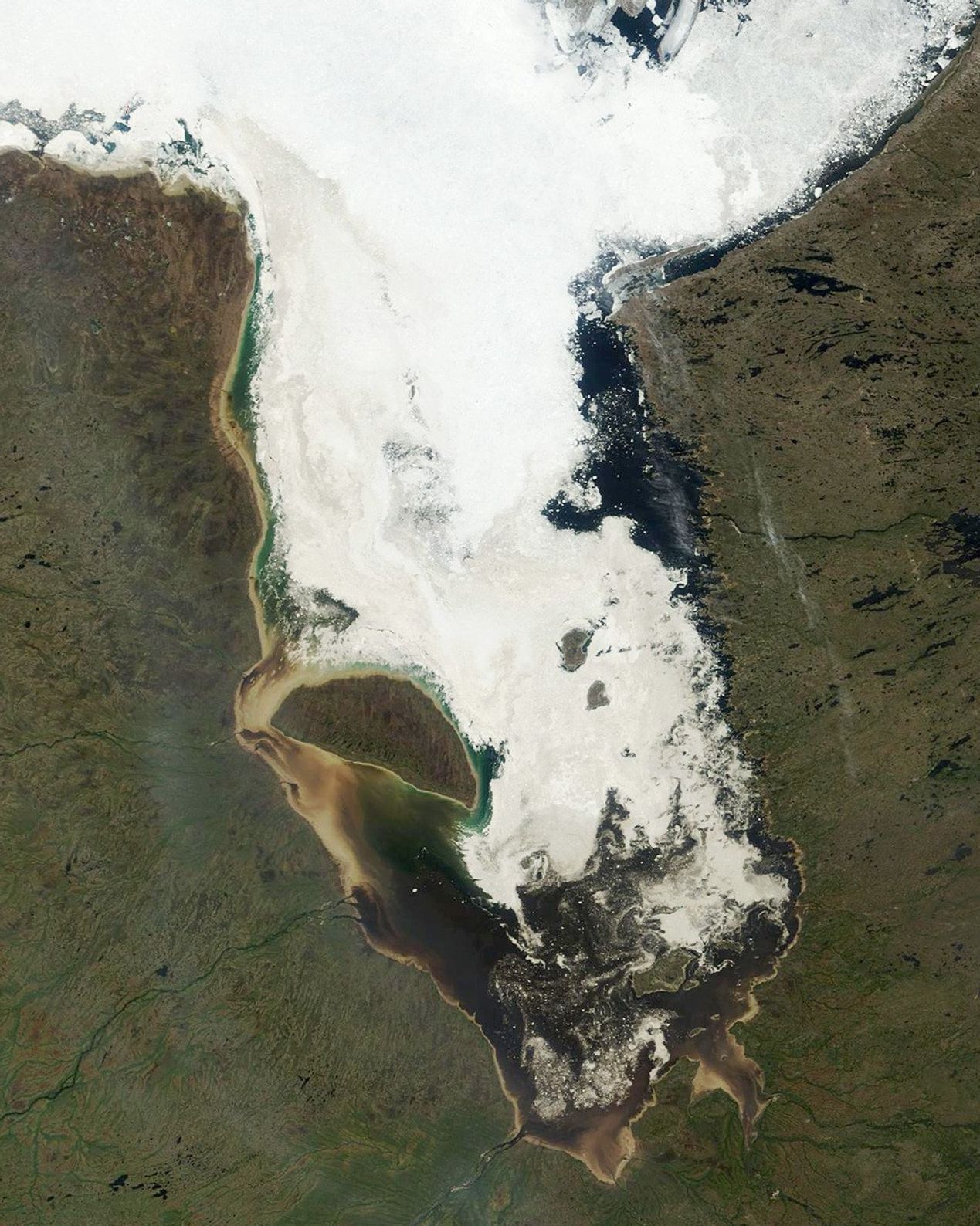
Northern-latitude landscapes—and seascapes—come to life in the lead-up to the longest days of the year. Early in June 2023, sea ice breakup was underway in James Bay, an offshoot of Canada’s Hudson Bay. The seasonal rhythms of sea ice are vital to the feeding habits of animals such as polar bears, seals, and walrus. The water and surrounding wetlands also provide habitat for marine mammals, including beluga whales, along with migratory shorebirds and waterfowl.
The Moderate Resolution Imaging Spectroradiometer (MODIS) on NASA’s Terra satellite acquired this image of thinning ice on June 2, 2023. At the time of this image, little if any fast ice—stationary sea ice that is “fastened” to the surrounding coastlines—remained in James Bay. On average, fast ice starts growing along the coast of the bay in December and breaks up in mid- to late-May. By the end of July, mobile ice floes have typically all melted away.
The open water at the bottom of the image appears in various shades of brown where rivers such as the Harricana, Moose, Albany, and Attawapiskat drain into the bay. Those rivers flow over boreal peat bogs, or muskeg, in the James Bay Lowlands on their journey out to sea. Partially decayed organic matter in the peat releases tannins that stain the water dark brown. Suspended sediment in the water gives it a tan color.
Much of the remaining ice in the bay is also visibly stained with sediment. Canadian researchers studying sea ice in southern Hudson Bay note that sediment-laden sea ice is typical there. They speculate that most of the sediment is initially stirred up by tidal action across the region’s tidal flats. The sediment then gets incorporated into the ice, especially at the edges of the fast ice which easily crack and refreeze when tides ebb and flow. As snow and ice melt in the spring, sediment in the ice pack becomes concentrated on the surface and apparent in satellite imagery.
The researchers also suspect that sediment transported via sea ice could influence the marine ecosystem. For example, ice may serve as a vessel for redistributing nutrients in the sea by depositing organic material from the tidal flats further from shore. In addition, heavily sediment-laden ice may block sunlight from photosynthetic organisms, including algae within the ice and phytoplankton in the water column beneath it. This could delay and dampen the magnitude of primary productivity in the spring, they write, but the potential impacts of this phenomenon are not well understood.
References & Resources
- Barber, D.G., et al. (2021) Sediment-laden sea ice in southern Hudson Bay: Entrainment, transport, and biogeochemical implications. Elementa: Science of the Anthropocene, 9 (1), 00108.
- Gupta, K., et al. (2022) Landfast sea ice in Hudson Bay and James Bay: Annual cycle, variability and trends, 2000–2019. Elementa: Science of the Anthropocene, 10 (1), 00073.
- NASA Earth Observatory (2013, July 6) Sediment, Smoke, and Stained Ice in Quebec. Accessed June 15, 2023.
- NASA Earth Observatory (2016, July 1) Some Tea with Your River? Accessed June 15, 2023.
- NASA Earth Observatory (2017, July 28) Lingering Sea Ice on Hudson Bay. Accessed June 15, 2023.
NASA Earth Observatory image by Wanmei Liang, using MODIS data from NASA EOSDIS LANCE and GIBS/Worldview . Story by Lindsey Doermann.